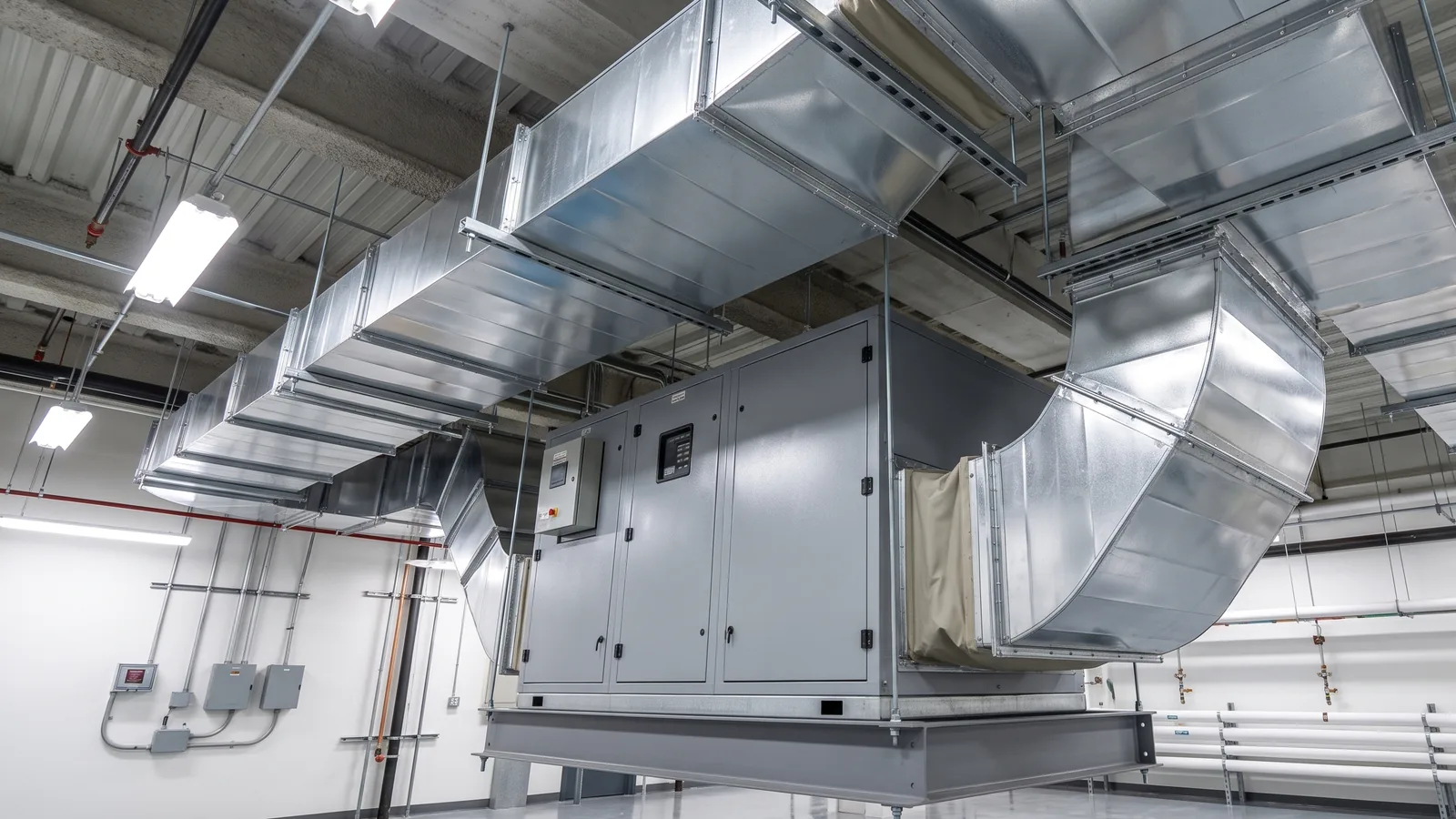
Refrigerant dehumidifiers are the most common commercial moisture removal technology in Australia. They use a closed-loop refrigeration cycle to pull water vapour out of the air, and they work well in the temperature range most warehouses, factories, food plants, and commercial buildings operate in. Moisture Cure Commercial supplies a full range of commercial dehumidifiers for these environments.
How Refrigerant Dehumidification Technology Works
A refrigerant dehumidifier uses the same hardware as an air conditioner, but an air conditioner is trying to cool the room while a dehumidifier is trying to wring water out of the air. That distinction matters when specifying equipment, and Moisture Cure Commercial covers how dehumidifiers compare with air conditioners in a separate guide.
Warm, humid air passes over a cold evaporator coil. The coil temperature sits below the air’s dew point, so moisture condenses on the surface and drains away. The now-dry air then passes over the warm condenser coil, picks up heat, and returns to the room at a lower relative humidity.
Core Components and Their Functions
| Component | Primary Function | Performance Impact |
|---|---|---|
| Compressor | Compresses refrigerant gas to high pressure | Determines extraction capacity and power draw |
| Evaporator Coil | Cools incoming air below dew point | Controls moisture removal rate |
| Condenser Coil | Releases heat and reheats processed air | Affects discharge temperature and energy recovery |
| Expansion Valve | Regulates refrigerant flow and pressure drop | Optimises cooling capacity relative to load |
| Fan System | Moves air through the unit | Sets coverage area and air changes per hour |
Each component needs to be sized relative to the others. An oversized compressor paired with an undersized evaporator wastes energy without extracting more moisture, while a mismatched fan reduces the effective coverage area.
Common Refrigerants in Commercial Dehumidifiers
The refrigerant inside the sealed circuit affects both performance and long-term serviceability. Most commercial dehumidifiers sold in Australia use one of four types.
- R-410A is the most widely used refrigerant in commercial dehumidifiers sold today. It delivers strong cooling performance and parts are readily available across Australia.
- R-32 is a lower global warming potential (GWP) alternative appearing in newer units. Energy efficiency is marginally better than R-410A.
- R-134a appears in some larger industrial and process-cooling dehumidifiers, particularly in high-capacity systems.
- R-290 (propane) has an ultra-low GWP and is starting to appear in smaller commercial units, though its flammability limits use in certain facility classifications.
Australian law under the Ozone Protection and Synthetic Greenhouse Gas Management Act 1989 governs which refrigerants can be installed and serviced. All refrigerant work must be carried out by a technician holding an ARCTick licence issued by the Australian Refrigeration Council.
Performance Specifications for Commercial Systems
Commercial refrigerant dehumidifier systems are rated by extraction capacity, measured in litres per day at standardised test conditions (typically 30°C and 80% relative humidity, per ASHRAE testing protocols).
Key Performance Metrics
- Extraction capacity: commercial units range from under 50 to over 500 litres per day, depending on unit size
- Operating temperature range: most standard refrigerant units work effectively between 5°C and 35°C
- Coefficient of performance (COP): efficient models achieve a COP between 2.5 and 4.0, with higher values typical of newer variable-speed compressor models
- Airflow rate: commercial units deliver 500 to over 5,000 cubic metres per hour
- Power consumption: proportional to extraction capacity and ambient conditions
- Noise levels: 45 to 65 dBA depending on fan speed and compressor size
Real-world performance shifts with temperature and humidity. Units run most efficiently in warm, humid air and may trigger automatic defrost cycles when the ambient temperature drops below about 15°C.
In occupied facilities, noise matters. Moisture Cure Commercial’s guide to industrial dehumidifier noise levels covers what to expect and how to manage it.
Commercial and Industrial Applications
Different industries need different humidity targets. Refrigerant dehumidification suits facilities operating in the normal temperature band, where the refrigeration cycle runs at peak efficiency.
Industry-Specific Requirements
| Industry Sector | Target RH Range | Critical Control Factors |
|---|---|---|
| Pharmaceutical Warehouses | 35-45% | Product stability, TGA compliance |
| Electronics Manufacturing | 30-50% | Static discharge prevention, corrosion control |
| Food Processing | 50-65% | Mould prevention, packaging integrity |
| Document Storage | 45-55% | Paper preservation, ink stability |
| Indoor Sports Facilities | 50-60% | Condensation control, air quality |
| Manufacturing Plants | 40-60% | Product quality, worker comfort |
| Self Storage Facilities | 50-60% | Tenant goods protection, mould prevention |
Actual setpoints depend on the materials stored, process requirements, and applicable regulations for each sector. Facilities with mixed-use storage, such as commercial self storage operations, often benefit from a refrigerant dehumidifier set to hold moderate RH without overcooling the space.
Selecting Between Refrigerant and Desiccant Technologies
Refrigerant dehumidifiers suit most commercial applications in Australia’s climate, but not all. Choosing the wrong technology means paying for the unit and then paying again when the humidity problem it was supposed to solve persists.
Technology Comparison
- Refrigerant systems have lower purchase and operating costs when the space stays above 15°C
- Energy efficiency peaks between 20°C and 30°C, which covers most climate-controlled commercial buildings
- Desiccant dehumidifiers using moisture-absorbing rotors work where refrigerant units cannot: cold stores, unheated warehouses, and environments below 10°C
- Refrigerant units need less maintenance and produce liquid condensate that drains by gravity
- Desiccant systems reach very low humidity levels (below 35% RH) that refrigerant technology cannot achieve efficiently
- For continuous 24/7 operation in a stable-temperature building, refrigerant is usually the more practical option
The choice often comes down to temperature and target humidity rather than unit cost. Facilities with challenging below-grade spaces can find a detailed comparison in Moisture Cure’s guide to choosing the right dehumidifier for a commercial basement.
Installation and Integration Considerations
Installation quality has a direct effect on how well a refrigerant dehumidifier performs over its life. Poor drainage, restricted airflow, or an undersized power supply will undercut even a well-specified unit.
Installation Requirements
- Three-phase power supply for units above 100 litres per day capacity
- Dedicated drainage connection or condensate pump system
- Minimum 500 mm clearance on all sides for airflow and service access
- Level mounting surface rated for the unit’s operational weight
- Integration with existing HVAC or BMS controls for automated operation
- Acoustic assessment for occupied spaces, with isolation mounts where needed
Getting condensate drainage right on a commercial dehumidifier prevents water damage and keeps the unit running unattended. A unit producing hundreds of litres per day needs properly graded drainage runs or a high-capacity condensate pump.
Ducted dehumidifier configurations allow centralised moisture control while keeping equipment out of occupied areas. These systems connect to existing air handling ductwork in larger commercial buildings.
Maintenance Requirements and Operational Costs
Preventive maintenance keeps a refrigerant dehumidifier extracting at its rated capacity. Most commercial units last well over a decade with routine servicing, with compressors and fan motors being the typical wear items.
Maintenance Schedule
| Maintenance Task | Frequency | Impact on Performance |
|---|---|---|
| Filter cleaning or replacement | Monthly | Maintains airflow and extraction efficiency |
| Evaporator and condenser coil cleaning | Quarterly | Prevents efficiency loss from dust buildup |
| Drainage system inspection | Monthly | Prevents condensate overflow and water damage |
| Refrigerant pressure and level check | Annually | Confirms rated extraction capacity |
| Electrical connection inspection | Every 6 months | Catches loose connections before they cause faults |
| Humidistat and control calibration | Annually | Keeps RH setpoint accurate |
Running costs cover electricity, filter replacements, and periodic servicing by a licensed refrigeration technician. Units with higher COP ratings use less power per litre of moisture extracted, and the energy savings on a high-efficiency model typically recover the purchase premium within two to three years.
Frequently Asked Questions
What refrigerant do most commercial dehumidifiers use?
R-410A is the most widely used refrigerant in commercial dehumidifiers sold in Australia. Newer models are shifting to R-32, which has a lower global warming potential while delivering similar efficiency. Some larger industrial units use R-134a.
Are refrigerant dehumidifiers safe for commercial use?
Yes. The refrigerant stays inside a sealed circuit and never contacts the air being processed. Australian law requires all refrigerant installation and servicing to be carried out by a technician with an ARCTick licence under the Ozone Protection and Synthetic Greenhouse Gas Management Act 1989.
What is the difference between a desiccant and a refrigerant dehumidifier?
A refrigerant dehumidifier cools air below its dew point to condense moisture out of it. It works best above 15°C. A desiccant dehumidifier uses a moisture-absorbing rotor and operates from -20°C to over 40°C, making it the right choice for cold stores, unheated warehouses, and any application needing very low humidity below 35% RH.
How do I size a refrigerant dehumidifier for my facility?
Sizing depends on room volume, ventilation rate, ambient temperature, ambient humidity, and target RH. Calculate the volume of air the unit needs to treat per hour and match that to a unit’s rated extraction capacity at conditions closest to your site. A professional site assessment accounts for heat loads, door openings, and seasonal variation that online calculators miss.
Can refrigerant dehumidifiers run continuously?
Commercial-grade units are built for 24/7 operation. They use heavy-duty compressors and automatic humidistat control that cycles the compressor to maintain the target RH without manual intervention.
What happens when the temperature drops below the operating range?
Below about 15°C, the evaporator coil gets cold enough to ice up, restricting airflow and reducing extraction capacity. Most commercial units include an automatic defrost cycle that warms the coil to clear ice. In consistently cold environments below 10°C, a desiccant dehumidifier is the more practical choice.
Making the Right Choice for Your Facility
Getting dehumidification right starts with understanding the facility’s temperature range, target humidity, and operating hours. Accurate inputs avoid oversizing (wasted capital) and undersizing (uncontrolled moisture).
Contact Moisture Cure Commercial for a site assessment and a recommendation matched to your facility. Bring your floor plan, operating temperature range, and target RH. The more specific the inputs, the more useful the recommendation.