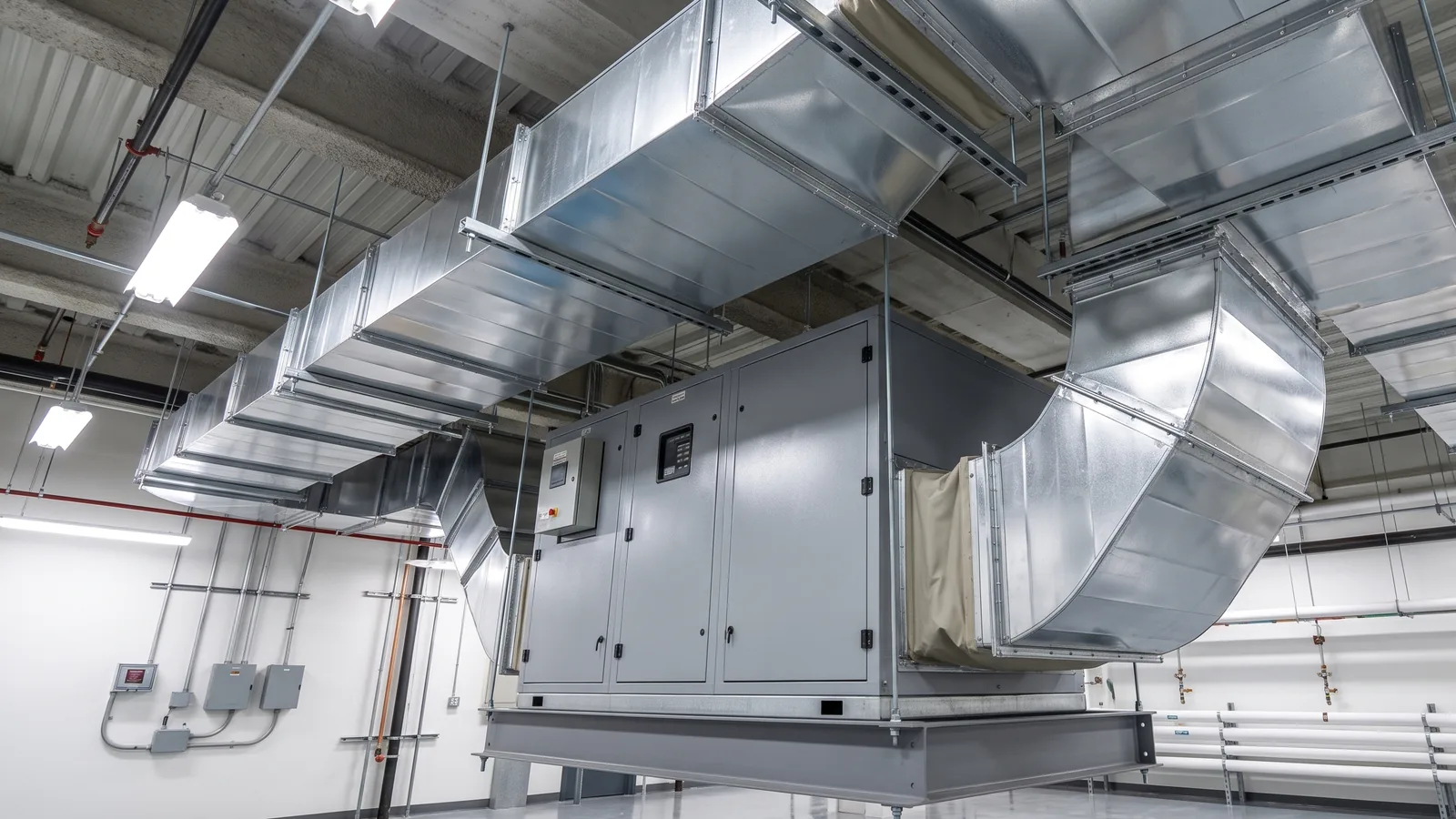
Ducted dehumidification systems are the most efficient approach to controlling humidity across entire commercial and industrial facilities. These integrated systems connect directly to existing HVAC infrastructure, providing centralised moisture control that eliminates the need for multiple standalone units scattered throughout your building.
Understanding Ducted Dehumidification Technology
A ducted dehumidifier operates as a centralised moisture extraction system that processes air through your building’s existing ventilation network. The system draws humid air from multiple zones simultaneously, removes excess moisture through either refrigerant or desiccant technology, then redistributes the conditioned air back through supply ducts.
The key advantage is full coverage without visible equipment in the workspace. Unlike portable units that only treat localised areas, ducted dehumidification systems maintain consistent humidity levels across warehouses, manufacturing floors, laboratories and multi-storey office buildings through a single, powerful unit.
| Component | Function | Commercial Benefit |
|---|---|---|
| Central Processing Unit | Extracts moisture from airstream | Single point of maintenance |
| Return Air Ducts | Collects humid air from zones | No equipment in work areas |
| Supply Air Ducts | Distributes dry air | Uniform conditions facility-wide |
| Condensate Drainage | Automatic water removal | Zero manual intervention |
| Control System | Monitors and adjusts operation | Precise humidity targets |
Operating Principles and Moisture Extraction Process
The dehumidification cycle begins when return air sensors detect humidity levels exceeding your preset parameters. The system activates automatically, drawing humid air through return ducts into the central processing unit where moisture extraction occurs.
Two primary technologies drive commercial ducted systems:
- Refrigerant-based systems: Cool incoming air below its dew point, causing moisture to condense on evaporator coils. Refrigerant dehumidification units are ideal for temperatures above 15°C and moderate humidity levels.
- Desiccant wheel systems: Pass air through a rotating wheel containing moisture-absorbing materials. Commercial desiccant dehumidifiers using this principle excel in low-temperature environments and where extremely low humidity levels are required.
After moisture extraction, the system reheats the air to your specified temperature before distribution. This prevents overcooling and maintains comfortable working conditions while achieving target humidity levels.
Integration with Existing HVAC Infrastructure
Successful ducted dehumidifier installation requires careful integration with your building’s existing ventilation system. Professional installers assess your existing ductwork capacity, identify optimal connection points, and ensure proper airflow balance across all zones.
Critical integration considerations include:
- Duct sizing calculations to handle additional airflow without creating pressure imbalances, consistent with AIRAH ventilation design guidance
- Strategic placement of humidity sensors in representative locations throughout the facility
- Control system compatibility with existing building management platforms
- Condensate drainage routing to appropriate disposal points
- Electrical supply adequate for the dehumidifier’s power requirements
Modern ducted systems incorporate smart controls that communicate with your building automation system. This integration enables remote monitoring, automated scheduling based on occupancy patterns, and coordination with heating and cooling operations for optimal energy efficiency.
Pre-planning a ducted dehumidifier installation also involves structural assessments, acoustic isolation and ensuring adequate access for future servicing.
Commercial Dehumidification Ducting Requirements
Effective ducting design is the foundation of any commercial dehumidification installation. Poorly designed ductwork restricts airflow, reduces extraction capacity and forces the unit to work harder, driving up energy costs and shortening component life.
Key ducting considerations for commercial installations:
- Duct diameter: Size return and supply ducts to maintain airflow velocities between 3 and 5 metres per second. Undersized ducts create excessive static pressure and reduce the unit’s rated capacity.
- Run length and bends: Keep duct runs as short and straight as possible. Each 90-degree bend adds the equivalent of several metres of straight duct in airflow resistance, so use long-radius elbows where turns are unavoidable.
- Insulation: Insulate supply ducts passing through unconditioned spaces to prevent condensation forming on the duct exterior, which reintroduces moisture into the building envelope.
- Return air placement: Position return grilles in areas with the highest moisture load, such as wash-down zones, loading docks or above cooking equipment, to capture humid air at its source.
Capacity Sizing for Commercial Applications
Proper system sizing determines whether your ducted dehumidifier delivers effective moisture control or struggles to maintain target conditions. Undersized units run continuously without achieving desired humidity levels, while oversized systems cycle frequently, reducing efficiency and equipment lifespan.
Professional capacity calculations consider multiple variables:
| Factor | Impact on Sizing | Measurement Required |
|---|---|---|
| Floor Area | Base moisture load | Square metres of conditioned space |
| Ceiling Height | Total air volume | Metres from floor to ceiling |
| Occupancy | Human moisture generation | Peak number of people |
| Processes | Industrial moisture sources | Litres per hour from equipment |
| Infiltration | Outside air moisture ingress | Air changes per hour |
Manufacturing facilities with wash-down procedures or steam processes require substantially larger capacities than office buildings. Industrial-grade dehumidification systems must handle higher moisture loads from production equipment, raw materials and increased ventilation requirements.
Facilities that need to calculate the right dehumidifier size should account for worst-case ambient conditions, not annual averages. A unit sized for average summer humidity will fall short during peak wet-season days when doors are open and infiltration spikes.
Specifying a Ducted Dehumidifier for Procurement
A purchase order that says “one ducted dehumidifier” invites the wrong unit on site. Procurement documents need to state the duty point, not just the catalogue extraction rate, because every dehumidifier’s real capacity shifts with inlet temperature and humidity.
A clear specification should include:
| Specification Item | What to State | Why It Matters |
|---|---|---|
| Rated Inlet Conditions | Dry-bulb and wet-bulb temperature at the return air grille | Catalogue figures assume 30°C / 80% RH; your site may differ |
| Required Extraction Rate | Litres per day at your actual inlet conditions | Prevents oversizing from catalogue numbers at ideal conditions |
| Airflow at External Static Pressure | m³/h at the duct resistance your layout creates | Long duct runs or many bends reduce delivered airflow |
| Electrical Supply | Voltage, phase, maximum draw in amps | Confirms existing switchboard capacity before delivery |
| Noise Rating | dB(A) at 1 metre from the unit casing | Critical for offices, hotels and aged care co-located with plant rooms |
Ask suppliers to quote extraction capacity at your specific duty point, not at their standard test conditions. Two units with identical catalogue ratings can deliver very different results when operating in a 15°C cold store versus a 35°C wash-down bay.
Zone Separation for Multi-Area Facilities
Most commercial buildings contain areas with different humidity requirements, contamination risks, or operating temperatures. A single ducted system can serve multiple zones, but only when the ductwork includes motorised dampers and independent humidity sensors for each area.
Common scenarios requiring zone separation:
- Clean rooms adjacent to general manufacturing: The clean room needs tighter humidity control and positive pressure to prevent cross-contamination from the production floor.
- Cold storage next to ambient warehousing: Mixing cold, dry air with warm, humid air at the boundary creates condensation on walls, ceilings and stored goods. Warehouse ceiling condensation is one of the most common symptoms of poor zone separation.
- Office wings sharing ductwork with process areas: Occupant comfort targets (45 to 55% RH) rarely match process targets (sometimes below 30% RH), so shared ductwork without damper control leaves one zone over-dried or the other under-served.
Zone separation does not always mean separate dehumidifiers. A single high-capacity unit with a ducted manifold and proportional dampers can maintain different setpoints across zones, provided the control system supports independent PID loops for each area.
Commissioning and Handover Acceptance Checks
A ducted dehumidifier is only as reliable as its commissioning. Skipping acceptance checks at handover is how facilities inherit problems that surface months later as condensation, mould, or unexplained energy bills.
A thorough commissioning checklist covers:
- Closed-door return paths: Verify that return air can reach the unit when all internal doors are closed. Starving the return side drops airflow and extraction capacity.
- Sensor placement and calibration: Confirm each humidity sensor reads within ±2% RH of a calibrated reference instrument at the installed location, not just on the bench.
- Condensate drainage: Run the unit at full load for at least two hours and watch the drain. A blocked or incorrectly graded drain line will back up into the unit tray and overflow.
- Independent humidity call: Each zone sensor should be able to call the unit on independently. Test by raising humidity in one zone while the others are satisfied.
- BMS integration: Verify alarm points, trend logging, and remote setpoint adjustment all function through the building management system.
- Baseline recording: Log supply air temperature, return air humidity, airflow (measured at each diffuser with a balometer), and power draw as a commissioning baseline for future comparison.
Document the baseline readings and file them with the operations manual. When performance drifts months later, the commissioning record tells the maintenance team exactly what “normal” looked like on day one.
Performance Monitoring and Control Systems
Modern control systems do more than switch the unit on and off. Digital controllers continuously monitor humidity levels across multiple zones, adjusting operation to hold precise conditions while keeping energy consumption down.
Key control features for commercial operations include:
- Multi-zone humidity sensing with individual setpoint control
- Trend logging for compliance documentation and performance analysis
- Alarm notifications for out-of-range conditions or equipment faults
- Scheduling functions to reduce operation during unoccupied periods
- Integration with existing BMS platforms via BACnet or Modbus protocols
Remote monitoring capabilities allow facility managers to track system performance from any location. Cloud-based platforms provide real-time data access, historical trending and predictive maintenance alerts that prevent unexpected downtime.
Maintenance Requirements for Optimal Performance
Regular maintenance ensures your ducted dehumidifier continues delivering reliable moisture control year after year. Neglected systems suffer reduced capacity, increased energy consumption and premature component failure.
Essential maintenance tasks include:
- Monthly: Check condensate drainage for blockages, inspect control panel for error codes
- Quarterly: Clean or replace air filters, verify sensor calibration
- Bi-annually: Professional coil cleaning, belt tension adjustment (if applicable)
- Annually: Comprehensive system inspection, refrigerant charge verification, electrical connection testing
Facilities operating in dusty or corrosive environments require more frequent filter changes and coil cleaning. Food processing plants must also consider hygiene requirements when scheduling maintenance activities.
Energy Efficiency Considerations
Energy consumption is a significant running cost for commercial dehumidification systems. Understanding what a ducted dehumidifier costs to run helps facility managers budget accurately and identify savings opportunities.
Variable speed compressors adjust capacity to match actual moisture loads rather than cycling between full power and off states. Heat recovery options capture energy from the dehumidification process to preheat incoming air or provide hot water for other facility needs.
Efficiency optimisation strategies include:
- Installing economiser controls that utilise outside air when conditions permit
- Implementing demand-based ventilation to reduce unnecessary air processing
- Upgrading to high-efficiency fan motors with variable frequency drives
- Adding thermal insulation to ductwork in unconditioned spaces
- Scheduling reduced operation during periods of naturally low humidity
Common Applications Across Industries
Different commercial sectors require specific humidity control strategies based on their unique operational needs. Understanding these requirements helps select appropriate ducted dehumidification technology and control parameters.
| Industry | Typical RH Target | Critical Requirement |
|---|---|---|
| Pharmaceutical Manufacturing | 40-50% | Precise control for product stability |
| Food Processing | 50-60% | Prevent condensation on equipment |
| Electronics Assembly | 30-50% | Protect sensitive components |
| Document Archives | 35-45% | Preserve paper integrity |
| Indoor Sports Facilities | 50-60% | Maintain safe playing surfaces |
These target ranges are general industry guidelines aligned with ASHRAE Standard 55 recommendations. Specific requirements vary by process, product and local building codes.
Each application demands specific features from the dehumidification system. Pharmaceutical facilities need commercial-grade units with precise control capabilities and validation documentation, while gymnasiums and sports halls prioritise high capacity and rapid response to occupancy changes.
Hotels and aged care facilities benefit from ducted systems that maintain occupant comfort without visible equipment in guest areas. Australia’s indoor aquatic centres rely on ducted dehumidification to manage the constant evaporation from heated pool surfaces.
Troubleshooting Performance Issues
Even well-maintained ducted dehumidifiers occasionally experience performance problems. Quick identification and resolution of these issues minimises disruption to your operations.
Common symptoms and their likely causes:
- Insufficient dehumidification: Undersized unit, clogged filters, refrigerant leak, failed compressor
- Excessive energy consumption: Dirty coils, worn bearings, incorrect setpoints, air leaks in ductwork
- Uneven humidity levels: Improper air distribution, blocked ducts, malfunctioning dampers
- Water leaks: Blocked condensate drain, damaged drain pan, frozen evaporator coils
- Unusual noises: Loose components, failing motors, debris in fans
In practice, performance issues rarely have a single cause. Regular monitoring catches problems early, before they affect production or comfort.
Ready to get humidity under control across your facility? Contact Moisture Cure Commercial for a comprehensive site assessment, then explore our ducted dehumidifier range to find the right fit for your operational requirements.
YAKE Ducted Dehumidifiers from Moisture Cure Commercial
Moisture Cure Commercial stocks the YAKE AMDZ and RYDZ ducted dehumidifier range, available in multiple capacities for whole-building humidity control.
Frequently Asked Questions
How does a ducted dehumidifier work in a commercial facility?
A ducted dehumidifier draws humid air from multiple zones through return ductwork into a central unit, extracts moisture using refrigerant coils or a desiccant wheel, then distributes dried air through supply ducts. This centralised approach maintains consistent conditions across an entire facility from one installation point.
What is the difference between ducted desiccant and refrigerant dehumidifiers?
Refrigerant ducted units cool air below its dew point to condense moisture and work best above 15°C. Desiccant units use a moisture-absorbing wheel that operates from -20°C to 50°C, making them better suited to cold stores, freezer rooms and low-temperature processing environments.
What size ducted dehumidifier does a commercial building need?
Sizing depends on total air volume, moisture sources (occupants, equipment, wash-down areas), infiltration rates and the target relative humidity. A professional site assessment measures these variables to calculate the required extraction rate in litres per day.
Can a ducted dehumidifier connect to existing HVAC ductwork?
Yes. Most commercial ducted dehumidifiers integrate with existing ventilation systems. Professional installers assess duct capacity, identify connection points and balance airflow to prevent pressure imbalances in the building.
What maintenance does a commercial ducted dehumidifier require?
Monthly checks cover condensate drainage and error codes. Clean or replace filters quarterly. Professional coil cleaning and sensor recalibration should happen twice a year, with more frequent attention in dusty or corrosive environments.
What humidity level should a commercial facility maintain?
Most commercial environments target 40 to 60 per cent relative humidity. Pharmaceutical manufacturing typically requires 40 to 50 per cent, electronics assembly 30 to 50 per cent, and document archives 35 to 45 per cent, aligned with ASHRAE Standard 55 recommendations.
Can you duct a standalone dehumidifier?
Some portable and semi-portable units accept short duct runs on the inlet or outlet, but they are not designed for the static pressure of a full duct network. Purpose-built ducted dehumidifiers include higher-pressure fans, flanged duct connections and controls designed for distributed airflow across multiple zones.
What are the downsides of a ducted dehumidifier?
The main drawbacks are higher upfront installation cost (ductwork, electrical, controls) and the need for professional commissioning. Maintenance access can also be harder when the unit is ceiling-mounted or in a plant room, and any ductwork leak reduces the system’s effective capacity.
Is a central dehumidifier worth it for a commercial building?
For buildings larger than a few hundred square metres with consistent humidity requirements, a central ducted system almost always costs less to run than multiple portable units. It also delivers more uniform conditions, requires less floor space in work areas, and produces a single maintenance schedule instead of managing several individual machines.