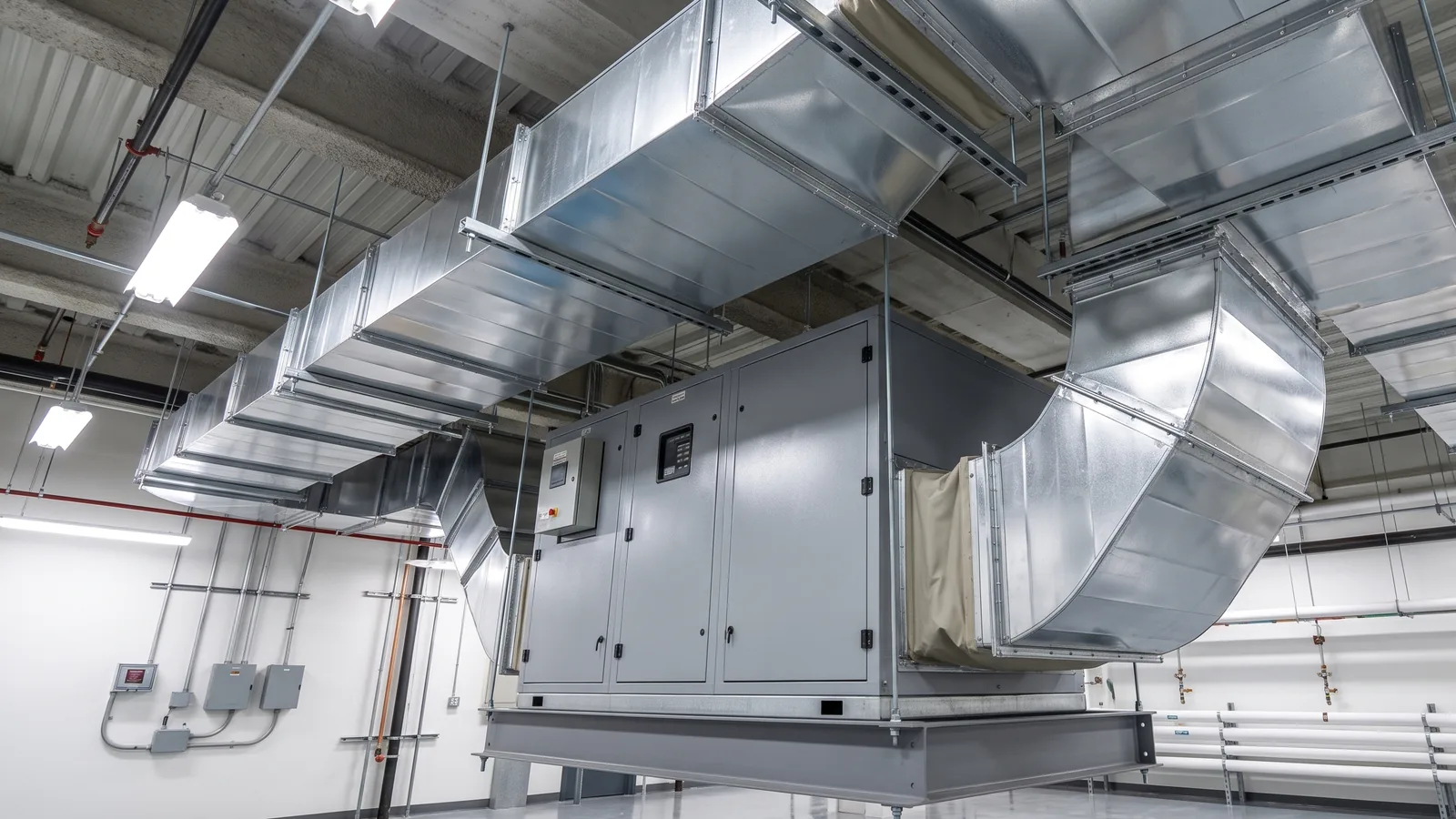
Server equipment and data storage systems demand precise environmental conditions to prevent costly failures. Humidity-related outages remain among the most preventable causes of data centre downtime, yet many Australian facilities lack dedicated moisture control independent of their cooling systems.
Critical Humidity Parameters for Australian Data Centres
ASHRAE TC 9.9 Thermal Guidelines for Data Processing Environments defines the Class A1 recommended envelope at 18-27°C with a maximum 15°C dew point and 8-80% relative humidity. Most operators target a tighter 40-60% RH band for optimal equipment protection.
Australian data centres face particular challenges during subtropical summer months when ambient humidity in Brisbane, Sydney, and coastal Queensland regularly exceeds 80% RH. Inland facilities in Adelaide and western Sydney experience rapid seasonal swings that stress cooling systems not designed for independent latent load management.
| Humidity Range | Server Impact | Risk Level | Mitigation Required |
|---|---|---|---|
| Below 40% RH | Static electricity buildup | High | Ultrasonic humidification system |
| 40-60% RH | Optimal operation | Low | Monitoring only |
| 60-70% RH | Increased corrosion risk | Medium | Active dehumidification |
| Above 70% RH | Condensation formation | Critical | Emergency dehumidification response |
Equipment Failure Risks and Downtime Costs
Electrostatic discharge is the primary threat in low-humidity environments, causing immediate component failure or latent defects that surface months later. The Uptime Institute’s 2024 Annual Outage Analysis found that over 55% of significant outages cost more than US$100,000, with humidity-related equipment failures among the most preventable causes.
High humidity presents equally serious risks. Condensation on circuit boards and corrosion of metallic components throughout server enclosures can progress undetected until a critical failure occurs.
- Circuit board delamination from sustained moisture absorption
- Contact corrosion on connectors and bus bars
- Hard drive head crashes from condensation on platters
- Power supply failures from internal arcing
- Cooling fan bearing deterioration and seizure
- Conductive dust bridging from humidity-laden particulates
Coastal Australian facilities face accelerated corrosion from salt-laden air combining with excess humidity. This is particularly acute in tropical Queensland and Northern Territory installations where ambient conditions challenge even well-maintained HVAC systems.
How Evaporative Cooling Affects Data Centre Humidity
Evaporative cooling systems are increasingly adopted in Australian data centres for energy efficiency. These systems lower air temperatures through water evaporation but add moisture to the supply airstream, requiring paired dehumidification to prevent humidity overshoot.
Direct evaporative coolers can extend free-cooling hours from approximately 70% to over 90% of the year in temperate Australian climates. However, operators must size dehumidification capacity to handle the additional moisture load.
- Direct evaporative coolers add 3-6 g/kg moisture to supply air depending on intake conditions
- Indirect evaporative systems cool through a heat exchanger without adding moisture to the server-facing airstream
- Hybrid configurations pair evaporative pre-cooling with trim refrigeration for year-round coverage
- Adiabatic cooling extends economiser hours in temperate Australian climates where dry-bulb conditions permit
Pairing evaporative cooling with desiccant dehumidification systems that operate across -20°C to +50°C provides the best balance of energy efficiency and humidity precision. Desiccant units maintain full capacity whether the cooling mode is compressor-based, evaporative, or free-air.
Calculating Dehumidification Requirements for Server Rooms
Proper sizing requires analysis of multiple heat and moisture sources. Server equipment generates substantial sensible heat but minimal latent load, while fresh air infiltration and building envelope characteristics contribute the majority of moisture.
Most data centres operate with 10-20 air changes per hour to manage thermal loads as recommended by ASHRAE TC 9.9. The calculation starts with total room volume and works outward through each moisture source.
- Calculate room volume: length × width × height in cubic metres
- Determine fresh air requirement: typically 10-15% of total airflow
- Assess moisture load from infiltration: door openings, wall permeability, geographic humidity baseline
- Add occupant load: staff contribute approximately 50-75 g of moisture per person per hour (per ASHRAE Fundamentals)
- Include safety factor: 20-30% above calculated peak to cover seasonal extremes
A 200 m² server room with 3 m ceilings in coastal Sydney may require 60-90 litres of daily moisture removal during summer. Ducted dehumidifiers designed for commercial HVAC integration provide centralised humidity control across multiple server zones without disrupting hot-aisle/cold-aisle containment.
Technology Selection for Mission-Critical Applications
Refrigerant and desiccant dehumidification technologies each serve different data centre profiles. The choice depends on operating temperature range, required humidity precision, and integration with existing cooling infrastructure.
Refrigerant dehumidification systems perform well in standard environments maintaining 20-25°C, removing moisture through condensation while providing supplemental sensible cooling. However, refrigerant dehumidifiers lose capacity rapidly below 15°C, limiting their use in facilities with economiser modes or cold-aisle temperatures below that threshold.
| Technology | Best Application | Energy Profile | Key Limitation |
|---|---|---|---|
| Refrigerant | 20-30°C environments | High COP at design conditions | Capacity drops below 15°C |
| Desiccant | Below 20°C or ultra-low RH targets | Consistent across -20°C to +50°C | Requires regeneration heat source |
| Hybrid | Variable conditions and mixed cooling | Optimised across full operating range | Higher capital cost |
Desiccant systems maintain consistent dehumidification regardless of ambient temperature, operating across -20°C to +50°C. This makes them the standard choice for facilities using free-cooling or economiser modes where server room temperatures may drop during winter.
Integration with Building Management Systems
Data centres require seamless integration between humidity control and facility management platforms. Industrial dehumidifiers with BACnet, Modbus, or SNMP connectivity provide real-time monitoring and automated response within existing BMS infrastructure.
For protocol selection and wiring detail, see the guide to connecting industrial dehumidifiers to your building management system.
- Remote monitoring via web interface or mobile applications
- Automated alerts when humidity drifts outside the ASHRAE recommended envelope
- Historical trending for predictive maintenance scheduling
- Load balancing across multiple units to distribute wear evenly
- Integration with uninterruptible power and generator switchover sequences
- Failover capability for N+1 redundancy configurations critical to uptime SLAs
Preventive Maintenance for Continuous Operation
Data centre dehumidifiers run continuously under demanding thermal loads, making structured maintenance essential. Neglected systems lose capacity, consume more energy, and fail without warning.
Quarterly inspections should cover filter replacement, condensate system cleaning, and performance verification against commissioning baselines. Annual service extends to refrigerant charge checks, electrical connection torque testing, and sensor calibration.
- Document baseline performance metrics at commissioning
- Establish filter replacement intervals based on local air quality and particulate load
- Monitor condensate pH to detect coil corrosion early
- Test automatic controls and safety interlocks monthly
- Verify humidity sensor calibration against NATA-certified instruments quarterly
- Clean coils annually or when static pressure drop increases by 20%
Emergency Response Planning for Humidity Excursions
Equipment failures or extreme weather events can cause dangerous humidity levels requiring immediate intervention. An effective response plan minimises equipment damage while maintaining critical operations during recovery.
The first priority is isolating affected zones to prevent moisture migration across server areas. Portable dehumidification equipment provides rapid moisture removal while permanent systems undergo repair.
| Humidity Level | Response Window | Initial Action | Equipment |
|---|---|---|---|
| 65-70% RH | 4 hours | Increase ventilation rate | Existing air handling |
| 70-80% RH | 2 hours | Deploy portable dehumidifiers | Commercial dehumidifier units rated for continuous duty |
| Above 80% RH | Immediate | Isolate and power down affected racks | Emergency response team plus portable units |
Post-event recovery requires gradual environmental normalisation. Rapid humidity drops after a high-humidity excursion can cause condensation on equipment that cooled during the event, compounding the original damage.
Frequently Asked Questions
What humidity level should a data centre maintain?
ASHRAE TC 9.9 recommends 8-80% RH with a maximum 15°C dew point for Class A1 environments. Most operators target 40-60% RH for optimal equipment protection, balancing static discharge risk below 40% against corrosion and condensation risk above 60%.
Do Australian data centres need dedicated dehumidification?
In most coastal and subtropical locations, yes. Standard HVAC systems designed for sensible cooling cannot remove enough moisture to keep server rooms within safe operating limits during high-humidity months. Dedicated data centre dehumidification addresses the latent load independently of cooling.
Can evaporative cooling and dehumidification work together in a data centre?
Yes. Evaporative cooling reduces air temperature efficiently but adds moisture to the supply air. Pairing it with a desiccant dehumidifier removes excess humidity without adding heat, giving operators both energy-efficient cooling and precise moisture control.
How often should data centre dehumidifiers be serviced?
Filters should be inspected quarterly and replaced as needed. Full service including refrigerant checks, coil cleaning, and sensor calibration should occur annually. Units in high-particulate or coastal environments may need more frequent attention.
What is the difference between desiccant and refrigerant dehumidifiers for data centres?
Refrigerant units cool air below its dew point to condense moisture, working best above 15°C. Desiccant units use an adsorbent rotor to capture moisture directly from the airstream, maintaining full capacity across -20°C to +50°C. Data centres using free-cooling or economiser modes often need desiccant systems because room temperatures can drop below the refrigerant effective range.
Does humidity affect data centre energy consumption?
Uncontrolled humidity forces cooling systems to work harder. When relative humidity exceeds the target band, HVAC systems cycle more frequently and consume more energy. Purpose-built dehumidification handles latent heat separately from sensible cooling, reducing overall energy demand.
Contact Moisture Cure Commercial for a site assessment and customised humidity control recommendations for your data centre. Our technical team analyses your facility’s environmental challenges, cooling architecture, and expansion plans to specify the right dehumidification solution.