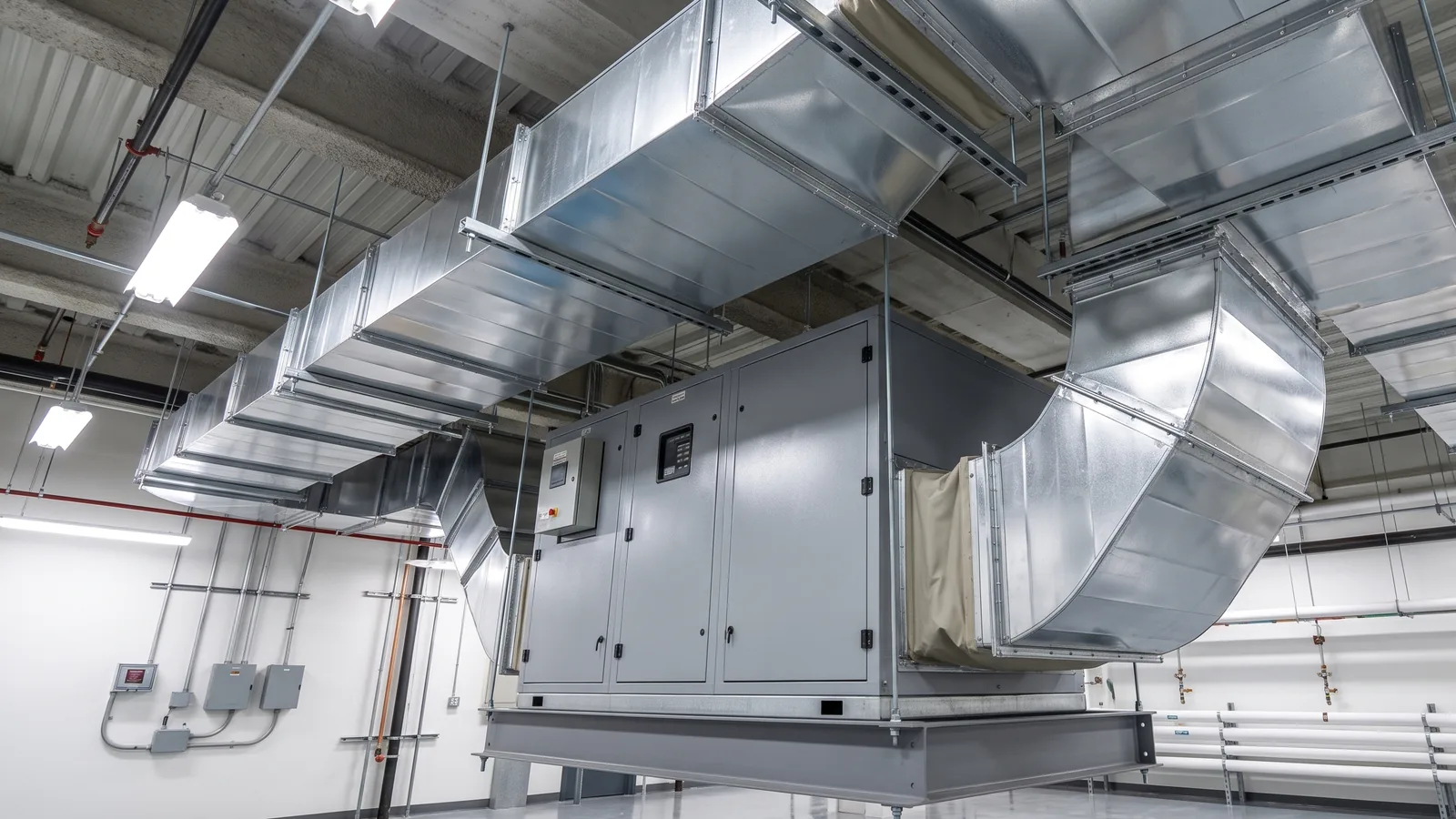
Electronics manufacturing facilities face constant threats from electrostatic discharge (ESD), which can destroy sensitive components and halt production lines. Maintaining proper humidity levels between 40% and 60% relative humidity provides the most effective defence against static electricity buildup. When relative humidity drops below 30%, surface resistance climbs and even routine movement across a production floor can generate thousands of volts.
How Static Discharge Damages Electronic Components
Modern electronic components operate at increasingly lower voltages, making them more vulnerable to static damage than ever before. A person walking across a factory floor can generate up to 35,000 volts in dry conditions, while many components fail at just a few hundred volts.
ESD damage falls into two categories that facility managers must understand:
- Catastrophic failure destroys the component immediately, causing visible burnout or open circuits that testing catches on the production line
- Latent damage weakens the component without causing immediate failure, leading to field returns weeks or months after assembly
Latent ESD damage is the greater threat because it passes quality checks but degrades over time. According to the ESD Association, latent failures account for a significant share of warranty returns in the electronics sector.
| Component Type | Typical ESD Failure Voltage | Recommended RH Range |
|---|---|---|
| MOSFET transistors | 100-200V | 45-55% |
| Integrated circuits | 200-500V | 40-60% |
| Schottky diodes | 300-2,500V | 40-55% |
| Film resistors | 300-3,000V | 35-50% |
| Bipolar transistors | 380-7,000V | 40-55% |
How Humidification Prevents Static Buildup
Water vapour in the air creates a thin conductive film on surfaces, allowing static charges to dissipate before reaching dangerous levels. This microscopic moisture layer reduces surface resistivity by 100 to 1,000 times compared to dry conditions.
- Surface conductivity increases exponentially above 40% RH
- Static generation drops by approximately 90% when humidity rises from 20% to 50%
- Charge decay time reduces from hours to seconds at proper humidity levels
- Particle attraction to charged surfaces decreases, improving cleanroom performance
- Worker comfort improves, reducing movement-generated static
Without adequate humidification, even comprehensive ESD protection programmes fall short. Wrist straps, conductive flooring, and ionisers work effectively only when combined with proper environmental conditions.
Humidification as Part of a Complete ESD Programme
Humidity control is one layer in a multi-layered ESD protection strategy. The ANSI/ESD S20.20 standard outlines the full framework that electronics manufacturers should follow.
Effective ESD programmes combine humidification with:
- Grounding systems including wrist straps, heel grounders, and continuous monitors
- ESD-safe flooring with conductive or dissipative properties
- Ionisation equipment to neutralise charges on non-conductive surfaces
- Antistatic packaging for component storage and transport
- Personnel training covering ESD-safe handling procedures
Humidification addresses the root cause by preventing charge accumulation in the first place. The other measures manage charges that do build up despite controlled humidity.
ESD Compliance Standards for Australian Manufacturers
Australian electronics manufacturers must comply with international ESD standards while adapting to local climate conditions. Multiple standards govern humidity requirements across different production areas.
| Standard | Humidity Requirement | Application |
|---|---|---|
| AS/NZS 61340.5.1 | 45-55% RH for general assembly | PCB assembly, component handling |
| ANSI/ESD S20.20 | Environment must support charge dissipation | ESD control programme framework |
| IPC-A-610 | 30-70% RH acceptable range | Soldering and inspection areas |
| JEDEC JESD625B | 40-60% RH for ESD control | Semiconductor packaging |
| ISO 14644-1 | 45 ± 5% RH for cleanrooms | Class 5-7 production areas |
Process-Specific Humidity Targets
Different production zones within an electronics facility require different humidity setpoints. A single facility-wide target rarely meets every process requirement.
| Production Zone | Target RH Range | Reason |
|---|---|---|
| SMT assembly lines | 40-55% | Solder paste performance and ESD protection |
| Component storage | 40-60% | Moisture-sensitive device (MSD) preservation |
| Wave soldering areas | 40-50% | Flux activation and joint quality |
| ISO Class 5-7 cleanrooms | 45-55% | Particle control and ESD prevention |
| Testing and inspection | 40-60% | Measurement accuracy and static control |
| Warehousing and staging | 35-55% | Corrosion prevention during storage |
Sizing Humidification Systems for Production Facilities
Proper system sizing requires analysis of multiple factors including facility volume, air change rates, outdoor conditions, and internal heat loads. Australian facilities face particular challenges with extreme seasonal humidity swings.
- Calculate total moisture load in kg/hour based on volume, air changes, and the gap between target and ambient moisture content
- Add 20-30% capacity for peak summer cooling loads that strip moisture from conditioned air
- Account for process heat from reflow ovens, wave soldering, and test equipment that destabilises humidity
- Factor in fresh air requirements under AS 1668.2
- Include capacity margin for future production expansion
Equipment heat loads are a common destabiliser that facility managers underestimate. Reflow ovens, wave soldering machines, and burn-in chambers generate significant heat that drives humidity down locally, even when the broader facility reads on target.
Humidification Technologies for Electronics Facilities
Different production areas suit different humidification approaches based on cleanliness requirements, temperature sensitivity, and energy costs. Most facilities benefit from combining multiple technologies.
| Technology | Best Application | Key Advantage |
|---|---|---|
| Ultrasonic | Cleanrooms, SMT lines | No heat addition, precise control |
| High-pressure misting | Large assembly areas | Energy-efficient, rapid response |
| Steam injection | Ducted HVAC systems | Sterile output, no mineral residue |
| Evaporative | Warehouses, staging areas | Low operating cost, adiabatic cooling benefit |
Ultrasonic humidification systems suit electronics production lines particularly well because they add moisture without raising air temperature. This matters in facilities where precise humidity and temperature control must work together.
Integration with Existing HVAC and BMS Systems
Most electronics facilities already have sophisticated HVAC systems that require careful integration with humidity control equipment. Poor integration leads to control conflicts, energy waste, and maintenance problems.
- Install humidity sensors upstream and downstream of cooling coils
- Programme deadbands to prevent simultaneous humidification and dehumidification
- Use modulating control valves for smooth capacity adjustment
- Implement cascade control with temperature as primary loop
- Monitor psychrometric conditions at multiple production zones
Building management systems should trend humidity levels continuously to identify problem areas and optimise setpoints. BMS-compatible humidity control systems provide real-time data logging and alarm capabilities that support compliance auditing.
Environmental Factors That Destabilise Humidity
Maintaining stable humidity in an electronics facility is harder than it appears. Several factors work against consistent control:
- Seasonal variation in outdoor humidity means systems must handle both winter drying and summer moisture loads
- High airflow rates required for cleanroom classification accelerate moisture removal
- Process equipment heat from ovens, soldering stations, and test chambers creates localised dry zones
- Door openings and dock areas introduce unconditioned air during material movements
- HVAC cooling cycles strip moisture from the air, requiring reheat or supplementary humidification
Facilities that monitor humidity at multiple points rather than relying on a single sensor catch these variations before they cause ESD events.
Maintenance for Continuous Operation
Electronics manufacturing operates around the clock, demanding humidification systems with minimal downtime and maximum reliability. Planned maintenance prevents unexpected failures that could compromise production.
- Weekly: Check water quality, clean nozzles, verify sensor calibration
- Monthly: Replace filters, inspect distribution systems, test alarms
- Quarterly: Deep clean reservoirs, calibrate controls, check valve operation
- Annually: Replace wear parts, update control software, run full performance test
Water quality has the biggest impact on maintenance frequency and system longevity. Reverse osmosis or deionisation prevents mineral buildup that could contaminate sensitive production areas. For detailed maintenance planning, see our guide to commercial dehumidifier maintenance schedules.
Return on Investment Through ESD Prevention
Quantifying the financial benefits of humidification helps justify capital expenditure. Direct savings come from reduced component losses, while indirect benefits include improved yields and fewer field returns.
| Benefit Category | Typical Impact | Measurement Method |
|---|---|---|
| Component failure reduction | 50-75% fewer ESD events | Track ESD incidents per shift |
| First-pass yield improvement | 2-5% increase | Monitor test station results |
| Warranty claim reduction | 30-50% decrease | Analyse field return rates |
| Production uptime | 1-3% improvement | Track static-related line stops |
Facilities that implement proper humidification alongside a full ESD programme typically recover system costs within 12 to 18 months through reduced component losses alone.
Frequently Asked Questions
What humidity level prevents static discharge in electronics manufacturing?
The optimal range is 40-60% relative humidity. Below 30% RH, static charge buildup accelerates dramatically and ESD risk becomes severe. Most standards recommend maintaining at least 40% RH as a minimum threshold, with 45-55% RH preferred for sensitive assembly work.
Why do electronics factories need humidifiers when they already have ESD mats and wrist straps?
Grounding equipment manages static charges after they form. Humidification prevents charges from building up in the first place by creating a thin conductive moisture film on surfaces. Facilities using both approaches together see significantly lower ESD event rates than those relying on grounding alone.
Can too much humidity damage electronic components?
Yes. Relative humidity above 60% increases the risk of condensation, corrosion, and moisture absorption in hygroscopic components. Semiconductor and PCB manufacturing requires precise humidity control that avoids both extremes.
Which humidification technology suits cleanroom electronics production?
Ultrasonic humidifiers are the preferred choice for cleanroom environments because they produce no heat, allow precise RH control, and atomise water into fine droplets that evaporate without wetting surfaces or leaving mineral deposits.
How do I size a humidification system for my electronics facility?
Calculate the total moisture load based on your facility volume, air change rate, and the difference between target and ambient moisture content. Add 20-30% capacity for seasonal peaks, process heat loads, and future expansion. A specialist assessment accounts for variables like reflow oven heat output and cleanroom airflow rates that generic calculators miss.
What maintenance does an industrial humidifier need in a manufacturing environment?
Weekly nozzle cleaning and sensor checks, monthly filter changes, quarterly reservoir deep cleans, and annual wear-part replacement. Water treatment through reverse osmosis or deionisation extends maintenance intervals and prevents mineral contamination in production areas.
Does humidification help with dust control in electronics production?
Yes. Airborne particles carry static charges and are attracted to charged surfaces. Proper humidity reduces both particle generation and electrostatic attraction, which supports cleanroom classification and reduces contamination-related defects.
What Australian standards apply to humidity in electronics manufacturing?
AS/NZS 61340.5.1 specifies 45-55% RH for general electronics assembly. Facilities also reference IPC-A-610 for soldering environments (30-70% RH), JEDEC JESD625B for semiconductor packaging (40-60% RH), and ISO 14644-1 for cleanroom humidity requirements.
How quickly does a humidification system pay for itself?
Most electronics manufacturing facilities recover their humidification investment within 12 to 18 months through reduced component failures, improved first-pass yields, and fewer warranty returns. The ongoing savings from lower reject rates and improved uptime continue well beyond the payback period.
Contact Moisture Cure Commercial for a site assessment of your electronics manufacturing facility. Our humidity control specialists will analyse your specific production requirements and recommend the right humidification solution for protecting sensitive components from static discharge.