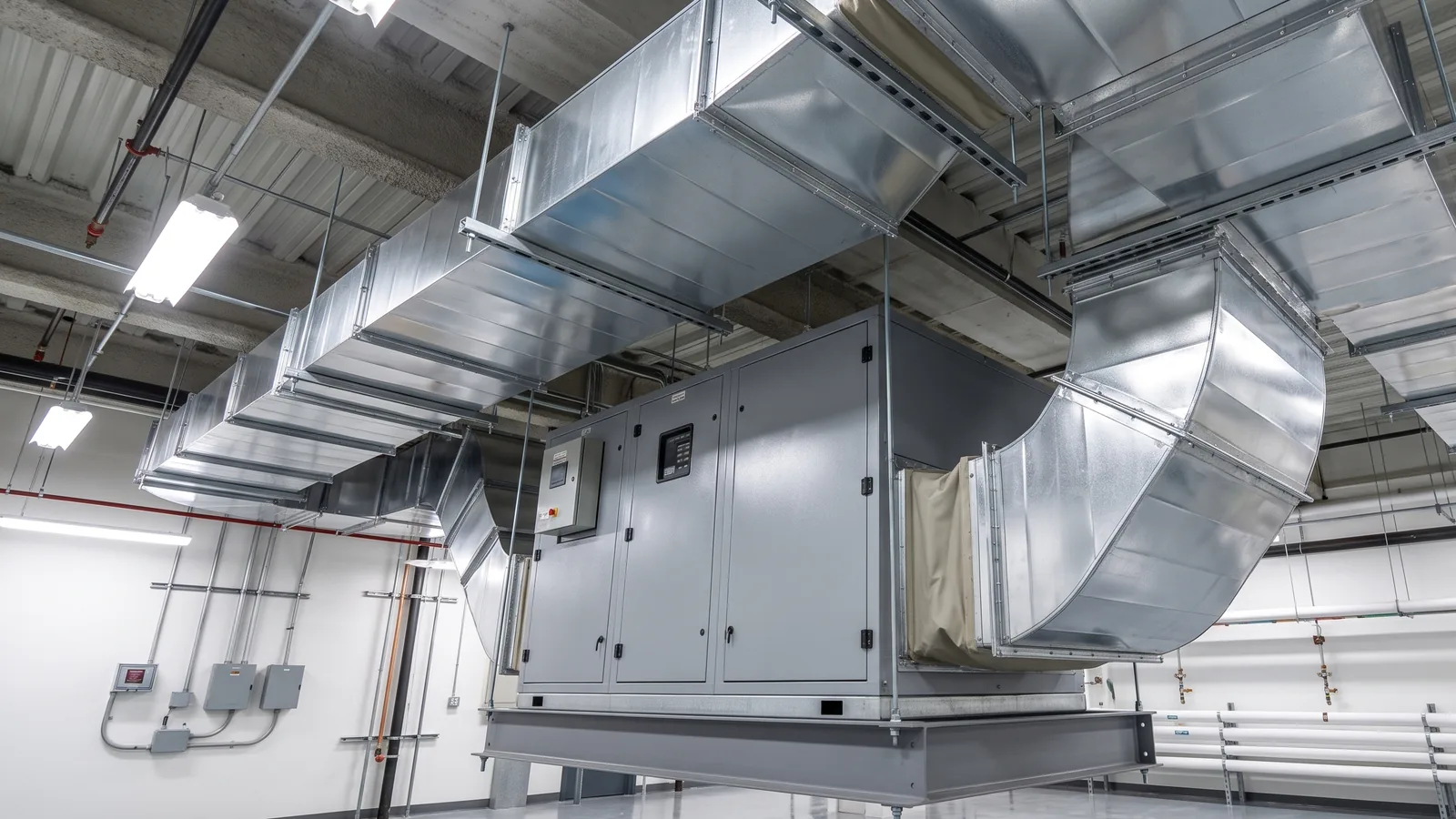
Ducted dehumidifiers provide central moisture control across commercial buildings, process areas and connected zones. Air is drawn from the controlled space, dried by the dehumidifier and returned through ductwork, so facilities teams can manage humidity without relying on separate portable units in each room.
The value of a ducted system depends on sound design. Moisture load, airflow, operating temperature, duct resistance, drainage and controls all need to be considered before equipment is selected.
What a ducted dehumidifier adds to a commercial building
A ducted dehumidifier treats moisture as a building service rather than a room-by-room task. It can serve one large space, several linked zones or a process area with dedicated return and supply paths.
- Central humidity sensing and automatic control
- Conditioned air delivered to the areas that need it
- Permanent condensate drainage instead of manual tank emptying
- Equipment located in a plant room or service area
- Access for monitoring, alarms and building management system integration
These features make purpose-built ducted dehumidifier systems suitable for facilities that need repeatable control across a defined area. The product type fits applications where distribution, drainage and central controls matter as much as extraction capacity.
How ducted dehumidification works
Return air passes through the dehumidifier, where water vapour is removed by a refrigerant coil or a desiccant rotor. The dried air then returns to the space through the supply duct, while collected water or regeneration air leaves through a separate path.
A refrigerant unit cools air below its dew point so moisture condenses on a coil. A desiccant unit transfers water vapour to a moisture-attracting rotor and uses a separate heated air stream to regenerate that rotor.
| Approach | Where it tends to fit | Design point to check |
|---|---|---|
| Ducted refrigerant | Warm commercial spaces with a steady latent load | Performance at the actual entering air temperature and humidity |
| Ducted desiccant | Cool rooms, low dew point processes and cold weather operation | Regeneration air, heat source and exhaust route |
| HVAC dry mode | Intermittent moisture removal where cooling and humidity loads occur together | Whether humidity can be controlled without overcooling the space |
ASHRAE guidance on mechanical dehumidifiers recommends selecting dedicated equipment for latent capacity rather than total air-conditioning capacity alone. This distinction matters when a facility has a large moisture load but only a modest need for sensible cooling.
Ways to integrate the system with HVAC
A ducted unit can operate independently or as part of the main air-handling arrangement. The right layout depends on where moisture enters the building and how existing HVAC equipment controls temperature and outdoor air.
- Parallel return-air system: the dehumidifier draws from and returns to the controlled space independently of the main air conditioner.
- Series installation: air passes through the dehumidifier and then another HVAC component, or the order is reversed to suit the design conditions.
- Dedicated zone system: separate ductwork serves a pool hall, archive, production room or other area with a distinct moisture load.
- Outdoor-air treatment: ventilation air is dried before it enters occupied or process spaces.
ASHRAE describes dedicated outdoor-air systems as a way to condition ventilation air separately from the equipment that maintains room temperature. That arrangement can make humidity control easier to verify, particularly where outdoor air is a major part of the moisture load.
Commercial applications for ducted systems
Suitable applications share one feature: moisture must be controlled across a defined space or process rather than beside a single piece of equipment. The target condition should come from the product, process or building requirement, not from a generic comfort range.
| Application | Moisture concern | Why ducted control fits |
|---|---|---|
| Indoor pools and aquatic centres | Continuous evaporation and condensation on cool surfaces | Air can be collected at the moisture source and distributed across the enclosure |
| Pharmaceutical production | Product-specific environmental and process limits | Central sensing and documented control can support the site’s validated HVAC strategy |
| Archives and museums | Seasonal moisture variation across storage areas | Stable distribution reduces isolated damp zones around collections |
| Food processing and packaging | Condensation, hygroscopic ingredients and washdown moisture | Dedicated zones can be controlled around the production requirement |
| Warehouses and storage | Outdoor-air infiltration and changing stock loads | A central unit can serve broad areas with permanent drainage and controls |
The TGA’s PIC/S GMP guidance for medicinal products says production air controls, including humidity where necessary, should suit the products, operations and external environment. It does not prescribe one universal humidity setting, so pharmaceutical targets must come from the process and quality system.
Pool facilities also need application-specific design. Moisture Cure Commercial’s indoor swim centre condensation control project in Hobart shows why enclosure conditions, air distribution and exposed building fabric have to be assessed together.
How to specify a ducted dehumidifier
Nominal litres per day is only one selection input. Published capacity is tied to stated air conditions, and extraction will change when temperature and humidity change.
- Room volume, ceiling height and connected zones
- Outdoor-air infiltration and mechanical ventilation
- Moisture from people, open water, wet products or industrial processes
- Starting and target temperature, relative humidity or dew point
- Required recovery time after doors open, washdown or production peaks
- Available static pressure and the resistance of ducts, filters and grilles
- Electrical supply, condensate route, service clearance and controls
Start with the design condition and peak moisture load, then compare unit performance at that point. Moisture Cure Commercial’s broader range of commercial and industrial humidity control equipment is useful when a project needs a different configuration or capacity from a standard ducted unit.
For a cold space or a process that needs a low dew point, review desiccant systems designed for demanding operating conditions. This product type keeps removing moisture in conditions where coil-based performance can fall away, but the regeneration air and energy supply must be included in the design.
Installation and commissioning details
Good equipment can still underperform if air bypasses the controlled area, the ducts impose too much resistance or the drain cannot clear condensate. Commissioning should compare actual readings with the design values rather than stopping when the unit starts.
- Measure supply and return airflow at the final fan setting
- Confirm sensor location represents the controlled zone
- Test the drain, trap, pump and high-level alarm where fitted
- Check duct insulation wherever surface condensation is possible
- Verify room pressure and interaction with exhaust systems
- Record temperature and humidity during representative operation
- Prove alarms, interlocks and building management system points
Maintenance and operating checks
Service intervals should reflect dust load, operating hours and the consequences of loss of control. A clean filter alone does not confirm that the system is removing the expected moisture.
- Trend space humidity or dew point and investigate repeated excursions
- Inspect filters, coils, rotor seals and air paths as applicable
- Clean and test condensate drains, pumps and alarms
- Check sensor accuracy against a calibrated reference
- Review fan condition, airflow and unusual noise
- Compare measured performance with commissioning records
For a closer look at components and airflow paths, see how ducted dehumidifiers work in commercial facilities. That explanation helps maintenance teams trace faults between the return air, moisture-removal section, drain and supply air.
Frequently asked questions
What is the main purpose of a ducted dehumidifier?
Its purpose is to remove water vapour from a defined building area or process and distribute the dried air through ductwork. Central controls allow the system to respond to measured conditions rather than manual operation.
Can a ducted dehumidifier work with an existing HVAC system?
Often, yes. The design must confirm airflow, static pressure, air temperature, controls, available space and the effect on the existing heating and cooling equipment.
Is air conditioning enough to control humidity?
It can be enough where cooling demand and moisture load occur at the same time. Dedicated dehumidification is usually considered when humidity remains high at low cooling load, when overcooling is a risk or when the process requires tighter control.
What are the limitations of a ducted dehumidifier?
It cannot correct water leaks, failed waterproofing or uncontrolled air infiltration by itself. It also needs correctly sized ducts, a reliable drain or regeneration path, service access and controls matched to the application.
How is a commercial ducted dehumidifier sized?
Sizing starts with a moisture-load calculation covering ventilation, infiltration, occupants, open water and process sources. The required unit is then checked at the project’s actual temperature and humidity, with allowance for duct resistance and recovery time.
Where should a ducted dehumidifier be installed?
The unit should be accessible for service and close enough to the controlled zone to keep duct losses manageable. Plant rooms, service corridors and accessible ceiling spaces can work when drainage, noise, structure and clearances are addressed.
Plan humidity control around the facility
Ducted dehumidification is most useful when the equipment, ductwork and controls are selected as one system. A site assessment can identify moisture sources, confirm operating conditions and show whether refrigerant, desiccant or another configuration fits the duty.
- Define the controlled zones and required conditions
- Measure the likely peak and normal moisture loads
- Review the existing HVAC, ventilation and electrical services
- Confirm installation access, drainage and control requirements
Contact Moisture Cure Commercial for a technical consultation or site assessment. The team can develop a system specification around the building, process and operating conditions.