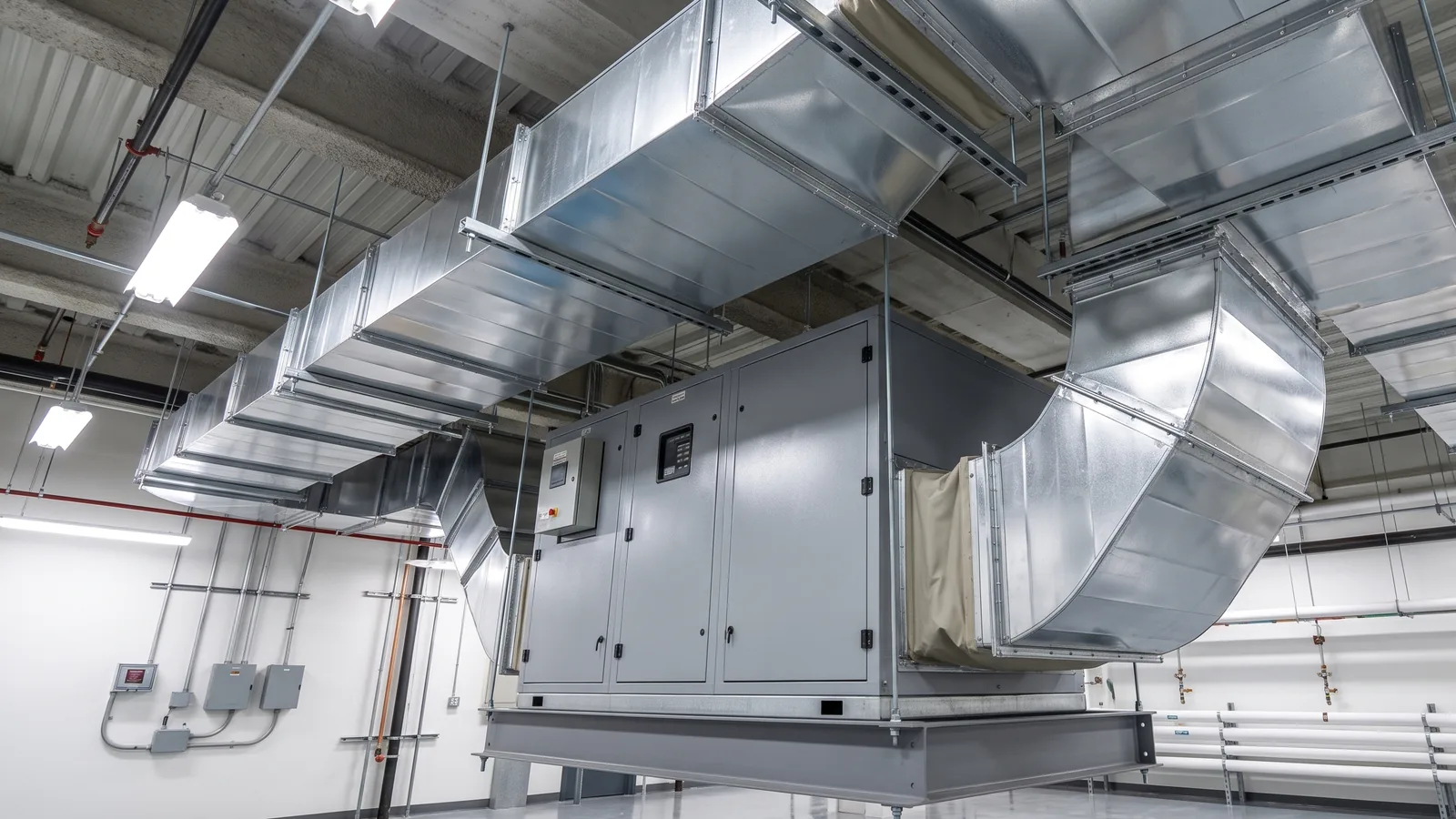
Ultrasonic humidification technology creates water vapour through high-frequency vibrations rather than heat or evaporation. This process delivers precise humidity control for commercial and industrial environments while consuming far less energy than traditional steam-based systems.
Core Technology Behind Ultrasonic Humidification
Ultrasonic humidifiers operate by vibrating a piezoelectric transducer at frequencies typically around 1.7 MHz, creating microscopic water droplets that disperse as a fine mist. The transducer converts electrical energy into mechanical vibrations, breaking surface tension and atomising water without requiring heat.
Two physical phenomena drive the atomisation process. Cavitation bubbles form and implode near the vibrating surface, while Rayleigh surface waves eject droplets from the water film.
Together, these forces overcome surface tension and shatter liquid water into a cloud of particles.
| Component | Function | Maintenance Interval |
|---|---|---|
| Piezoelectric Disc | Creates ultrasonic vibrations | 12-24 months |
| Water Chamber | Holds water for atomisation | Weekly cleaning |
| Control Board | Manages frequency and output | Annual inspection |
| Distribution Fan | Disperses mist into space | Quarterly cleaning |
The atomisation process produces droplets typically measuring 1-5 microns in diameter, small enough to remain suspended in air until complete evaporation. This particle size ensures rapid absorption into the environment without creating wet surfaces or condensation issues.
Because no heating element is involved, the entire process is adiabatic. Water converts to mist and then evaporates at ambient temperature, which is one reason ultrasonic humidification systems draw a fraction of the energy that steam units require.
How Ultrasonic Systems Compare to Steam and Evaporative Units
Facility managers evaluating humidification options typically weigh ultrasonic technology against steam generators and evaporative units. Each approach suits different operating conditions, and understanding the trade-offs helps match the right system to the application.
| Factor | Ultrasonic | Steam | Evaporative |
|---|---|---|---|
| Energy consumption | Low (no heating element) | High (boils water) | Moderate (fan-driven) |
| Noise output | Very low | Moderate to high | Moderate (fan noise) |
| Water treatment needed | Yes (RO or demineralised) | Minimal | Moderate (filter pads) |
| Humidity precision | High | High | Lower (depends on airflow) |
| Startup time | Seconds | Minutes (boil-up lag) | Seconds |
| Burn risk | None (cool mist) | Yes (hot steam) | None |
Steam systems remain the default in some pharmaceutical and healthcare settings where sterile output matters more than energy cost. Evaporative units suit large open warehouses where close humidity control is less critical.
For applications demanding tight control, low energy draw, and quiet operation, ultrasonic is the strongest fit.
A broader look at how dehumidifiers and humidifiers work together in commercial environments explains where each technology fits within a facility-wide moisture strategy.
Water Quality Requirements for Commercial Systems
Water quality directly impacts ultrasonic humidifier performance and maintenance requirements. High mineral content in feed water leads to white dust formation and accelerated component wear, making water treatment essential for most commercial applications.
- Total Dissolved Solids (TDS) should remain below 50 ppm per manufacturer guidelines for optimal operation
- Calcium and magnesium levels require monitoring to prevent scale buildup
- pH levels between 6.5 and 8.5 prevent corrosion of internal components
- Bacterial contamination requires UV sterilisation or regular biocide treatment
Reverse osmosis systems provide comprehensive water treatment, typically removing upwards of 95% of dissolved minerals. For facilities with existing RO infrastructure, ultrasonic systems integrate seamlessly with treated water supplies to minimise maintenance.
Indoor Air Quality and Mineral Particle Management
Ultrasonic humidifiers atomise everything dissolved in the feed water, not just the water itself. When untreated tap water passes through the transducer, dissolved minerals such as calcium, sodium, and magnesium are released into the air as fine particulate matter.
Research published by the U.S. Environmental Protection Agency confirms that indoor sources of fine particles, including humidifiers running untreated water, can push PM2.5 concentrations well above typical ambient thresholds.
Commercial installations avoid this problem through water treatment.
Reverse osmosis reduces dissolved solids by roughly 95% according to manufacturer specifications, and deionised water cuts airborne particle output significantly compared with raw tap water. The table below summarises how different water sources affect particle generation.
| Water Source | Typical TDS (ppm) | Relative Particle Output | Suitability for Commercial Use |
|---|---|---|---|
| Raw tap water | 150-400 | High | Not recommended |
| Filtered tap water | 80-200 | Moderate | Acceptable for non-critical spaces |
| Reverse osmosis | 5-20 | Low | Standard commercial specification |
| Deionised water | <1 | Negligible | Required for cleanrooms and pharma |
Facilities operating in regulated environments, such as pharmaceutical manufacturing plants and cleanroom environments, pair ultrasonic systems with deionised or ultrapure water supplies as standard practice. This eliminates mineral aerosolisation entirely and keeps indoor air quality within compliance thresholds.
Microbial control matters just as much as mineral management. Stagnant water in humidifier reservoirs can harbour bacteria within days, as noted in ASHRAE’s HVAC Applications Handbook guidance on humidifier hygiene.
Commercial systems address this through continuous-flow designs that prevent water from sitting idle, UV sterilisation modules that treat water before it reaches the transducer, and automated drain cycles that flush the reservoir on a set schedule.
Energy Efficiency and Operating Costs
Ultrasonic technology draws a fraction of the power steam humidifiers consume because it never boils water. A typical 10 kg/hour ultrasonic unit draws roughly 300-400 watts compared with 7-8 kilowatts for equivalent steam capacity.
The table below shows indicative comparisons based on commercial product data and an assumed electricity rate of $0.30 per kWh.
| Output Capacity | Ultrasonic Power Draw | Steam Power Draw | Annual Energy Savings (est.) |
|---|---|---|---|
| 5 kg/hour | 150 W | 3.7 kW | $4,200 |
| 10 kg/hour | 350 W | 7.5 kW | $8,500 |
| 20 kg/hour | 700 W | 15 kW | $17,000 |
| 50 kg/hour | 1.8 kW | 37 kW | $42,000 |
Additional savings come from reduced maintenance requirements and longer equipment lifespan compared to electrode or resistance steam systems.
Industrial Applications and Performance Parameters
Different industries require specific humidity levels and distribution patterns to maintain product quality and process efficiency. Ultrasonic systems excel in applications requiring precise control within narrow humidity bands.
- Printing facilities: 45-55% RH prevents static electricity and paper curl. Ultrasonic humidifiers address several paper handling problems in commercial printing that static and moisture imbalance create.
- Electronics manufacturing: 35-45% RH for electrostatic discharge protection. Facilities producing circuit boards or assembling components benefit from using ultrasonic humidifiers for static control in electronics production.
- Pharmaceutical production: 40-60% RH maintains tablet integrity and coating consistency.
- Food processing: 60-80% RH reduces product weight loss and maintains freshness. In cheese maturation, for example, precision ultrasonic humidification at Milawa Cheese demonstrated how tightly controlled systems protect product quality over extended ageing periods.
- Bakery proving rooms: 75-85% RH supports proper dough fermentation. Industrial humidifiers designed for bakery proving environments maintain the stable conditions that consistent product quality depends on.
- Textile manufacturing: 55-65% RH prevents fibre breakage and static buildup. Humidity control in textile manufacturing facilities covers the specific challenges and solutions for these environments.
- Cigar storage and humidors: 65-72% RH preserves tobacco leaf moisture and prevents cracking. Ultrasonic humidifiers in commercial cigar humidors deliver the narrow humidity band that premium tobacco storage demands.
- Greenhouses: 60-80% RH supports plant transpiration and reduces heat stress. Industrial humidifiers scaled for large greenhouse operations provide uniform coverage across growing areas where evaporative systems often leave dry pockets.
- Data centres: 40-50% RH protects sensitive equipment from static discharge.
For larger industrial spaces, commercial-grade ultrasonic humidification systems offer modular configurations that scale to match facility requirements. These systems integrate with building management systems for automated control and monitoring.
Installation Considerations for Commercial Facilities
Proper installation ensures optimal performance and minimises operational disruption. Key factors include water supply quality, electrical capacity, drainage provisions, and air circulation patterns within the target space.
| Installation Factor | Requirement | Impact on Performance |
|---|---|---|
| Mounting Height | 2.5-4 metres above floor | Ensures proper mist dispersion |
| Water Pressure | 200-500 kPa | Maintains consistent output |
| Electrical Supply | 240 V single phase or 415 V three phase | Prevents voltage fluctuations |
| Drainage | Floor drain within 3 metres | Handles overflow and cleaning |
Professional installation teams assess airflow patterns to optimise nozzle placement and prevent localised over-humidification. This analysis is especially important in facilities with complex air handling systems or variable occupancy patterns.
Maintenance Requirements and Operational Longevity
Regular maintenance extends equipment life and maintains consistent performance. Ultrasonic systems require less frequent servicing than steam-based alternatives but benefit from structured maintenance programmes.
- Daily: Visual inspection of water levels and mist output
- Weekly: Clean water chamber and check for mineral deposits
- Monthly: Test hygrostat calibration and control functions
- Quarterly: Replace water filters and inspect distribution nozzles
- Annually: Replace piezoelectric discs and service control systems
Facilities that follow a structured maintenance programme commonly see operational lifespans exceeding 10 years for quality ultrasonic systems. This longevity, combined with low energy consumption, delivers attractive total cost of ownership compared to alternative technologies.
Selecting the Right System Capacity
Calculating required humidification capacity involves analysing space volume, air exchange rates, existing humidity levels, and target conditions. Professional assessment ensures systems neither underperform nor waste energy through oversizing.
Key calculation factors include:
- Room volume in cubic metres
- Air changes per hour from ventilation systems
- Temperature differential between supply and room air
- Moisture load from processes or occupants
- Insulation quality and vapour barriers
For complex industrial environments where both excess and insufficient moisture cause problems, combining ultrasonic humidification with dehumidification gives operators full control regardless of seasonal variation or process changes.
Frequently Asked Questions
How does an ultrasonic humidifier work step by step?
Water feeds into a reservoir where it flows across a piezoelectric transducer disc. The disc vibrates at approximately 1.7 million cycles per second, creating cavitation bubbles and surface waves that shatter the water into droplets between 1 and 5 microns in diameter.
A low-speed fan then pushes this mist into the surrounding air, where the droplets evaporate and raise humidity levels. The entire process runs at ambient temperature with no heating element involved.
Can ultrasonic humidifiers use tap water?
Tap water works in residential units but creates problems in commercial systems. Dissolved minerals leave white dust on surfaces and accelerate transducer wear.
Commercial installations should use reverse osmosis or demineralised water to keep TDS below 50 ppm and extend equipment life.
Are ultrasonic humidifiers safe for food production areas?
Yes, provided the water supply is treated and the system includes UV sterilisation or biocide dosing to control microbial growth. The cool mist output eliminates burn risk, and precise RH control helps maintain food safety compliance.
Wine barrel storage facilities are one example where ultrasonic humidifiers reduce product loss while meeting hygiene standards.
Are ultrasonic humidifiers safe in commercial environments?
Commercial ultrasonic humidifiers are safe when operated with treated water and proper maintenance. The main concern with untreated water is mineral particle aerosolisation, which commercial systems eliminate through RO or deionised water feeds.
Cool mist operation removes burn hazards present with steam systems, and automated drain cycles prevent microbial buildup in reservoirs.
How loud are commercial ultrasonic humidifiers?
Ultrasonic humidifiers are among the quietest commercial humidity control options. They produce minimal mechanical noise because the vibrations occur at frequencies above the range of human hearing, and the only audible component is the low-speed distribution fan.
What is white dust from an ultrasonic humidifier?
White dust is a fine mineral residue left behind when dissolved solids in untreated water are atomised and deposited on nearby surfaces. It is not harmful in most settings, but in electronics manufacturing or cleanroom environments it can contaminate products.
Using demineralised or RO-treated water eliminates the issue.
How long do piezoelectric transducers last?
In a well-maintained commercial system running treated water, transducers typically last 12 to 24 months before replacement. Hard water and inconsistent cleaning shorten that lifespan.
Replacement is straightforward, and most systems are designed for quick disc swaps without major disassembly.
What is the difference between ultrasonic and evaporative humidifiers?
Ultrasonic humidifiers use a vibrating transducer to break water into a fine mist, while evaporative units blow air through a wet filter or wick pad and rely on natural evaporation. Ultrasonic systems offer tighter humidity control, quieter operation, and lower energy draw.
Evaporative systems self-regulate (output drops as humidity rises) and do not require treated water, but they need regular pad replacement and produce more fan noise.
Do ultrasonic humidifiers work in cold environments?
Ultrasonic humidifiers function across a wide temperature range because they do not rely on evaporation or heating. In cold storage, ripening rooms, and other low-temperature facilities they continue to produce consistent mist output where evaporative systems would struggle.
Can ultrasonic humidifiers connect to a building management system?
Commercial-grade ultrasonic units typically support BACnet, Modbus, or 0-10 V analogue connections for integration with building management systems (BMS). This allows centralised monitoring of humidity levels, automated setpoint adjustment based on occupancy or process schedules, and alarm triggering when readings drift outside the target band.
Contact Moisture Cure Commercial for a site assessment and customised ultrasonic humidification recommendation. Our technical specialists analyse your facility requirements and recommend systems matched to your capacity, water quality, and control needs.