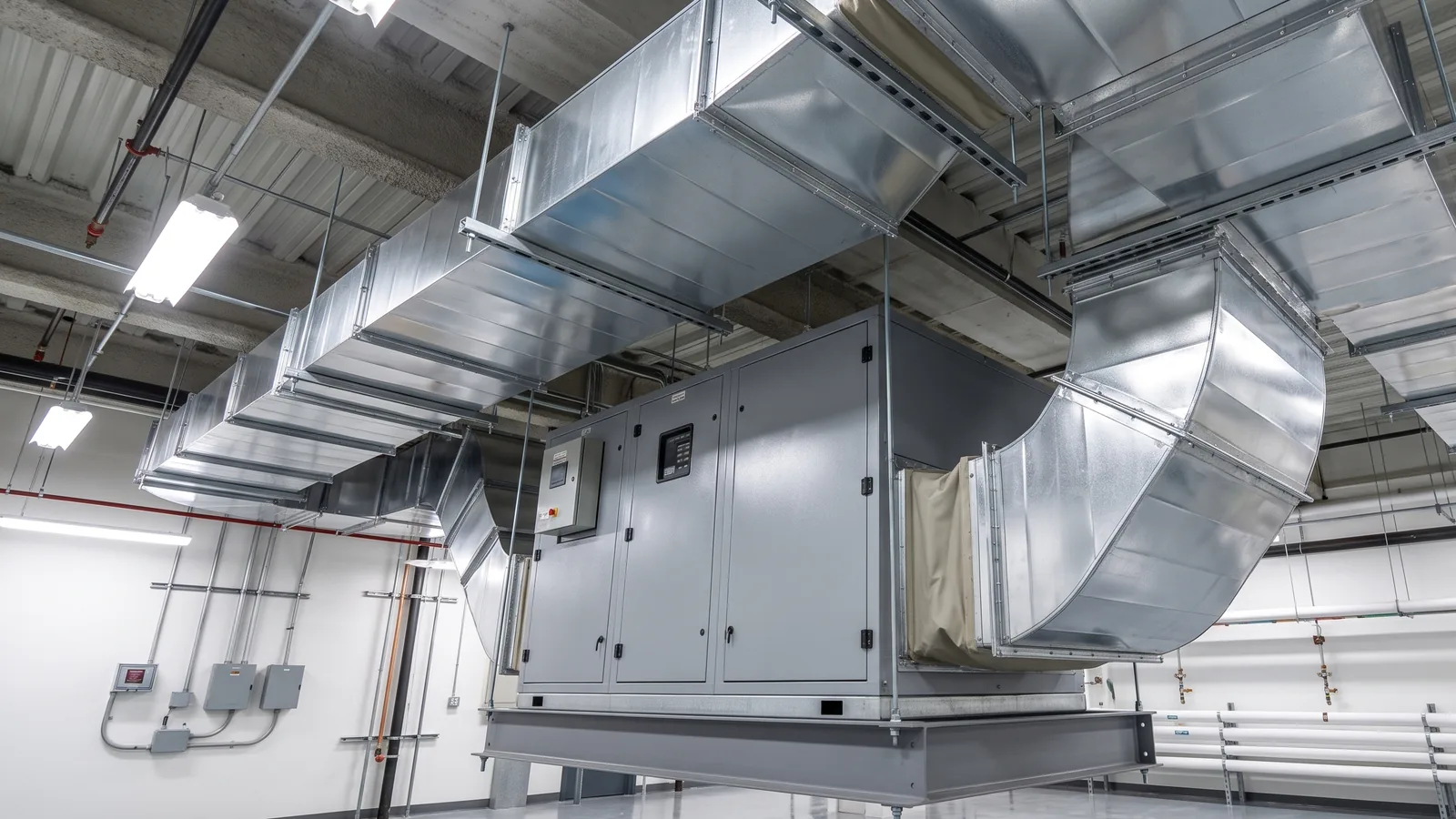
A desiccant dehumidifier is a moisture-removal system that uses a sorbent rotor to strip water vapour from air. Instead of cooling air below its dew point, the technology transfers moisture onto a hygroscopic surface and then drives it off with heat in a separate airstream. That separation makes desiccant systems useful when a commercial facility needs a low supply-air dew point, dependable operation in cold conditions or humidity control that is independent of sensible cooling.
The rotor is only one part of the system. Delivered performance also depends on airflow, seals, reactivation heat, controls and the building’s moisture load.
How desiccant dehumidification works
A desiccant rotor has a large internal surface coated or impregnated with a hygroscopic material, commonly a silica-gel composite. Water molecules adhere to that surface through adsorption, which IUPAC defines as an increase in concentration at an interface.
The rotor turns slowly between two separated air paths. One path dries the process air while the other removes the collected water vapour, allowing the cycle to continue without waiting for a tank or coil to defrost.
| Part of the cycle | What happens | What the facility receives |
|---|---|---|
| Process air | Humid air crosses the active portion of the rotor and water vapour adheres to the desiccant surface. | Air with a lower moisture content and dew point |
| Rotor movement | The moisture-loaded section rotates out of the process stream and into the reactivation stream. | Continuous rather than batch moisture removal |
| Reactivation | Heated air drives water vapour from the desiccant and carries it away through an exhaust duct. | A regenerated section ready to adsorb moisture again |
| Purge or heat recovery | Some designs recover heat or condition part of the airflow before full reactivation. | Lower reactivation demand where the design and duty allow it |
Why temperature and dew point change the technology choice
Refrigerant and desiccant dehumidifiers remove moisture in different ways. A refrigerant unit cools air below its dew point so water condenses on a coil, while a desiccant unit transfers water vapour onto a sorbent surface.
That distinction matters in cold rooms and low-dew-point processes. Coil-based capacity can fall as entering-air temperature and moisture content drop, whereas a correctly selected desiccant rotor can continue producing dry air without a refrigeration defrost cycle.
| Operating requirement | Technology usually considered first | Engineering reason |
|---|---|---|
| Warm, humid air with a moderate humidity target | A refrigerant system designed to condense moisture at the cooling coil | Latent moisture removal can be efficient when coil conditions remain favourable. |
| Cold space or low supply-air dew point | Desiccant | Moisture removal does not rely on maintaining a cold condensing surface. |
| Cooling and deep drying are both required | Hybrid | Cooling coils can manage sensible load while the rotor manages the low-dew-point duty. |
Actual selection depends on entering-air conditions, target dew point, available heat, operating hours and system layout.
Why heating or ventilation alone does not remove moisture
Facility managers sometimes try to control condensation by raising the air temperature or increasing outside-air ventilation. Both approaches lower relative humidity temporarily, but neither actually removes water vapour from the space.
Heating shifts the air’s capacity to hold moisture without reducing the absolute moisture content. Once the heated zone cools, the relative humidity climbs back to where it started, and any surface below the dew point still collects condensation.
| Approach | What it changes | What it does not change |
|---|---|---|
| Space heating | Lowers relative humidity by raising air temperature | Absolute moisture content stays the same. Condensation risk returns when heating stops. |
| Outside-air ventilation | Dilutes indoor moisture when outdoor air is drier | Ineffective when outdoor humidity is equal to or higher than indoor levels, and raises heating or cooling load. |
| Desiccant dehumidification | Physically removes water vapour from the airstream via adsorption | Operates at any temperature and targets the actual moisture load rather than masking it. |
This is the practical reason desiccant systems are specified for cold stores, pharmaceutical clean rooms and commercial food drying operations where the moisture must leave the space, not just redistribute within it.
Core components and controls
A suitable rotor will still perform poorly if airflow is unbalanced or the seals leak. Check the full air path and control sequence during design.
- Desiccant rotor: provides the sorption surface and must suit the required dew point and process contaminants.
- Process fan and filters: move and clean the air being supplied to the controlled space.
- Reactivation heater and fan: provide the energy and airflow needed to release captured water vapour.
- Drive assembly and perimeter seals: keep the rotor moving and limit leakage between wet and dry air paths.
- Sensors and controls: modulate output against dew point, relative humidity, airflow, temperature or a process demand signal.
- Ducts and dampers: distribute dry air, bring back return air where required and discharge the wet reactivation air safely.
Airflow and regeneration conditions interact, so a single generic efficiency figure is not enough. Experimental research into desiccant-wheel inlet conditions documents this relationship.
Where the technology fits commercial operations
Desiccant suitability comes down to the process moisture load, operating temperature and required dew point.
| Commercial setting | Moisture-control problem | Why a desiccant system may fit |
|---|---|---|
| Cold storage and freezer access areas | Frost, fog and condensation caused by humid infiltration air | Dry air can be supplied at low ambient temperatures. |
| Pharmaceutical and food production | Moisture-sensitive ingredients, packaging or process steps | The system can be selected around a defined process-air dew point for pharmaceutical manufacturing. |
| Electronics and battery dry rooms | Very low moisture limits during handling or assembly | Rotor systems can form part of a staged, low-dew-point air treatment design. |
| Archives, galleries and storage facilities | Seasonal moisture swings and material sensitivity | Dedicated latent control can operate separately from room cooling. |
| Mining, marine and energy assets | Corrosion risk during storage, shutdown or transport | Dry-air distribution can protect enclosed mining equipment without heating the whole volume. |
Temporary and large-volume jobs need a measured moisture-load calculation and a workable air-distribution plan. Moisture Cure’s large-scale dehumidifier deployment for LNG operations illustrates the practical effect of equipment numbers, duct runs and site access.
Integration with HVAC and process systems
A stand-alone machine may be enough for one zone. Larger systems often need ducted distribution or coordination with an air-handling unit, with the layout designed to prevent short-circuiting, outside-air leakage and reactivation exhaust entering the intake.
- Define whether the unit will treat outside air, return air, a mixed stream or a closed process loop.
- Locate supply and return points so dry air reaches the moisture source rather than only the nearest sensor.
- Confirm available external static pressure before finalising ducts, filters and dampers.
- Interlock fans, heaters, fire controls and plant enable signals in a safe start-up and shutdown sequence.
- Use dew-point control for low-moisture processes where relative humidity would vary with temperature.
Where central distribution is required, a ducted system configured around the building’s airflow and control requirements can serve several zones without relying on portable units.
Energy use and reactivation design
Desiccant systems need heat to regenerate the rotor, so energy assessment starts with the required reactivation temperature, airflow and operating hours. Nameplate power alone can be misleading if the reactivation heater runs at full output during periods of low moisture demand.
| Design option | What to assess | Potential benefit |
|---|---|---|
| Electric reactivation | Electrical capacity, tariff and modulation range | Simple control and installation where sufficient power is available |
| Gas, steam or hot-water reactivation | Existing plant, temperature availability and safety requirements | May use an established site energy source |
| Recoverable process heat | Temperature, availability and coincidence with dehumidification demand | Can reduce purchased reactivation energy when the heat source is dependable |
| Purge and heat-recovery arrangements | Target dew point, leakage, pressure balance and equipment design | Can reduce reactivation load or improve dry-air performance |
| Demand-based controls | Sensor location, setpoint deadband and production schedule | Avoids running maximum output when conditions are already within target |
Savings depend on the duty, controls and heat source, so they should be modelled for the site. This overview of commercial dehumidification advances in controls and heat recovery covers other options worth considering during design.
Maintenance and performance verification
A desiccant wheel is regenerated during normal operation, but the system is not maintenance-free. Dust loading, damaged seals, drive faults, heater problems and airflow imbalance can all reduce delivered performance.
| Inspection point | What to check | Useful evidence |
|---|---|---|
| Filters and air paths | Loading, blockage and unexpected pressure loss | Differential pressure and airflow readings |
| Rotor, drive and seals | Rotation, belt condition, contamination, wear and air bypass | Visual inspection and drive alarms |
| Reactivation circuit | Heater output, fan operation and exhaust path | Temperature and airflow measurements |
| Dry-air performance | Whether supply conditions meet the design requirement | Calibrated supply and return dew-point readings |
| Controls | Sensor drift, setpoints, interlocks and modulation | Calibration records and trend logs |
Maintenance frequency should follow the equipment manual and the site’s contamination level, operating hours and criticality. For a structured approach to scheduling inspections and component checks, see desiccant dehumidifier maintenance and service intervals.
Selecting a commercial desiccant dehumidifier
Size the unit from the moisture entering and generated within the space. The calculation must also test whether air distribution will maintain the target condition at the critical point.
- Required room condition and supply-air dew point
- Space volume, infiltration and door-opening patterns
- Process moisture generation and production schedule
- Entering-air temperature and humidity across seasonal extremes
- Available reactivation energy and exhaust route
- Duct pressure, filtration and air-distribution constraints
- Controls integration, redundancy and alarm requirements
Moisture Cure Commercial’s commercial rotor-based systems for cold and low-dew-point duties suit projects where adsorption technology matches the operating envelope. The broader commercial dehumidification range for engineered facility applications also allows desiccant, refrigerant and ducted options to be assessed against the same site data.
Frequently asked questions
How do desiccant dehumidifiers work?
The unit passes humid process air through a rotating sorbent wheel, where water vapour adheres to the desiccant surface. A separate heated airstream then releases that moisture and exhausts it outside while the rotor continues turning.
What are the disadvantages of a desiccant dehumidifier?
The system needs reactivation heat and normally requires separate process and exhaust air paths. It can also add heat to the dry supply air, so the complete design may need cooling, heat recovery or tighter modulation to keep the space comfortable.
When is a desiccant unit better than a refrigerant unit?
It is usually considered when the space is cold, the target dew point is low or moisture control must be separated from cooling. Refrigerant equipment may be the better first option for warmer, humid conditions with a moderate target.
Do you have to replace the desiccant?
The rotor is regenerated continuously, so the desiccant is not consumed on every pass. Replacement should be based on contamination, physical condition and verified loss of performance rather than an assumed calendar interval.
How long does a commercial desiccant dehumidifier last?
There is no useful universal lifespan because duty cycle, contaminants, maintenance, heat exposure and component availability vary between sites. Procurement teams should ask for service requirements, parts support and performance-verification procedures for the proposed model.
What information is needed to size the system?
A supplier needs the target condition, design temperatures, infiltration, process moisture load, operating schedule and available energy sources. Air-distribution constraints and required redundancy also affect the final equipment and duct selection.
What desiccant materials are used in commercial rotors?
Most commercial rotors use a silica-gel composite bonded to a honeycomb substrate. Some applications call for molecular-sieve or lithium-chloride rotors, which can reach lower dew points but may need higher reactivation temperatures. The material choice depends on the required outlet moisture level and the contaminants present in the process air.
Does a desiccant dehumidifier add heat to the supply air?
The adsorption process releases a small amount of heat of sorption, and some conducted heat can cross from the reactivation side to the process side through the rotor. In practice, the dry supply air leaves the rotor warmer than it entered. Post-cooling or a heat-recovery wheel can bring that temperature back down where the process or space requires it.
Can a desiccant dehumidifier work alongside an existing air-conditioning system?
It can, and that combination is common in facilities where both temperature and moisture targets matter. The air-conditioning system handles the sensible cooling load while the desiccant unit handles the latent moisture load. Coordination between the two prevents one system from working against the other.
Plan the system around measured site conditions
Select the rotor, airflow, reactivation circuit and controls against the same design conditions. Room area and headline extraction ratings do not reveal the actual moisture load or required supply-air condition.
- Confirm the moisture source and target dew point.
- Measure or calculate peak design conditions.
- Compare technology and energy options on the same duty.
- Commission the installed system against measured supply and room conditions.
Send Moisture Cure Commercial’s technical team the target dew point, design conditions and available services for a system recommendation. Arrange a consultation or commercial site assessment if the moisture load or installation constraints still need to be confirmed.