According to the Food and Agriculture Organisation (FAO), approximately 1.3 billion tonnes of food is lost globally during post-harvest operations each year. For agricultural storage facilities, maintaining correct humidity levels is the single most controllable factor in preventing crop degradation, mould contamination, and weight loss. Crop deterioration accelerates rapidly once environmental conditions exceed safe thresholds, making proactive humidity management critical for protecting stored value.
Our commercial humidification solutions and desiccant dehumidification systems address both sides of this challenge for crop storage applications across Australia.
Humidity Challenges in Australian Crop Storage
Australian agricultural operations face distinct humidity control challenges created by the country’s diverse climate zones. Tropical northern grain belts contend with persistent high humidity that drives storage moisture above safe thresholds, while southern produce regions experience wide day-night temperature swings that create condensation risks.
Temperature and humidity interact in ways that compound storage problems. Warm, humid conditions above 70% RH and 20°C create ideal environments for storage moulds and insects. Cooling stored grain or produce without active humidity management causes moisture to migrate and condense on cooler surfaces, triggering localised spoilage.
Common humidity-related storage failures include:
- Grain facilities experiencing mycotoxin contamination when moisture content exceeds 14%
- Root vegetable stores developing bacterial soft rot in uncontrolled humidity
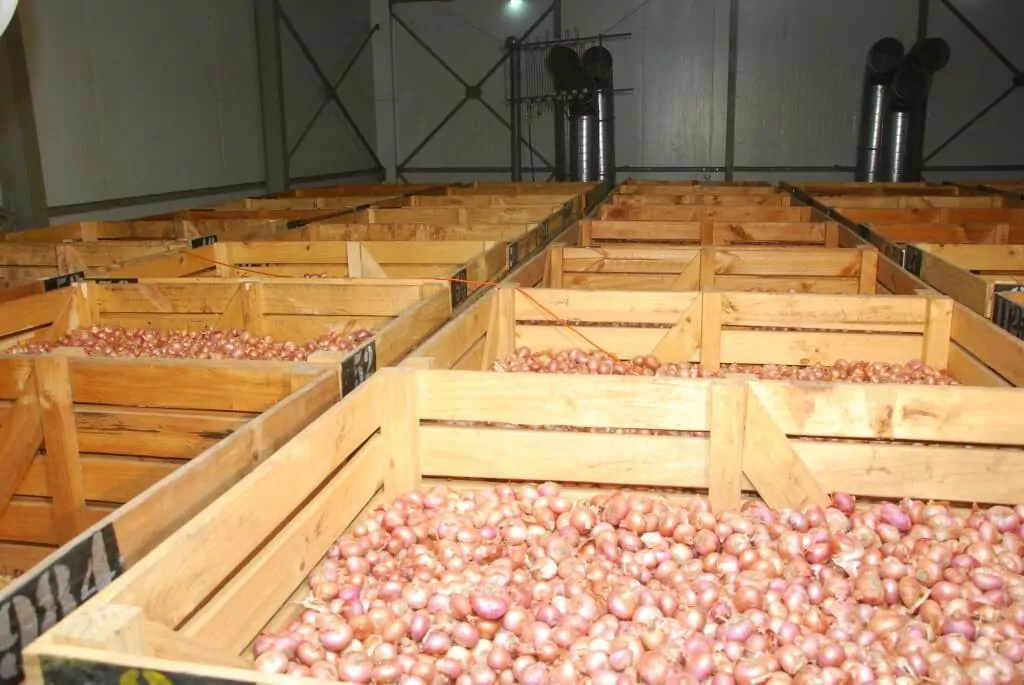
- Onion warehouses losing 20-25% of inventory through weight loss, sprouting, and decay
- Cold-stored fruit suffering accelerated ripening and quality degradation, with colour changes, texture loss, and reduced nutritional value
- Insect populations thriving in warm, humid storage environments where temperature and RH are unmanaged
Each failure type requires specific humidity strategies tailored to product characteristics, storage temperature, and intended duration.
Humidity Requirements by Product Category
Different agricultural products demand precise environmental conditions to maintain commercial viability throughout storage. The table below shows target ranges based on University of Maine Extension and GRDC Australia guidelines.
| Product Category | Optimal RH / Moisture Content | Critical Control Points | Storage Duration |
|---|---|---|---|
| Cereal Grains | 12-14% grain moisture content | Moisture migration prevention, mould suppression | 6-12 months viable |
| Root Vegetables | 90-95% RH | Weight loss prevention, surface moisture retention | 4-8 months storage |
| Onions & Garlic | 65-70% RH | Dormancy maintenance, sprout suppression | 6-10 months possible |
| Apples & Pears | 90-95% RH | Respiration rate control, texture preservation | 8-12 months cold storage |
| Dried Products | 55-60% RH | Equilibrium moisture content, clumping prevention | 12-24 months shelf life |
These ranges are baseline requirements that facility managers must adjust for specific cultivars, harvest conditions, and target market specifications. The hygroscopic nature of stored crops means they constantly exchange moisture with surrounding air until equilibrium is reached, making active humidity control essential rather than optional.
When Crops Need Humidification vs Dehumidification
Crop storage presents a dual challenge that many facilities overlook. Depending on the product and storage conditions, you may need to add moisture to the air or remove it entirely.
Crops that require humidification (moisture added to the air):
- Fresh fruit and vegetables in cold stores, where refrigeration strips moisture and causes weight loss through dehydration. Ultrasonic humidifiers protect produce from dehydration during cold storage by maintaining RH at optimal levels without wetting surfaces.
- Root crops stored at low temperatures, where dry air leads to shrivelling and loss of market grade
- Produce undergoing post-harvest chilling, where rapid cooling can drop ambient RH below 80% and accelerate quality decline
Crops that require dehumidification (moisture removed from the air):
- Cereal grains and seeds in silos, where excess moisture above 14% triggers mould growth, mycotoxin contamination, and insect activity
- Dried herbs, spices, and processed products in ambient storage, including food drying operations that require precise moisture removal
- Any stored crop in high-humidity climate zones where ambient air pushes storage conditions above safe thresholds
Facilities storing multiple product categories often need both ultrasonic humidifiers and desiccant dehumidifiers operating in separate zones to maintain product-specific conditions across the facility.
Financial Impact of Poor Humidity Management
Uncontrolled humidity creates compounding financial losses beyond immediate crop damage. Research published in the journal Foods found that 50-60% of stored cereal grains can be lost due to technical inefficiencies in storage, while properly managed facilities reduce losses to 1-2%.
Direct cost impacts include:
- Product downgrading from premium to feed-grade classifications
- Complete write-offs of contaminated inventory
- Emergency reprocessing expenses for salvageable products
- Contract penalties for failing to meet delivery specifications
- Increased labour costs for sorting and quality control
Indirect costs often exceed direct losses through supply chain disruptions and lost market opportunities during peak pricing periods. Investing in proper humidity control equipment is consistently more cost-effective than remediation after crop damage has occurred.
Desiccant vs Refrigerant Systems for Crop Storage
The choice between desiccant and refrigerant dehumidification depends primarily on operating temperature. Refrigerant dehumidifiers lose effectiveness below 15°C as their evaporator coils ice over, making them unsuitable for cold storage applications where most perishable crops are held.
| System Type | Operating Range | Best Applications | Key Consideration |
|---|---|---|---|
| Desiccant (YAKE) | -20°C to +50°C | Cold stores, seed vaults, chilled produce | Full performance in sub-zero conditions |
| Refrigerant | 15°C to 35°C | Ambient warehouses, grain silos above 15°C | Lower operating cost in warm conditions, ineffective in cold stores |
For cold storage environments common across Australia’s fruit and vegetable supply chain, desiccant dehumidifiers are the only reliable option. Many larger facilities implement hybrid approaches, running desiccant units in cold zones and refrigerant systems in ambient warehouses to manage varying seasonal conditions.
Technology Selection and Implementation
Modern agricultural storage demands equipment capable of maintaining precise conditions across large volumes while operating continuously through extended storage seasons.
Key technology considerations include:
- Capacity sizing based on product respiration rates and facility air exchange requirements
- Temperature-independent operation for cold storage applications
- Remote monitoring and BMS integration for unmanned rural facilities
- Energy-efficient operation suitable for 24/7 running over entire storage seasons
- Corrosion-resistant construction for ammonia-rich or high-dust agricultural environments
Retrofitting existing facilities requires baseline humidity mapping across all storage zones, moisture load calculations based on product throughput, and airflow design to eliminate dead zones where humidity pockets form. Commissioning during low-inventory periods minimises operational disruption.
Maintenance and Regulatory Compliance
Agricultural environments create unique maintenance challenges due to dust, chemical exposure, and continuous operation demands.
Recommended maintenance intervals:
- Weekly: Filter condition checks and cleaning
- Monthly: Condensate drainage system inspection
- Quarterly: Calibration of humidity sensors
- Annually: Complete system performance testing and desiccant dehumidifier servicing
Australian storage facilities must meet HACCP requirements for temperature and humidity logging, export certification standards for specific destination markets, and organic certification environmental control protocols. Automated monitoring systems streamline compliance documentation while reducing administrative burden.
Frequently Asked Questions
What is the purpose of humidity control in crop storage?
Humidity control prevents two opposing problems. Excessive moisture triggers mould, mycotoxin contamination, and insect activity in grain storage. Insufficient moisture causes weight loss, shrivelling, and quality degradation in fresh produce and root crop storage.
What humidity level should be maintained for stored grain vs fresh produce?
Cereal grains require a moisture content of 12-14% (equivalent to approximately 65-70% ambient RH) for safe long-term storage. Fresh produce such as fruit and vegetables needs much higher humidity at 90-95% RH to prevent dehydration and weight loss.
Why do refrigerant dehumidifiers fail in cold storage?
Refrigerant dehumidifiers rely on cooling coils to condense moisture from the air. Below 15°C, these coils ice over and the unit stops extracting moisture effectively. Desiccant dehumidifiers use chemical adsorption instead, maintaining full performance from -20°C to +50°C.
How does humidification reduce weight loss in stored produce?
When cold storage systems cool produce, they also dry the air. This low-humidity air draws moisture from the crop surface, causing weight loss that directly reduces saleable volume. Humidification systems restore RH to 90-95%, slowing moisture transfer and preserving product mass.
Can one facility need both humidifiers and dehumidifiers?
Yes. Multi-product storage operations commonly require humidification in cold rooms holding fresh produce and dehumidification in ambient areas storing grain or dried goods. Zone-specific humidity control allows each crop type to be maintained at its optimal conditions.
How does Australia’s climate affect crop storage humidity requirements?
Australia’s diverse climate zones create different storage challenges. Tropical regions such as Far North Queensland have persistent high humidity that drives grain moisture above safe levels without active dehumidification.
Southern regions experience wider seasonal temperature swings, creating condensation risks in storage structures that lack humidity management. Both scenarios require tailored solutions rather than a one-size-fits-all approach.
Contact Moisture Cure Commercial for a comprehensive assessment of your agricultural storage facility. With over 20 years of experience in commercial humidity control, our specialists can specify the right combination of humidification and dehumidification systems for your crop types and storage conditions.