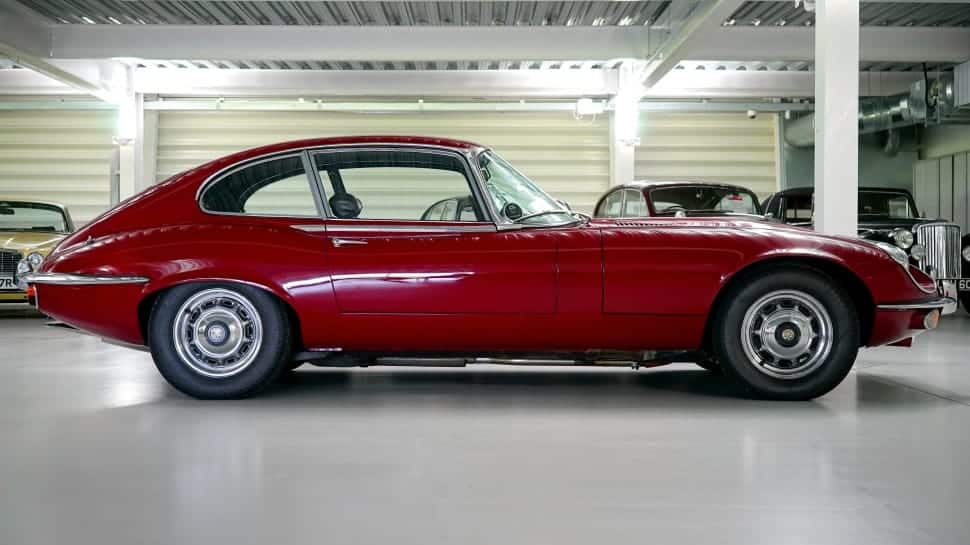
Classic car storage facilities face unique environmental challenges that directly impact vehicle preservation and asset value. Without proper humidity control, irreversible damage to valuable automotive collections can occur within weeks, affecting everything from chrome finishes to leather interiors.
Critical Humidity Risks in Vehicle Storage Environments
Classic vehicles contain diverse materials that react differently to moisture fluctuations. Each component requires specific humidity ranges to prevent deterioration while maintaining structural integrity.
| Vehicle Component | Excess Humidity Effects | Low Humidity Effects | Optimal RH Range |
|---|---|---|---|
| Chrome and metal finishes | Corrosion, pitting, rust spots | Minimal impact | 35-45% |
| Leather seats and trim | Mould growth, staining | Cracking, brittleness | 45-55% |
| Wooden dashboards | Warping, veneer lifting | Splitting, joint failure | 40-50% |
| Wiring and electronics | Corrosion, short circuits | Insulation brittleness | 35-50% |
| Rubber components | Premature degradation | Hardening, cracking | 45-55% |
According to corrosion research published by the National Institutes of Health, steel corrosion rates increase significantly once relative humidity exceeds 60%. Keeping storage facilities well below this threshold protects chrome, body panels, and structural metalwork from degradation.
Where Moisture Comes From in Storage Facilities
Understanding moisture sources is the first step toward controlling them. Even sealed storage buildings are subject to humidity fluctuations that can push conditions outside the safe range.
- Temperature swings between day and night cause condensation on metal surfaces and concrete floors
- Vehicles driven into storage after rain or washing introduce moisture directly into the space
- Unsealed concrete slabs wick ground moisture upward through capillary action
- Door openings during vehicle access admit outside air, which can carry high ambient humidity
- Occupant activity (breathing, foot traffic on wet floors) adds moisture load in staffed facilities
Many facility operators assume that controlling humidity in commercial vehicle garages is as simple as running air conditioning. In practice, air conditioning alone manages temperature but does not remove enough moisture to protect stored vehicles from corrosion and mould.
Environmental Control Standards for Premium Vehicle Collections
Professional storage facilities typically maintain relative humidity between 45-55% to balance protection across all vehicle components. The ASHRAE Handbook guidelines for preservation storage recommend holding mixed-material collections at around 50% RH with minimal fluctuation, a standard directly applicable to classic vehicle environments.
Temperature stability between 15-20°C complements humidity control by reducing condensation risks during seasonal transitions.
- Daily humidity variance should not exceed 5% to prevent material stress from expansion and contraction cycles
- Air circulation must reach all storage bays uniformly to prevent localised humidity pockets
- Monitoring systems should track conditions at multiple points throughout the facility
- Backup systems ensure continuous operation during equipment servicing
- Seasonal adjustments accommodate external climate changes, particularly in coastal and tropical regions of Australia
Calculating Dehumidification Requirements for Storage Facilities
Proper equipment sizing depends on facility volume, insulation quality, and local climate conditions. Storage facilities require different approaches based on their construction and vehicle capacity.
| Facility Size | Typical Capacity | Indicative Moisture Load | Equipment Type |
|---|---|---|---|
| 500-1,000 m² | 20-40 vehicles | 15-25 L/day | Commercial units |
| 1,000-2,500 m² | 40-100 vehicles | 25-60 L/day | Industrial systems |
| 2,500-5,000 m² | 100-200 vehicles | 60-120 L/day | Ducted solutions |
| 5,000+ m² | 200+ vehicles | 120+ L/day | Multi-zone systems |
These moisture loads are indicative and vary with local climate, insulation quality, and door-opening frequency. For help matching a unit to your facility, see our guide to sizing a commercial dehumidifier for your space.
Why Desiccant Dehumidifiers Suit Classic Car Storage
Car storage environments present conditions where desiccant dehumidifiers outperform refrigerant alternatives. Refrigerant (compressor) units rely on cooling air below its dew point to extract moisture. When ambient temperatures drop below about 15°C, the evaporator coils frost over and extraction rates collapse.
Desiccant units use a silica gel rotor to adsorb moisture directly from the air, operating effectively across a wide temperature range from -20°C to +50°C. This makes them the preferred choice for facilities that experience cool overnight conditions or unheated winter storage.
- Consistent performance regardless of temperature, unlike refrigerant units that lose effectiveness below 15°C
- No condensate tank to empty, as moisture is expelled via a regeneration air stream
- Quieter operation, maintaining the premium atmosphere expected in high-end storage facilities
- Lower maintenance requirements with fewer moving parts
Integration with Existing HVAC Infrastructure
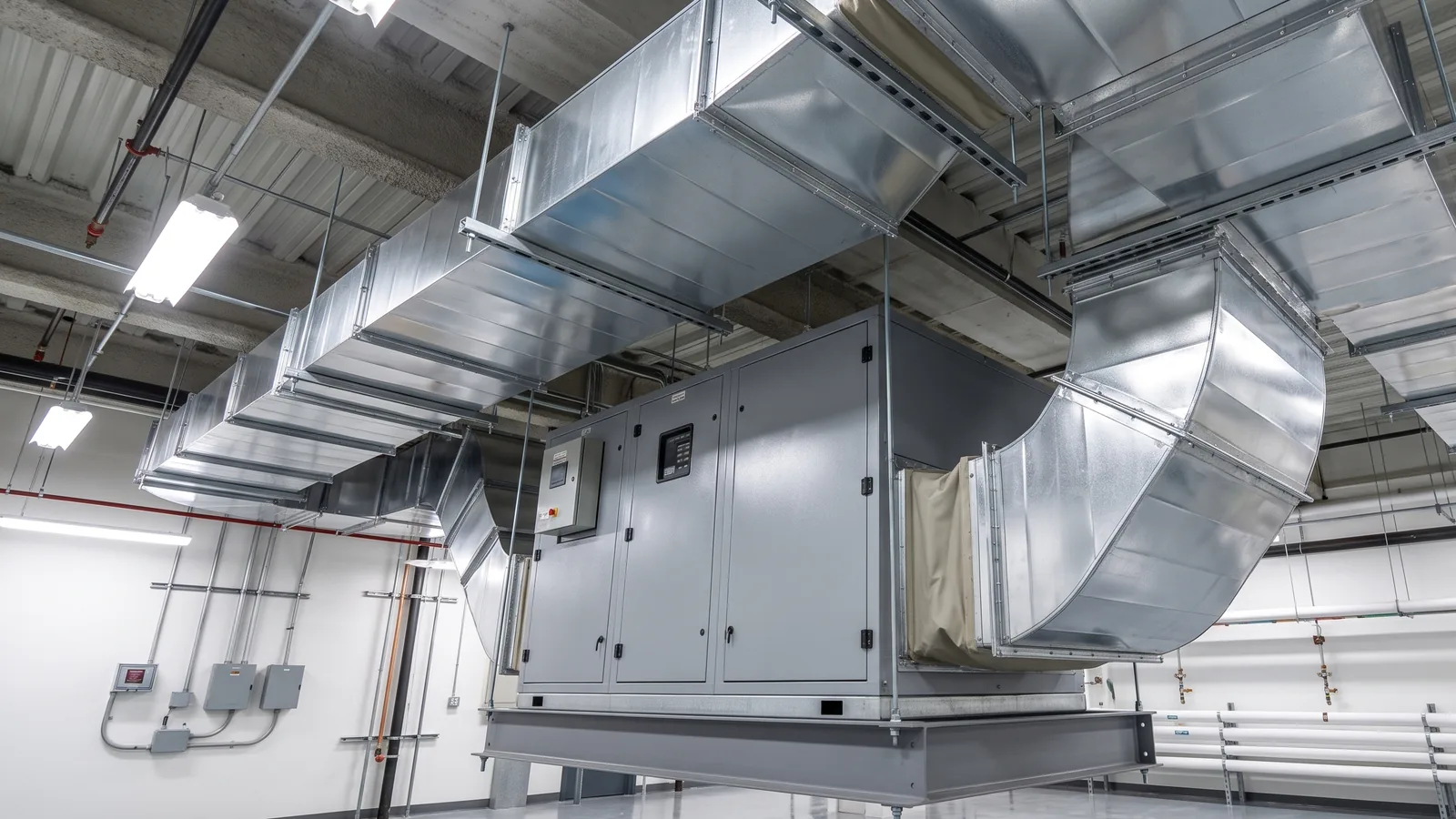
Most storage facilities benefit from integrating humidity control with existing climate systems. Ducted dehumidification solutions connect directly to air handling systems, providing centralised moisture control across multiple storage zones.
- Ducted systems eliminate the need for multiple standalone units
- Central control panels enable remote monitoring and adjustment
- Zone-specific humidity settings accommodate different vehicle requirements
- Energy recovery options reduce operational costs compared to heating-only approaches
- Quiet operation maintains the premium facility atmosphere
Monitoring and Maintenance Protocols
Continuous environmental monitoring prevents humidity excursions that could damage stored vehicles. Modern facilities implement comprehensive tracking systems with automated alerts for out-of-range conditions.
| Monitoring Parameter | Frequency | Alert Threshold | Response Time |
|---|---|---|---|
| Relative humidity | Continuous | ±5% from setpoint | Within 1 hour |
| Temperature | Continuous | ±3°C from setpoint | Within 1 hour |
| Equipment status | Hourly | Any fault code | Immediate |
| Filter condition | Weekly | 80% capacity | Within 48 hours |
| Drainage systems | Monthly | Any blockage | Within 24 hours |
Establishing a regular dehumidifier maintenance schedule extends equipment life and prevents gaps in protection that could expose vehicles to moisture damage.
Special Considerations for Long-Term Storage
Vehicles stored for extended periods face additional risks from stagnant air and localised humidity pockets. Proper air circulation and strategic equipment placement address these challenges effectively.
- Install circulation fans to prevent dead air zones around and under vehicles
- Position dehumidifiers to create consistent airflow patterns across all bays
- Use vapour barriers on unsealed concrete floors to reduce ground moisture ingress
- Implement regular vehicle rotation schedules when possible
- Avoid relying solely on car covers, which can trap moisture against surfaces and accelerate corrosion underneath
- Document environmental conditions continuously for insurance records and provenance files
For facilities requiring precise control across varying ambient conditions, desiccant dehumidification technology maintains performance even at low temperatures where refrigerant units struggle.
Return on Investment Through Asset Protection
Professional humidity control systems represent a fraction of the value they protect in classic car collections. Preventing just one instance of corrosion damage or interior deterioration can justify the infrastructure investment. The following ranges reflect typical costs reported by automotive restoration specialists.
| Protection Benefit | Risk Without Control | Typical Restoration Cost | Prevention Value |
|---|---|---|---|
| Chrome restoration | Surface pitting | $5,000-15,000 | Maintains originality |
| Leather reconditioning | Mould damage | $3,000-8,000 | Preserves patina |
| Electrical systems | Corrosion failure | $2,000-10,000 | Ensures reliability |
| Paint preservation | Moisture blistering | $10,000-50,000 | Protects authenticity |
Professional classic car storage facilities recognise that environmental control directly impacts their reputation and client retention. Understanding how dehumidifiers prevent corrosion across different facility types helps operators make informed decisions about equipment selection and placement.
Frequently Asked Questions
What humidity level should a classic car storage facility maintain?
Most preservation standards recommend maintaining relative humidity between 45-55%, with 50% as the ideal midpoint. This range balances protection for metal components (which need drier air) with leather and rubber (which crack if conditions become too dry). Daily fluctuations should stay within 5% of the setpoint to prevent material stress from repeated expansion and contraction.
Why are desiccant dehumidifiers preferred over refrigerant units for car storage?
Refrigerant dehumidifiers lose effectiveness when temperatures drop below about 15°C because their evaporator coils frost over. Classic car storage facilities often run unheated overnight or during winter, making desiccant units the more reliable choice. Desiccant technology operates consistently from -20°C to +50°C regardless of ambient temperature.
How does high humidity cause corrosion on classic cars?
When relative humidity exceeds 60%, a thin film of moisture forms on metal surfaces. This moisture film acts as an electrolyte, enabling electrochemical reactions that produce rust and pitting on chrome, steel, and aluminium components. Corrosion research shows that corrosion rates increase significantly above this 60% threshold.
What size dehumidifier does a classic car storage facility need?
Sizing depends on the facility volume, insulation quality, local climate, and how often doors are opened. As a general guide, a 500-1,000 m² facility storing 20-40 vehicles typically needs equipment capable of removing 15-25 litres of moisture per day.
Larger facilities with 100+ vehicles may require ducted systems handling 60-120+ litres daily. A site assessment ensures the unit matches the actual moisture load.
Can car covers protect vehicles from humidity damage in storage?
Car covers alone do not prevent humidity damage and can make it worse. Covers trap moisture against the vehicle surface, creating a microclimate where condensation forms and corrosion accelerates. In a humidity-controlled facility, breathable covers offer dust protection but are not a substitute for proper dehumidification.
Talk to Moisture Cure Commercial
Moisture Cure Commercial has supplied dehumidifiers and humidifiers to Australian businesses for over 20 years. Whether you need help selecting the right unit, sizing a system for your facility, or troubleshooting an existing setup, our team can help.
Call us on (02) 6584 2511 or browse our full range of humidity control solutions to find the right fit for your operation.