Every commercial dehumidifier sizing calculation starts with one number: air changes per hour.
Air changes per hour (ACH) determines how much airflow your dehumidifier needs to process the entire room volume within a set time. Get the ACH wrong and you either undersize the unit (it never reaches target humidity) or oversize it (wasted capital and energy).
This article walks through the ACH formula for dehumidifier sizing in metric units, with worked examples for Australian commercial and industrial facilities.
Looking for a general sizing overview first? Read our detailed guide to choosing the right dehumidifier size, or browse the full commercial dehumidifier range.
What Are Air Changes Per Hour for Dehumidifier Sizing
Air changes per hour (ACH) measures how many times the total air volume of a room passes through the dehumidifier in one hour. An ACH of 4 means the dehumidifier processes the full room volume four times every 60 minutes.
ACH for dehumidification is not the same as ACH for ventilation. Ventilation ACH (typically 0.35 to 1.0 for general buildings under AS 1668.2) measures how often fresh outside air replaces indoor air. Dehumidification ACH measures how often the total air volume cycles through the unit for moisture removal.
- Higher ACH means more passes through the dehumidifier per hour, removing moisture faster
- Lower ACH is sufficient for well-sealed, low-moisture spaces
- The required ACH depends on current humidity, building tightness, and the moisture load inside the space
Selecting the correct ACH value is the single most important step in dehumidifier sizing. Everything else flows from it.
The ACH Formula for Dehumidifier Sizing
The core calculation converts your room volume and required air changes into an airflow rate you can match against dehumidifier specifications.
Metric formula
Required airflow (m³/h) = Room volume (m³) × ACH
Imperial formula
Required airflow (CFM) = (Room volume in ft³ × ACH) ÷ 60
The steps are the same for both unit systems.
- Calculate room volume. Multiply length × width × ceiling height. For irregular shapes, break the space into rectangular sections and add them together.
- Select the appropriate ACH value. Use the humidity level table or the space type table below.
- Multiply volume by ACH. This gives you the required airflow in m³/h (or divide by 60 for CFM).
- Match to dehumidifier capacity. Compare your required airflow against the airflow and extraction rate in the unit’s data sheet.
Recommended ACH by humidity level
| Current relative humidity | Condition | Recommended ACH |
|---|---|---|
| 60–70% | Damp | 3 |
| 70–80% | Very damp | 4 |
| 80–90% | Wet | 5 |
| 90%+ | Extremely wet | 6 |
These values assume an average building envelope. Adjust upward for drafty or open-access buildings and downward for well-sealed enclosures.
Worked Example: Warehouse Dehumidifier Sizing
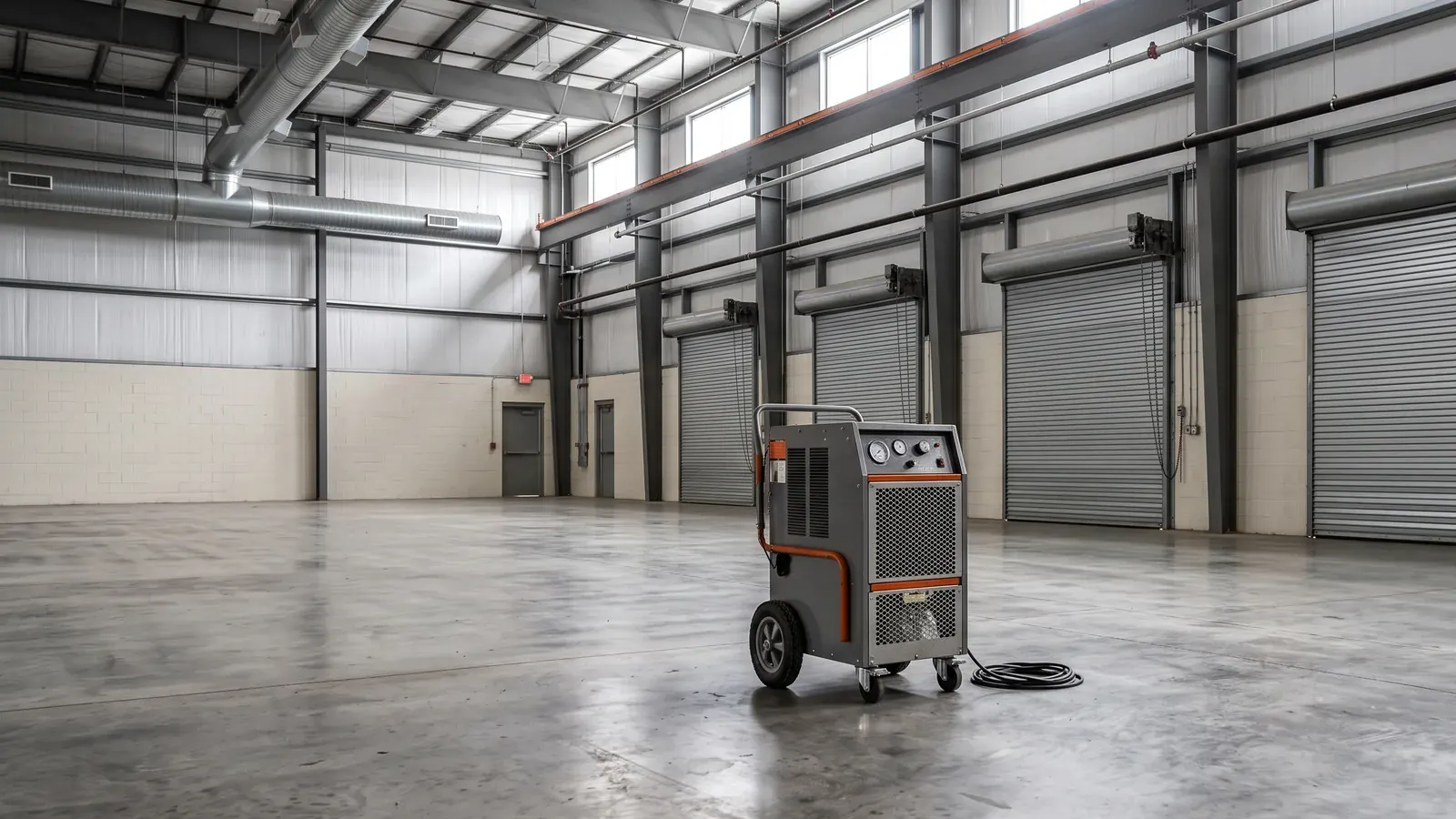
A distribution warehouse in western Sydney measures 20 m long, 15 m wide, and 5 m to the underside of the roof. Current relative humidity is sitting around 75% during summer.
- Room volume: 20 m × 15 m × 5 m = 1,500 m³ (52,972 ft³)
- ACH selection: 75% RH falls in the "very damp" range = 4 ACH
- Required airflow: 1,500 m³ × 4 = 6,000 m³/h (3,531 CFM)
- Match to equipment: Select a dehumidifier with at least 6,000 m³/h airflow capacity
For this scenario, a mid-range industrial desiccant dehumidifier with 6,000+ m³/h airflow and 20–30 L/day extraction would handle the load. If the warehouse has frequent door openings or forklift traffic, step up to 5 ACH (7,500 m³/h) to account for the extra infiltration.
Metric tip: Australian dehumidifier datasheets list airflow in m³/h and extraction in litres per day (L/day). If you encounter CFM or pints/day from overseas suppliers, multiply CFM by 1.699 to get m³/h, and multiply pints/day by 0.473 to get L/day.
Factors That Affect Your ACH Selection
The humidity-level table above gives a starting point. Several site-specific factors push the real requirement higher or lower.
Building envelope quality
- Tight/sealed building (new construction, vapour barriers, sealed doors): baseline ACH is sufficient. Infiltration rate around 8.8 m³/h per m² of envelope area.
- Average building (standard warehouse, some gaps around doors): add 15–25% to the calculated airflow. Infiltration around 25 m³/h per m².
- Loose/open building (old sheds, frequent door openings, open loading bays): add 30–50%. Infiltration around 50 m³/h per m².
Occupancy and process moisture
People add moisture. Each person releases roughly 100 g of water vapour per hour through breathing and perspiration (ASHRAE Handbook of Fundamentals). A facility with 50 workers adds approximately 5 kg/h of moisture that the dehumidifier must handle on top of the ambient load.
- Manufacturing processes that involve water (washing, coating, curing) add significant moisture loads
- Wet goods brought into the space (e.g. freshly poured concrete, damp timber, washed produce) release moisture as they dry
- Open water surfaces such as cooling tanks, wash bays, and pools continuously evaporate moisture into the air
Ventilation and fresh air requirements
Every litre of outside air brought in for ventilation carries its own moisture content. In tropical or coastal Australia, outdoor air at 28°C and 80% RH holds roughly 19 g of water per kilogram of dry air.
If AS 1668.2 requires mechanical ventilation at 7.5 L/s per person, that fresh air becomes an additional moisture load the dehumidifier must counteract.
Australian climate zone adjustments
- Tropical (Darwin, Cairns, Townsville): add 40–50% to the calculated capacity. Year-round high humidity and temperature.
- Coastal (Sydney, Brisbane, Perth): add 20–30%. Sustained humidity, especially through summer and autumn.
- Temperate (Melbourne, Adelaide): add 10–20%. Seasonal humidity peaks, particularly in autumn.
- Inland/arid: standard calculations are usually sufficient. Seasonal adjustments may apply during wet periods.
ACH Guidelines by Commercial and Industrial Space Type
Different facilities have different moisture profiles. The table below consolidates ACH recommendations, target relative humidity, and key considerations for common commercial and industrial applications.
| Space type | Recommended ACH | Target RH | Notes |
|---|---|---|---|
| General warehouse/storage | 4–8 | 40–55% | Higher ceilings increase total volume significantly |
| Manufacturing floor | 8–12 | 35–55% | Process moisture often dominates the load |
| Indoor pool/aquatic centre | 4–6 | 50–60% | Requires corrosion-resistant units and ducting |
| Cold storage (below 15°C) | 2–4 | 35–45% | Desiccant dehumidifiers required |
| Server room/data centre | 4–6 | 40–55% | Precision RH control protects equipment |
| Food processing | 6–10 | 30–50% | Hygiene code compliance drives tight control |
| Pharmaceutical/cleanroom | 10–20+ | 30–45% | HVAC system typically handles the ACH |
| Archives/museums | 2–4 | 35–55% | RH stability matters more than low RH |
These ranges account for typical moisture loads within each space type. Actual values should be confirmed with a site-specific assessment, especially for facilities with unusual moisture sources or strict regulatory requirements.
Moisture Cure Commercial provides free sizing assessments that factor in your specific building dimensions, climate zone, and operational conditions.
Choosing Between Desiccant and Refrigerant Dehumidifiers
Once you have the required airflow from your ACH calculation, the next decision is whether to use a desiccant or refrigerant dehumidifier. The operating temperature of your facility is the primary deciding factor.
- Refrigerant (condensation) dehumidifiers: extract moisture by cooling air below its dewpoint on refrigerated coils. Effective above 15–18°C, with highest extraction rates at elevated temperatures and humidity. Browse the refrigerant dehumidifier range for temperature-controlled spaces.
- Desiccant dehumidifiers: use a moisture-absorbing rotor to strip humidity from the air regardless of temperature. They operate from -20°C to +50°C and can achieve dewpoints below -60°C. Choose desiccant units for cold stores, unheated warehouses, and environments with wide temperature swings.
If the operating temperature drops below 15°C at any point during the year, a desiccant unit is the safer choice. Refrigerant dehumidifiers lose performance rapidly in cold conditions as their evaporator coils ice up.
For large facilities, ducted dehumidifier installations distribute dry air evenly across the space. Ducting is particularly important in racking-dense warehouses and L-shaped buildings where a single freestanding unit would leave dead zones.
When ACH Calculations Are Not Enough
The ACH method works well for standard commercial spaces with predictable moisture loads. In certain situations, a more detailed analysis is required.
- High process moisture loads: facilities with open wash lines, spray booths, or wet coating processes generate moisture faster than a simple ACH calculation accounts for
- Open water surfaces: pools, cooling tanks, and large wash bays need an evaporation rate calculation layered on top of the ACH figure
- Multiple simultaneous moisture sources: the total moisture load formula accounts for all inputs: W(total) = W(people) + W(process) + W(goods) + W(ventilation)
- Precision applications: pharmaceutical cleanrooms and semiconductor fabrication require psychrometric analysis to control both temperature and humidity simultaneously
In these cases, Moisture Cure Commercial can run a full latent-load analysis using your building data, process specifications, and local climate records. Read more in our comprehensive guide to industrial dehumidifier sizing.
What Happens When You Get the Sizing Wrong
Both undersizing and oversizing a dehumidifier carry real costs. The Australian Institute of Refrigeration, Air Conditioning and Heating (AIRAH) emphasises correct equipment sizing as the single most important factor in HVAC system performance.
| Problem | Undersized dehumidifier | Oversized dehumidifier |
|---|---|---|
| Runtime | Runs continuously, never reaches target RH | Short-cycles on and off repeatedly |
| Energy | High energy consumption with poor results | Wasted energy during idle cycles |
| Equipment life | Premature compressor or rotor failure (2–3× faster) | Reduced from excessive cycling |
| Moisture control | Target RH never achieved, damage continues | Achieves target but wastes capital |
| Cost | Ongoing damage costs exceed the unit price | Higher upfront purchase price than needed |
The best practice is to size for the worst-case moisture load your facility will encounter (peak summer in coastal locations, maximum process output) and use speed controllers or staging to reduce output during lighter loads.
When to Use Multiple Dehumidifiers
A single large dehumidifier is simpler to install and maintain. Multiple smaller units offer advantages in certain layouts.
- Large floor areas (1,000+ m²): two or more units placed at opposite ends provide more uniform RH across the space
- L-shaped or multi-room buildings: separate units prevent dead zones in areas the primary unit cannot reach
- Redundancy: if one unit fails, the remaining units maintain partial humidity control until the repair is complete
- Staged operation: run fewer units during drier months and bring additional units online during peak humidity seasons
When splitting capacity across multiple units, the combined airflow must still meet the total ACH requirement calculated for the space.
Get Your ACH Calculation Right the First Time
An accurate air changes per hour calculation is the foundation of every successful dehumidification project. The formula is straightforward, but the variables (building quality, climate zone, process loads) need site-specific data to get right.
Moisture Cure Commercial has over 28 years of experience sizing humidity control systems for Australian commercial and industrial facilities. Contact the team for a free sizing assessment based on your building dimensions, operating conditions, and target humidity levels.
Frequently Asked Questions
What is a good ACH for dehumidification?
For most commercial spaces, 3 to 6 air changes per hour. Damp spaces (60–70% RH) need a minimum of 3 ACH, while extremely wet spaces (90%+ RH) require 6 ACH. Well-sealed buildings need fewer changes than drafty or open-access ones.
How do I calculate the airflow needed for my dehumidifier?
Multiply your room volume by the recommended ACH. In metric: airflow (m³/h) = volume (m³) × ACH. In imperial: CFM = (volume in ft³ × ACH) ÷ 60. The result is the minimum airflow capacity your dehumidifier needs.
What happens if I choose a dehumidifier that is too small?
An undersized unit runs continuously without reaching your target humidity. Energy consumption stays high, the equipment wears out 2 to 3 times faster, and moisture-related damage (mould, corrosion, product degradation) continues unchecked.
Does ceiling height affect dehumidifier sizing?
Directly. A 500 m² floor area with 3 m ceilings has 1,500 m³ of air. The same floor area with 8 m ceilings has 4,000 m³. Higher volumes need proportionally larger dehumidifiers or higher ACH values to maintain the same humidity level.
When should I use a desiccant dehumidifier instead of a refrigerant model?
When operating temperatures drop below 15°C, when you need very low dewpoints (below 10°C), or when consistent performance across wide temperature ranges matters more than peak extraction rate at room temperature.
How does Australian climate affect dehumidifier sizing?
Tropical regions (Darwin, Cairns, Townsville) may need 40 to 50% more capacity than standard calculations suggest. Coastal areas (Sydney, Brisbane, Perth) typically need 20 to 30% additional capacity. Temperate and inland areas can usually rely on standard calculations with seasonal adjustments.