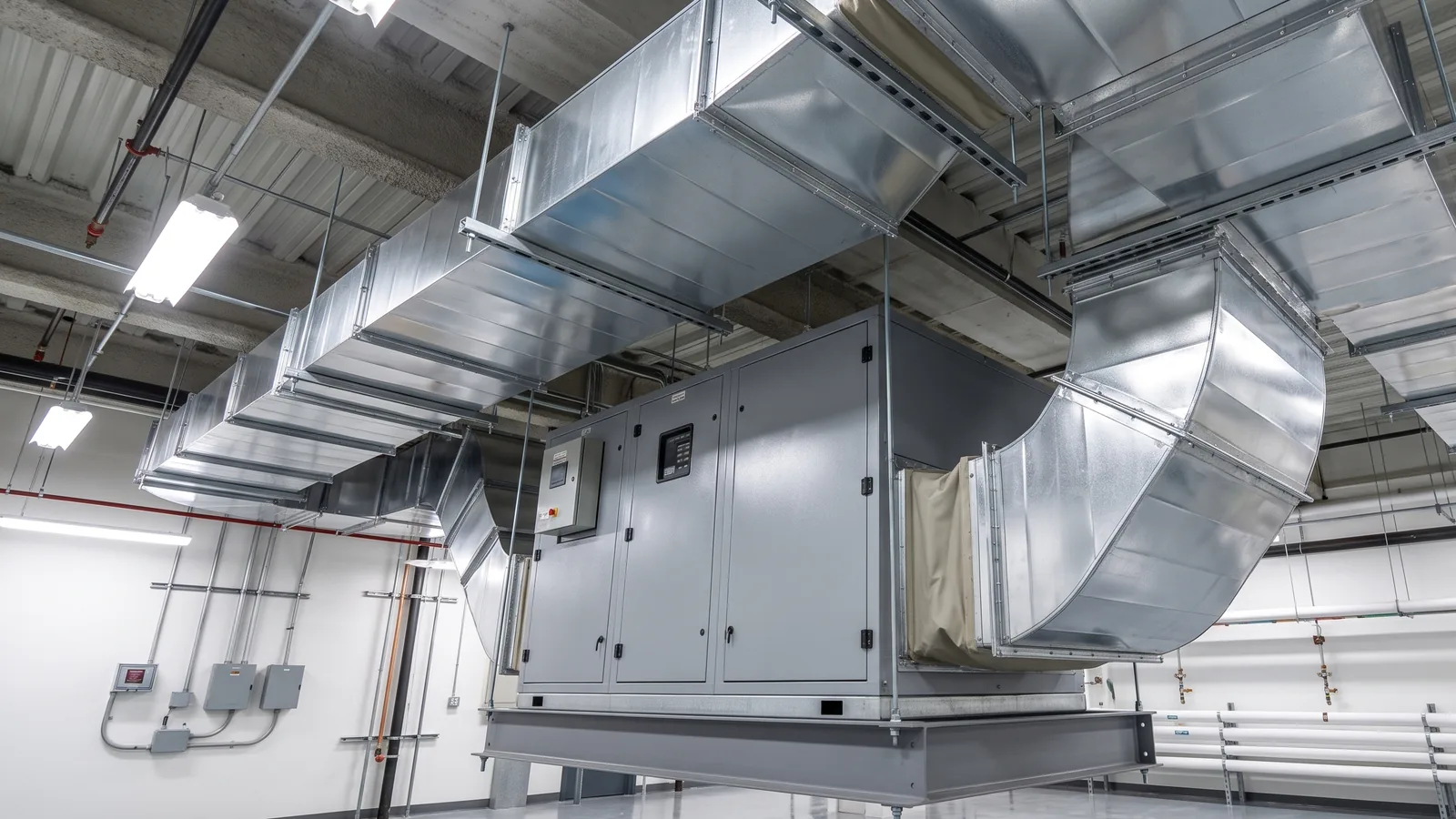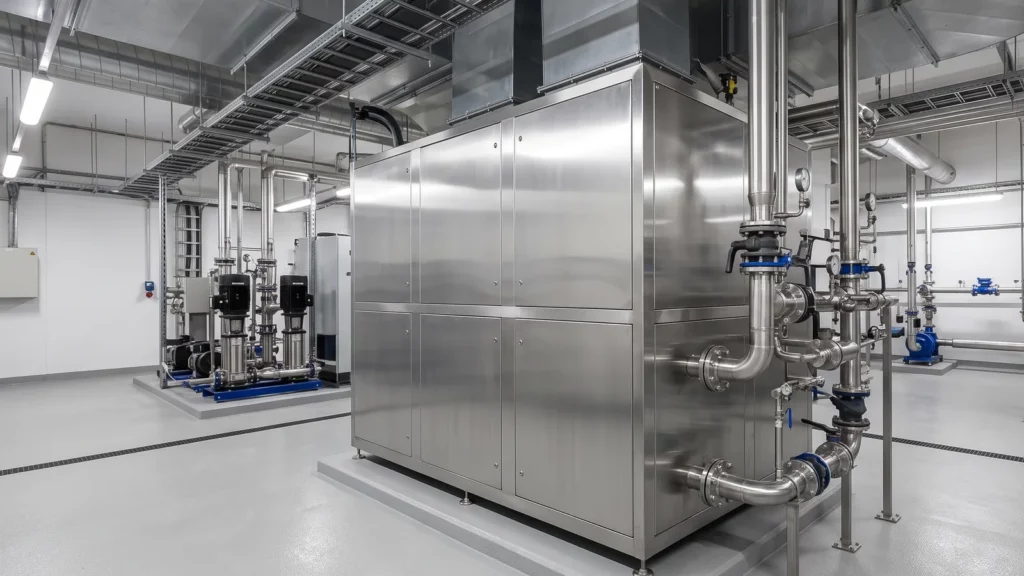
Industrial humidifiers fall into four main types, and picking the wrong one wastes energy, creates hygiene problems, or fails to hold your target humidity.
Facility managers and engineers face this decision whenever a production line, warehouse, or cleanroom needs moisture added to the air. Each humidification technology works on a different physical principle, and those differences dictate where it belongs.
This article breaks down the four industrial humidifier categories used in Australian commercial and industrial facilities. We cover how each one works, where it fits, and what to watch out for when specifying equipment. If you need a quick comparison, jump to the table below.
How Industrial Humidifiers Work
All industrial humidifiers add water vapour to air, but they do it through two fundamentally different approaches. Understanding this split is the fastest way to narrow your options.
Isothermal systems (steam humidifiers) boil water to produce vapour. They consume significant energy because they must heat water to 100°C, but the output is sterile and adds no liquid droplets to the air.
Adiabatic systems (ultrasonic, evaporative, and high-pressure fogging) introduce moisture without external heating. They use the thermal energy already in the surrounding air to evaporate fine water droplets. This makes them far more energy-efficient, and they provide a secondary cooling effect.
- Isothermal: Steam (electrode, resistance, gas-fired)
- Adiabatic: Ultrasonic, evaporative pad, high-pressure nozzle, compressed air atomisation
The choice between isothermal and adiabatic usually comes down to three factors: whether you need sterile output, whether the cooling effect is welcome or problematic, and your energy budget.
Steam Industrial Humidifiers for Clean Processes
Steam humidifiers heat water to boiling point, producing pure water vapour that mixes directly into the airstream. Because the water reaches 100°C, bacteria and pathogens are destroyed before the vapour leaves the unit.
This makes steam the default technology in pharmaceutical manufacturing, hospital operating theatres, and food processing areas where microbial contamination is a serious liability. Australian facilities must comply with ventilation requirements under AS 1668.2, and steam humidifiers integrate well with existing mechanical ventilation systems.
- Electrode steam units pass current through water to generate heat. Mineral scaling limits cylinder life, typically requiring replacement every 1,000 to 3,000 operating hours.
- Resistance steam units use metal heating elements submerged in water. More tolerant of varying water quality than electrode types.
- Gas-fired steam humidifiers burn natural gas to boil water. Best suited to large-capacity installations where electricity costs are prohibitive.
The trade-off: Steam humidifiers consume significantly more energy than any adiabatic option. They also raise the ambient air temperature slightly, which can increase air conditioning loads in temperature-sensitive facilities.
If your facility already runs a boiler, steam-to-steam heat exchangers offer a more efficient path. They tap existing steam infrastructure rather than generating it from scratch.
Ultrasonic Humidifiers for Precision Humidity Control
Ultrasonic humidifiers use piezoelectric transducers vibrating at high frequency to shatter water into a fine cold mist. The droplets are small enough (typically 1 to 5 microns) to evaporate into the air before settling on surfaces.
This technology gives you tight humidity control with low energy consumption. Moisture Cure Commercial supplies commercial ultrasonic humidifiers built for continuous industrial duty, including models from the YAKE range that scale from 3 kg/h to over 100 kg/h output.
- Near-silent operation makes ultrasonic units practical in occupied workspaces, laboratories, and print rooms.
- No heating element means no burn risk and minimal energy draw.
- Droplet size is consistent and controllable, which matters for static control in electronics manufacturing.
- Water treatment is non-negotiable. Ultrasonic units atomise everything in the water, including dissolved minerals. Without reverse osmosis or demineralised supply, you get white dust deposits across the facility.
Ultrasonic humidifiers are the strongest choice where you need precise, low-energy humidification and can supply treated water. They are widely used in printing, textile storage, mushroom cultivation, cigar storage, and cold storage produce preservation.
Evaporative Humidifiers for Large-Volume Airflows
Evaporative humidifiers work by passing air through a wetted media pad or contact surface. The air absorbs moisture from the pad, and the latent heat of evaporation cools the air simultaneously.
These systems are common in large HVAC ducts and air handling units (AHUs). They suit applications where the cooling effect is acceptable or even desired, such as greenhouse ventilation during summer.
- Media-based evaporative systems need minimal water treatment because the evaporation process leaves minerals behind on the pad rather than dispersing them.
- Pad replacement is the main maintenance item, typically every 6 to 12 months depending on water quality.
- Humidity control precision is lower than ultrasonic or steam. These units work well for broad-range targets (40 to 60% RH) but struggle to hold tight tolerances.
- Biofilm and Legionella risk exists if the water reservoir is not drained and cleaned regularly.
If your humidity control needs require tight tolerances or your facility operates in cooler months where additional cooling is unwanted, consider ultrasonic or steam alternatives instead.
High-Pressure Fogging for Energy-Efficient Coverage
High-pressure fogging systems force water through micro-orifice nozzles at pressures around 70 to 100 bar, producing billions of droplets in the 5 to 10 micron range per second. These droplets evaporate rapidly, humidifying large volumes of air with very low energy input.
On a per-kilogram-of-moisture basis, high-pressure fogging is one of the most energy-efficient humidification methods available. The pump motor is the only significant electrical load. There is no heating element and no compressed air requirement.
- Suited to large open spaces: warehouses, textile mills, greenhouses, and spray booths.
- Dual benefit of humidification and evaporative cooling, which cuts air conditioning costs in warm climates.
- Requires reverse osmosis water treatment to prevent nozzle clogging and mineral deposits.
- Nozzle maintenance is periodic but straightforward. Typical intervals are 2,000 to 4,000 hours depending on water quality.
Australian consideration: High-pressure fogging works well in the drier states (SA, WA, inland NSW, QLD) where both humidification and cooling are needed. In tropical northern regions with already high ambient humidity, steam or ultrasonic may be more practical.
Matching Industrial Humidifier Types to Your Facility
The right industrial humidifier depends on your operating environment, required precision, energy budget, and hygiene standards. This comparison covers the four main types side by side.
| Factor | Steam | Ultrasonic | Evaporative | High-Pressure Fog |
|---|---|---|---|---|
| Energy use | High | Low | Low to moderate | Very low |
| Hygiene | Excellent (sterile) | Good (with RO water) | Moderate (biofilm risk) | Good (with RO water) |
| Humidity precision | ±2-3% RH | ±1-2% RH | ±5-10% RH | ±2-4% RH |
| Cooling effect | None (adds heat) | Slight | Significant | Significant |
| Water treatment | Minimal | RO or demineralised | Minimal | RO required |
| Typical capacity | 5 to 200+ kg/h | 3 to 100+ kg/h | 10 to 500+ kg/h | 20 to 1,000+ kg/h |
| Best for | Pharma, food, hospitals | Print, electronics, storage | HVAC ducts, greenhouses | Warehouses, textile mills |
For facilities that operate below 15°C, adiabatic systems generally outperform steam on cost. But if your process demands zero liquid water in the airstream, steam is the only option that guarantees it.
Water Quality and Maintenance Across Humidifier Types
Water quality is the single biggest variable in industrial humidifier lifespan and running costs. Hard water with high mineral content accelerates scaling in steam units and clogs nozzles in fogging systems. Untreated water in ultrasonic units disperses mineral dust across the facility.
- Steam: Softened water extends electrode or element life. Descaling or cylinder replacement on schedule is the main maintenance task.
- Ultrasonic: Reverse osmosis or demineralised water is mandatory. Transducer discs have a finite lifespan (typically 5,000 to 10,000 hours) and need periodic replacement.
- Evaporative: Drain and flush the reservoir weekly. Replace media pads on the manufacturer’s schedule. Monitor for biofilm growth.
- High-pressure fog: RO pre-treatment protects nozzle orifices. Inspect nozzles quarterly for wear or blockage.
Moisture Cure Commercial includes specification advice with every enquiry. If you are unsure which water treatment setup suits your facility, talk to the team about your requirements before purchasing.
Frequently Asked Questions About Industrial Humidifiers
What is the most energy-efficient industrial humidifier?
High-pressure fogging systems use the least energy per kilogram of moisture added because they rely on a pump motor only, with no heating element. Ultrasonic units are a close second. Steam humidifiers consume the most energy because they boil water.
Do ultrasonic humidifiers need demineralised water?
Yes. Ultrasonic transducers atomise everything in the water, including dissolved minerals. Without reverse osmosis or demineralised supply, mineral particles settle as white dust on surfaces and products.
Can you use a steam humidifier in a food processing facility?
Steam humidifiers are the preferred choice for food processing because the boiling process produces sterile vapour. This eliminates the microbial contamination risk that adiabatic systems can introduce if water treatment or maintenance is neglected.
How do you size an industrial humidifier?
Calculate the moisture deficit: the difference between your current indoor humidity and your target, adjusted for room volume, air change rate, and infiltration. Manufacturers express capacity in kilograms of moisture per hour (kg/h). Oversizing wastes energy. Undersizing fails to maintain setpoint.
What is the difference between adiabatic and isothermal humidification?
Adiabatic systems (ultrasonic, evaporative, fogging) add moisture without external heat, using the air’s own thermal energy. They cool the air as a side effect. Isothermal systems (steam) boil water to create vapour, adding both moisture and a small amount of heat.
Are industrial humidifiers safe for electronics manufacturing?
Ultrasonic humidifiers are widely used in electronics manufacturing because they maintain the 40 to 60% RH range needed to prevent electrostatic discharge hazards. The fine mist evaporates before contacting sensitive components, provided the system is correctly sized and positioned.
How often do industrial humidifiers need maintenance?
Maintenance frequency depends on the type. Steam electrode cylinders need replacement every 1,000 to 3,000 hours. Ultrasonic transducer discs last 5,000 to 10,000 hours. Evaporative pads are replaced every 6 to 12 months. Fogging nozzles are inspected quarterly.
What humidity level should a warehouse maintain?
Most warehouses storing general goods target 40 to 60% relative humidity. Paper and cardboard storage benefits from 45 to 55% RH. Pharmaceutical warehouses must meet TGA manufacturing principles and may require tighter control at 30 to 50% RH depending on the products stored.
Can industrial humidifiers be ducted into existing HVAC?
Steam and evaporative humidifiers are commonly ducted into air handling units. Ultrasonic and high-pressure fogging systems are more often deployed as in-room or in-zone units, though some models support duct mounting. The decision depends on whether you need whole-building or zone-specific control.