Museum humidity control is not optional. Get it wrong and you lose items that cannot be replaced, no matter how much money you throw at remediation.
Australian museums and galleries lose collection items every year to mould, corrosion, cracking, and foxing caused by poorly managed relative humidity. The damage is cumulative and often invisible until it is too late. A watercolour foxes. A bronze corrodes beneath its patina.
This guide covers the humidity levels Australian museums need, the standards that govern them, how different dehumidification technologies compare, and why Australia’s climate makes the job harder than in Europe or North America. Moisture Cure Commercial has spent 28 years specifying and supplying humidity control systems for commercial and institutional clients across Australia.
What Uncontrolled Humidity Does to Collections
Organic materials absorb and release moisture in response to changes in ambient RH. Each cycle causes dimensional change. Enough cycles and the object fails.
High Humidity Damage (Above 65% RH)
- Mould and fungal growth on paper, textiles, leather, and wood. Active mould starts at roughly 65% RH.
- Corrosion of metals, particularly iron and steel. Ferrous artefacts require RH below 15% to prevent ongoing oxidation.
- Foxing on paper and prints caused by fungal activity combined with metallic impurities in the paper.
- Adhesive failure in bound volumes, framed works, and laminated objects.
Low Humidity Damage (Below 40% RH)
- Cracking and splitting in wood, ivory, bone, and lacquered surfaces.
- Brittleness in paper, parchment, and leather as fibres lose flexibility.
- Paint delamination on canvas and panel paintings where support and paint layer shrink at different rates.
Rate of change matters more than absolute level. A steady 52% RH causes far less damage than a humidity that swings between 45% and 60% every day. The AICCM recommends limiting daily RH fluctuation to plus or minus 5%.
Recommended Museum Humidity Levels by Material
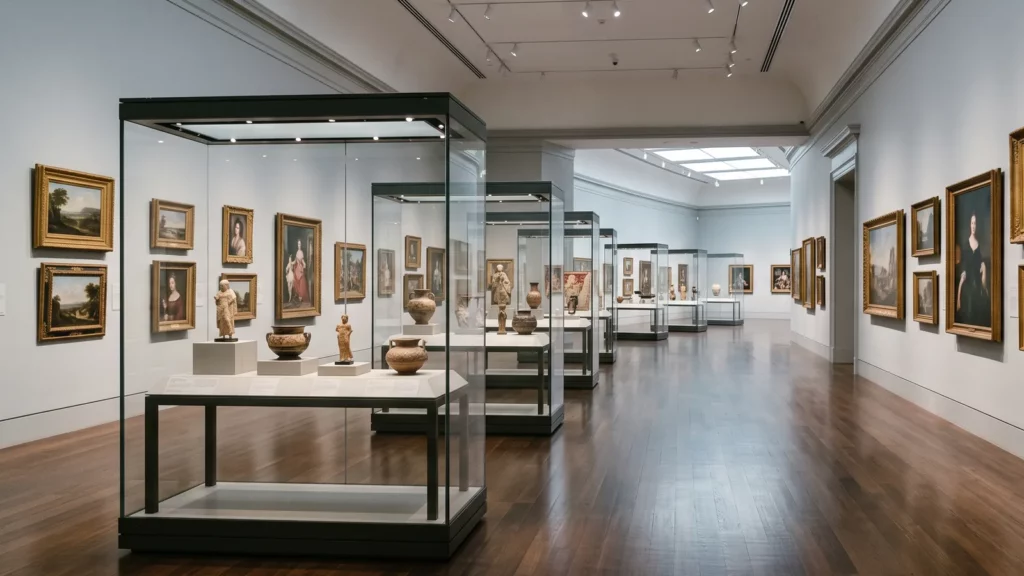
There is no single correct RH for a museum. Mixed collections pull the target in different directions. The standard compromise for mixed-collection galleries is 45 to 55% RH, but storage areas holding specific material types should be tighter.
| Material Type | Target RH Range | Critical Risk |
|---|---|---|
| Mixed general collection | 45 to 55% | Mould above 65%, cracking below 35% |
| Iron and ferrous metals | Below 15% | Active corrosion above 20% |
| Non-ferrous metals (bronze, copper) | Below 40% | Tarnishing and verdigris |
| Paper, books, archives | 30 to 50% | Foxing above 65%, brittleness below 25% |
| Photographs and film | 30 to 45% | Emulsion softening, acetate decay |
| Nitrate film | 20 to 30% | Decomposition above 40% |
| Textiles and costumes | 30 to 60% | Fibre stress outside range |
| Ivory, bone, antler | 50 to 60% | Cracking below 40% |
| Parchment and vellum | 55 to 60% | Distortion outside range |
| Wood and furniture | 40 to 55% | Splitting below 35%, swelling above 65% |
| Ceramics and pottery | 40 to 55% | Salt crystallisation at low RH |
The 2015 Bizot Green Protocol broadened the acceptable band to 40 to 60% RH for smaller institutions. This is a pragmatic concession, not best practice. For high-value or fragile items, tighter control remains necessary.
Standards and Guidelines for Museum Climate Control
Several international and Australian standards define acceptable ranges. Insurers and lending institutions enforce them.
- AICCM Interim Environmental Guidelines: 45 to 55% RH, plus or minus 5% daily variation, 15 to 25 degrees Celsius. The Australian benchmark for institutional collections.
- ASHRAE Chapter 24 (Museums, Galleries, Archives): Provides tiered specifications from AA (tightest) to D (most relaxed), allowing institutions to match control levels to collection value.
- Bizot Green Protocol (2015): 40 to 60% RH, 16 to 25 degrees Celsius. Designed for sustainability and cost reduction in smaller museums.
- BS EN 16893:2018: European standard for storage conditions, widely referenced by Australian institutions with international lending relationships.
Loan and insurance requirements: Lending institutions specify environmental conditions in loan agreements. Failure to maintain documented conditions can void insurance cover and result in the return of loaned works. This makes reliable monitoring and data logging a contractual obligation, not a nice-to-have.
Display Galleries vs Storage and Archives
A common mistake is treating the entire museum as a single climate zone. Display galleries and storage areas have fundamentally different requirements, and conflating them wastes energy and compromises preservation.
Display Galleries
- Must balance visitor comfort (20 to 22 degrees, 45 to 55% RH) with preservation requirements.
- Visitor traffic introduces moisture, heat, and CO2. A busy gallery has a markedly different humidity load than an empty one.
- Sealed display cases with their own micro-climate protect sensitive items within a gallery conditioned for general comfort.
Storage and Archives
- No visitor comfort requirement. Lower temperatures (15 to 18 degrees) are acceptable and extend material life.
- Tighter RH bands are achievable with no door openings, visitor loads, or lighting heat sources.
- Segregation by material type allows optimisation. Metal storage at below 15% RH. Film archives at 20 to 30% RH.
Explore the full range of commercial humidity control systems to find the right configuration for each zone in your facility.
Desiccant vs Refrigerant Dehumidification for Museums
The two main dehumidification technologies serve different roles in museum applications. Understanding where each performs best is the key to getting the specification right.
| Factor | Desiccant Dehumidifier | Refrigerant Dehumidifier |
|---|---|---|
| Operating temperature range | -20 to +50 degrees Celsius | Above 15 degrees Celsius (efficiency drops sharply below this) |
| Precision at moderate RH | Excellent. Can hold tight bands. | Good for bulk moisture removal, less precise. |
| Achieving very low RH (below 30%) | Capable of reaching below 15% for metal storage | Cannot reliably reach below 30 to 35% |
| Energy use at moderate temperatures | Competitive. No compressor cycling. | Efficient for high-volume extraction above 20 degrees. |
| Unheated storage areas | Fully effective | Ineffective. Coils ice up. |
| Noise level | Low. No compressor. | Moderate compressor noise. |
| Maintenance | Filter and rotor service | Refrigerant circuit, compressor, drain |
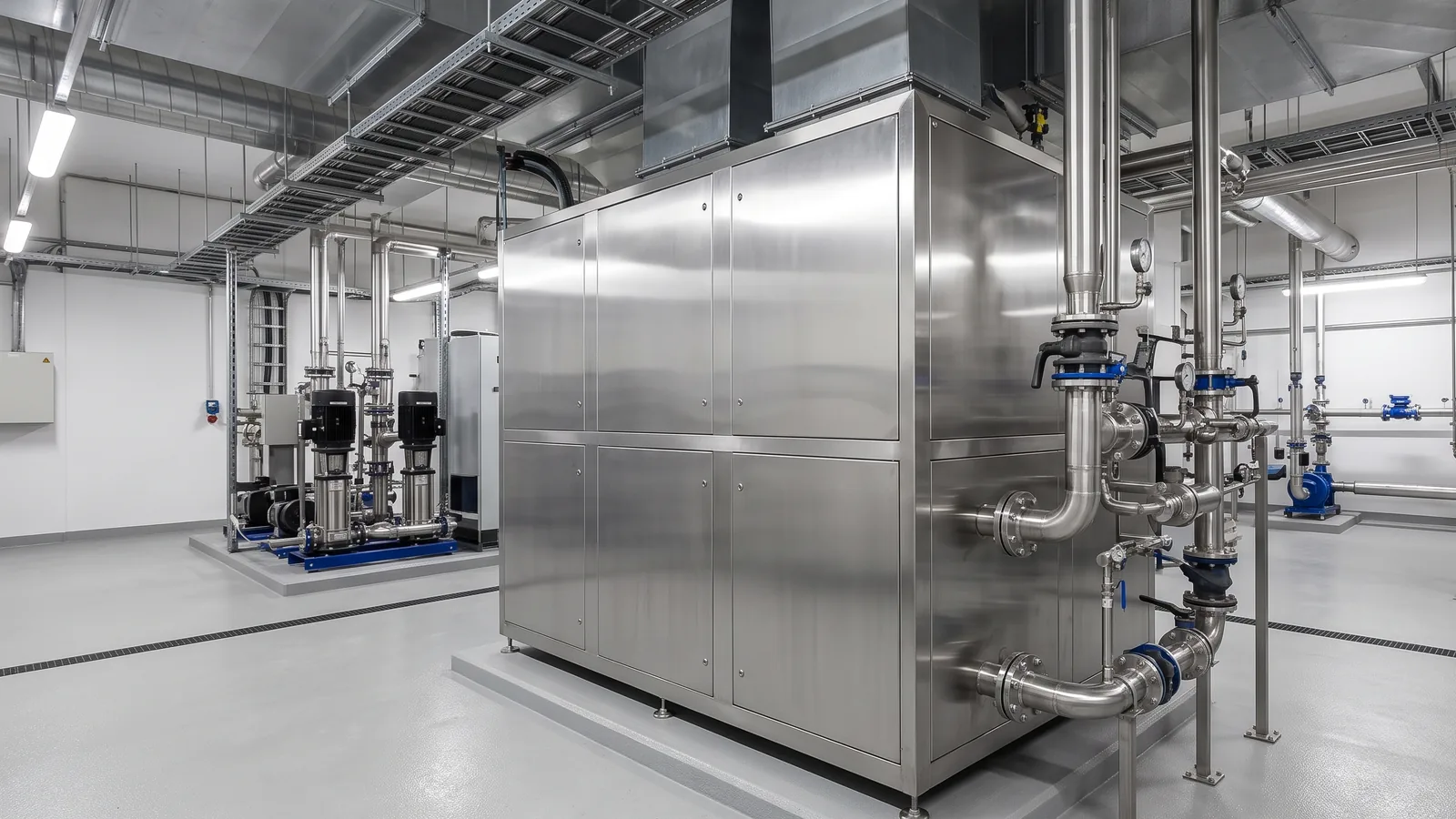
For museum applications, desiccant dehumidifiers are the stronger choice in most scenarios. They deliver the precision control that conservation standards demand, operate in unheated storage areas where refrigerant units fail, and can reach the very low RH levels required for metal and film archives.
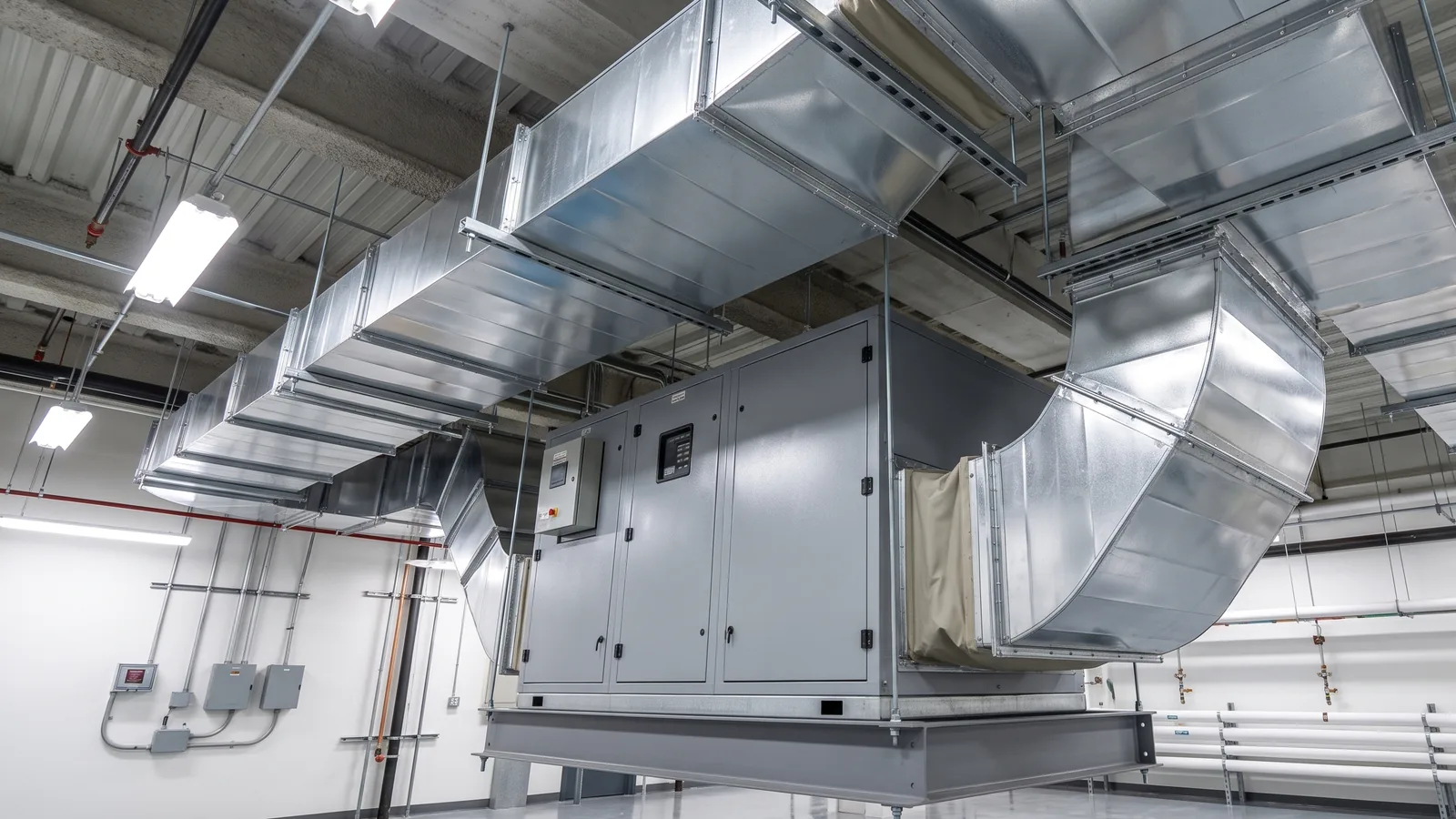
Refrigerant dehumidifiers still have a role in climate-controlled galleries above 20 degrees, particularly for bulk moisture removal after a water event. For larger facilities, ducted dehumidifiers integrate into existing HVAC systems to condition multiple zones from a single plant room.
Why Australian Museums Face Harder Humidity Challenges
Most museum climate guidance comes from the UK and continental Europe, where conditions are relatively mild. Australian institutions face a wider climate envelope that makes humidity control harder.
- Tropical north (QLD, NT, Top End): Ambient RH regularly exceeds 80% during the wet season. Dehumidification loads are extreme and continuous.
- Dry inland regions: Winter RH can fall below 20%, demanding humidification rather than dehumidification. Rapid swings between hot days and cold nights cause daily RH variations that exceed preservation guidelines.
- Coastal and temperate zones: Salt-laden air accelerates metal corrosion even at moderate RH levels. Seasonal variation requires systems that can both add and remove moisture.
- Regional and community museums: Often housed in heritage buildings with poor thermal envelopes. Limited funding makes energy efficiency a deciding factor in equipment selection.
The Bureau of Meteorology climate data for your region is the starting point for sizing any museum humidity control system. Moisture Cure Commercial has 28 years of experience specifying systems for Australian conditions, not imported assumptions from European climates.
Monitoring, Data Logging, and Continuous Operation
Museum collections do not have opening hours. A humidity spike at 3am on a Sunday causes the same damage as one at midday on a Tuesday. Systems must run continuously, monitored by sensors and backed by alarms.
- Calibrated sensors in every climate zone, with accuracy of plus or minus 2% RH or better.
- Continuous data logging at intervals of 15 minutes or less. This data serves as both an operational tool and a compliance record for insurers and lenders.
- Alarm thresholds at the boundaries of acceptable RH, with notifications to facilities staff before conditions reach damaging levels.
- BMS integration where available, linking humidity control to the building management system for coordinated HVAC response.
For a detailed overview of museum-specific solutions and equipment recommendations, visit our museum humidity control applications page.
Frequently Asked Questions
What humidity level should a museum be kept at?
The AICCM recommends 45 to 55% RH for mixed collections, with daily fluctuations limited to plus or minus 5%. Metal storage should be below 15% RH. Film archives sit best at 20 to 30%. The Bizot Green Protocol allows a broader 40 to 60% band for institutions with limited resources.
What happens if museum humidity is too high?
Above 65% RH, mould and fungal growth become active risks. Metal artefacts corrode, paper foxes, and textiles develop mildew. The damage is cumulative and often irreversible by the time it is visible.
What happens if museum humidity is too low?
Below 35 to 40% RH, organic materials lose moisture and shrink. Wood cracks. Leather becomes brittle. Ivory and bone are particularly vulnerable, cracking at RH below 40%.
Do different materials need different humidity levels?
Yes. A mixed collection forces a compromise around 45 to 55% RH. Where possible, segregate materials and condition them separately. Metal archives, film stores, and textile collections each need distinct conditions.
What is the difference between desiccant and refrigerant dehumidifiers?
Desiccant units use a moisture-absorbing rotor and work from minus 20 to plus 50 degrees Celsius, reaching the very low RH needed for metal and film storage. Refrigerant units condense moisture on cold coils and work efficiently above 15 degrees, but lose effectiveness in cooler environments.
How do you control humidity in museum display cases?
Sealed cases can be conditioned by piping dehumidified air from a desiccant unit, or by using passive buffering materials (silica gel) for small cases. Active systems are preferred for valuable items because passive buffers need regular reconditioning.
Get the Right Humidity Control for Your Museum
Every museum has a different combination of collection types, building characteristics, and climate zone. Moisture Cure Commercial provides tailored humidity control specifications backed by 28 years of commercial and institutional experience across Australia.
Contact Moisture Cure Commercial for a museum humidity assessment. We will review your collection requirements, building conditions, and climate data to recommend the right system for your facility.