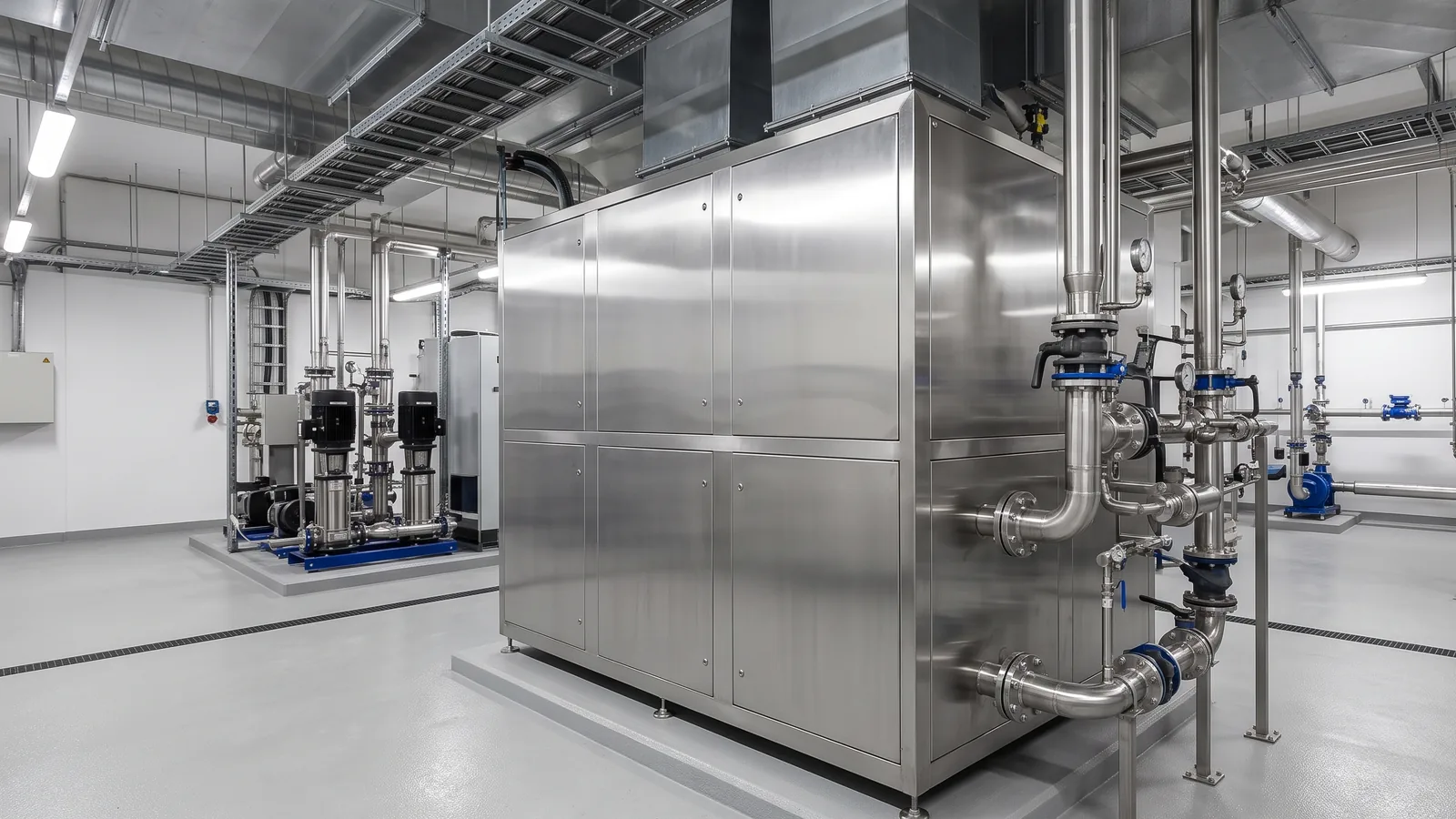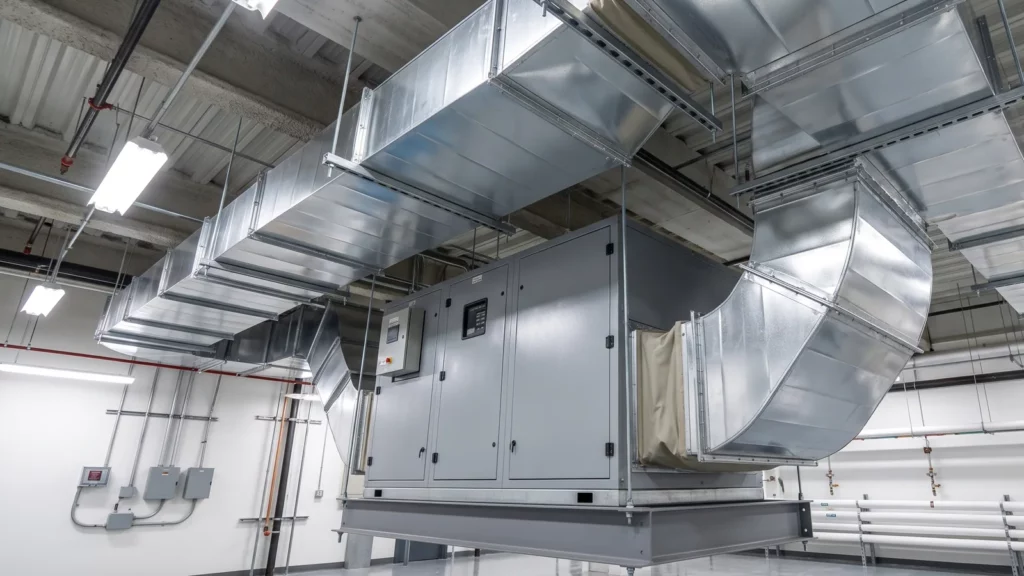
A commercial ducted dehumidifier typically draws between 0.5 kW and 3.5 kW, depending on capacity and technology type.
Running costs catch many facility managers off guard because ducted systems differ from standalone units in how they consume energy. Fan power, duct resistance, and continuous duty cycles all play a role that portable dehumidifiers simply do not face.
This article breaks down the real-world power consumption of commercial ducted dehumidifiers, covers the key cost drivers, and gives you a straightforward formula to estimate your annual spend.
Already exploring ducted options? Read about how ducted dehumidifiers work in commercial facilities for the technical foundations before diving into cost numbers.
Typical Power Draw for Commercial Ducted Dehumidifiers
Commercial ducted dehumidifiers range from compact ceiling-mounted units drawing around 0.5 kW to large industrial ducted systems pulling 3.5 kW or more. The power draw depends on compressor type, fan motor size, and moisture removal capacity measured in litres per day.
Small ducted units rated at 20–30 L/day sit around 0.4–0.7 kW. Mid-range systems handling 50–100 L/day typically draw 1.0–1.8 kW, while large industrial ducted plant processing 150+ L/day can reach 2.5–3.5 kW or higher.
| Capacity (L/day) | Typical Power Draw (kW) | Daily kWh (8 hrs) | Daily kWh (24 hrs) |
|---|---|---|---|
| 20–30 | 0.4–0.7 | 3.2–5.6 | 9.6–16.8 |
| 50–100 | 1.0–1.8 | 8.0–14.4 | 24.0–43.2 |
| 150–250 | 2.0–3.0 | 16.0–24.0 | 48.0–72.0 |
| 300+ | 3.0–3.5+ | 24.0–28.0+ | 72.0–84.0+ |
These figures cover compressor and fan power combined. Duct-mounted units draw additional energy from their internal fans to push air through connected ductwork, which portable units do not require. For a broader look at power consumption across all types, see our guide to industrial dehumidifier electricity consumption and running costs.
What Drives Ducted Dehumidifier Running Costs
Several factors shift a ducted system’s energy use well above or below the manufacturer’s rated power draw. Understanding them helps you avoid oversizing and wasted electricity.
- Ambient temperature and humidity levels in the space
- Ductwork design and total static pressure
- Target relative humidity setpoint
- Daily operating hours and duty cycle
Ambient Conditions
Warmer, more humid air means the compressor works harder and longer to reach target relative humidity. A warehouse at 30°C and 80% RH forces more energy through the system than an archive room sitting at 22°C and 60% RH.
Seasonal swings matter too. A ducted system in Brisbane will run harder in summer than the same unit in Melbourne’s cooler months.
Ductwork Design and Static Pressure
Every metre of ductwork adds resistance. The fan motor draws more power to push air through longer duct runs, tight bends, and undersized ducts.
Well-designed ductwork with smooth transitions and correct sizing keeps static pressure low and fan energy minimal. Poor duct layouts can increase fan power consumption by 15–25% compared to a properly engineered installation.
Target Relative Humidity
Pulling air from 70% RH down to 50% RH uses significantly less energy than targeting 40% RH or below. Each percentage point below 50% RH demands disproportionately more compressor run time.
Facilities that genuinely need sub-40% RH, such as pharmaceutical clean rooms or lithium battery dry rooms, should expect higher running costs. Desiccant dehumidifiers designed for ultra-low humidity applications often achieve these targets more efficiently than refrigerant alternatives.
Duty Cycle and Operating Hours
A ducted dehumidifier running 24/7 in a swimming pool hall costs far more annually than one cycling on and off in a well-sealed warehouse. Duty cycle is the single biggest variable in your electricity bill.
How to Calculate Ducted Dehumidifier Running Costs
The formula is straightforward:
Annual cost = kW × hours per day × days per year × electricity rate ($/kWh)
For a mid-range ducted unit drawing 1.5 kW, running 12 hours per day, 365 days per year, at a commercial electricity rate around $0.30/kWh:
1.5 × 12 × 365 × 0.30 = approximately $1,971 per year.
That same unit running 24/7 roughly doubles the figure. Halving the duty cycle to 6 hours per day drops costs to around $985 annually.
Australian commercial electricity rates typically fall between $0.25 and $0.40 per kWh depending on state, tariff structure, and time-of-use arrangements. Check your latest energy bill for your actual rate. The Australian Energy Regulator publishes current rate benchmarks. These cost examples are approximate guides only and will vary by location, tariff, and usage pattern.
The takeaway: unit power draw gets all the attention, but operating hours determine the real cost.
Ducted vs Portable Dehumidifier Running Costs
Facility managers sometimes consider scattering portable dehumidifiers around a building instead of installing a ducted system. On paper, a single 500 W portable looks cheaper than a 2 kW ducted unit.
The maths changes at commercial scale. Four portable units covering the same floor area draw a combined 2.0 kW, and each one cycles independently with no coordination. A single ducted system controlled by a humidistat covers the entire zone from one efficient compressor.
- Portable units create uneven humidity pockets, forcing some units to run constantly while others cycle off
- Ducted systems distribute conditioned air evenly through the duct network, reducing total compressor hours
- Maintenance multiplies with portables: more filters, more drain lines, more points of failure
- Ducted installations connect to building management systems for automated scheduling and load shedding
Over a 5-year period, a properly sized ducted dehumidifier system built for commercial duty almost always costs less to operate than the portable equivalent for any space over about 100 square metres.
Desiccant or Refrigerant Ducted Units and Energy Use
Refrigerant ducted dehumidifiers use a compressor cycle to cool air below its dew point and condense moisture. They are typically more energy-efficient in warm environments above 15°C.
Desiccant ducted units use a chemical rotor to adsorb moisture and regenerate with heat. They draw power differently, consuming steady wattage rather than cycling a compressor on and off.
- Above 20°C and moderate humidity: Refrigerant ducted units generally cost less per litre of moisture removed
- Below 15°C: Refrigerant compressors lose efficiency rapidly and may ice up. Desiccant systems like YAKE units operate reliably from -20°C to +50°C without performance loss
- Very low target RH (below 40%): Desiccant technology reaches lower humidity levels more efficiently than refrigerant at the same energy cost
For cold storage facilities, unheated warehouses, or environments that regularly drop below 15°C, a desiccant ducted dehumidifier can deliver lower running costs despite higher rated wattage. Read more about why refrigerant dehumidifiers lose efficiency in cold conditions.
Practical Ways to Cut Ducted Dehumidifier Running Costs
- Right-size the unit. An oversized dehumidifier short-cycles and wastes energy on startup surges. An undersized unit runs continuously without reaching target RH. Specifying the correct ducted dehumidifier for your facility is the single best cost-saving measure.
- Invest in good ductwork. Smooth, correctly sized ducts with minimal bends reduce static pressure and fan energy. Insulated ducts also prevent condensation forming inside the ductwork itself.
- Use BMS integration. Connecting your dehumidifier to a building management system allows scheduled operation, demand-based control, and coordination with HVAC. According to ENERGY STAR efficiency criteria, smart controls with humidistats can reduce dehumidifier energy consumption by 15–30%.
- Seal the building envelope. Every gap that lets humid air into the space makes the dehumidifier work harder. Dock seals, strip curtains, and proper insulation reduce infiltration and lower running hours.
- Maintain the system. Dirty filters increase airflow resistance and fan power. Blocked condensate drains force shutdowns. A regular maintenance schedule keeps efficiency steady year-round.
Get Accurate Running Cost Estimates
Ducted dehumidifier running costs depend far more on how the system is installed and operated than on the unit’s rated wattage alone. Ductwork design, operating hours, ambient conditions, and technology choice all shape the final electricity bill.
Moisture Cure Commercial has over 28 years of experience specifying ducted dehumidification systems for Australian commercial and industrial facilities. Contact our team for a site assessment and accurate running cost estimate tailored to your facility.
Frequently Asked Questions
How much electricity does a ducted dehumidifier use per day?
A mid-range commercial ducted dehumidifier drawing 1.5 kW and running 12 hours per day uses approximately 18 kWh. At Australian commercial rates around $0.30/kWh, that works out to roughly $5.40 per day. Larger units or longer run times increase this proportionally.
Are ducted dehumidifiers more expensive to run than portable units?
Per unit, a ducted system draws more power. But ducted systems cover larger areas from a single compressor, which makes them more cost-effective than deploying multiple portables across a commercial facility.
Does ductwork length affect running costs?
Yes. Longer duct runs and tight bends increase static pressure, which forces the fan motor to draw more power. Proper duct design with smooth transitions and correct sizing keeps this additional cost minimal.
Can you run a ducted dehumidifier continuously?
Commercial ducted units are built for continuous operation. Running 24/7 is common in swimming pool halls, cold stores, and food processing facilities. Factor the full duty cycle into your cost calculation when planning.
Is a desiccant ducted dehumidifier cheaper to run than refrigerant?
In cold environments below 15°C, desiccant units typically cost less to run because refrigerant compressors lose efficiency in cold air. Above 20°C, refrigerant ducted systems are generally more economical per litre of moisture removed.
What is the most effective way to reduce ducted dehumidifier running costs?
Correct sizing. An oversized unit short-cycles and wastes energy. An undersized unit runs non-stop. Getting the right capacity for your space, humidity load, and target RH is the biggest single factor in controlling running costs.