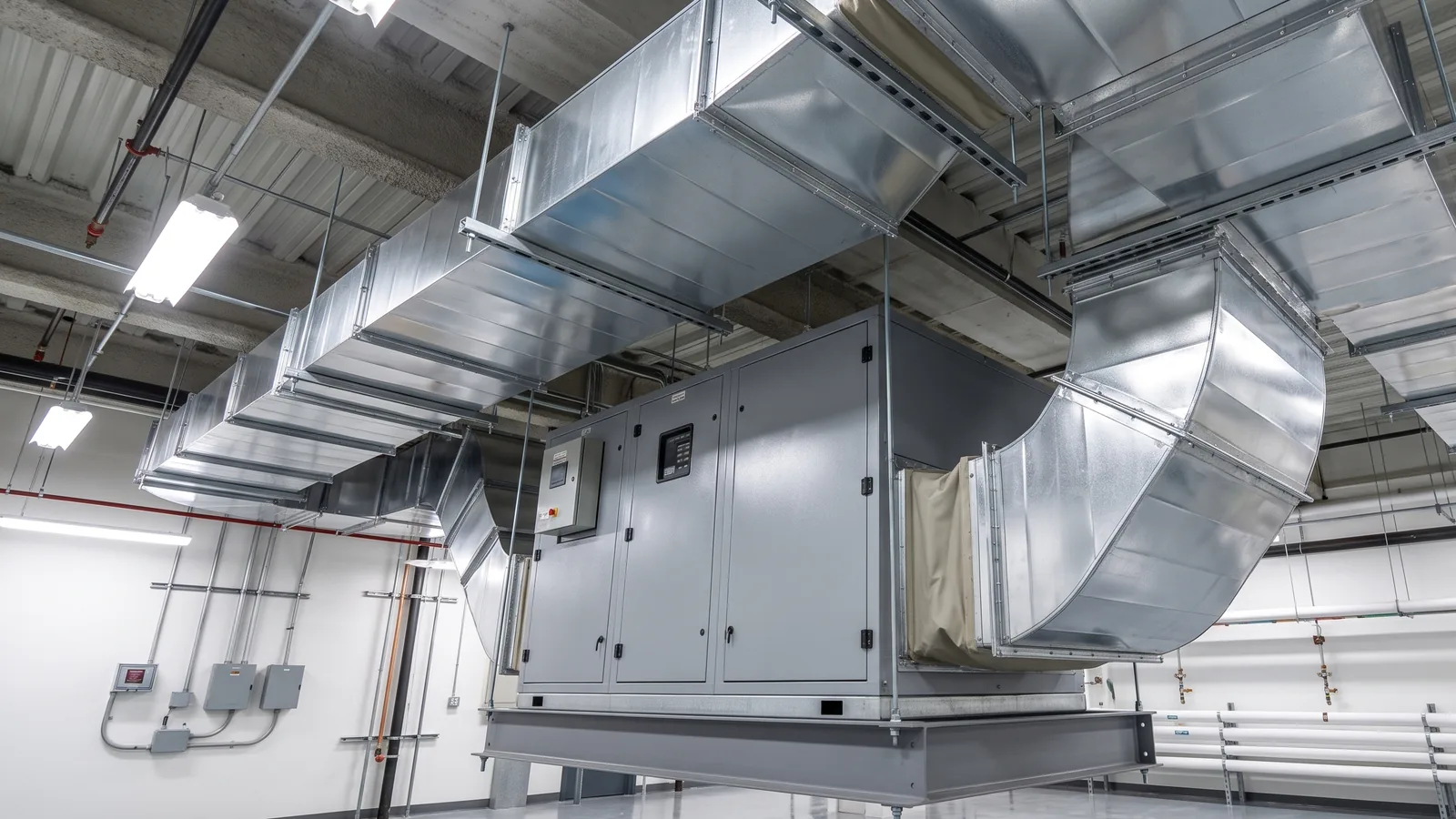
A ducted dehumidifier removes moisture from air and distributes the dried air through ductwork to designated spaces. Moisture Cure Commercial’s ducted systems for central moisture control suit facilities that need permanent equipment outside occupied areas.
Standalone portable units can manage humidity in individual rooms, but commercial and industrial facilities spanning thousands of square metres require a different approach. When moisture control affects product quality, equipment longevity, or workplace conditions across multiple zones, separate units can become difficult to monitor and maintain.
This article covers operating principles, applications and equipment selection for Australian facilities. Before finalising a specification, planning a ducted dehumidifier installation helps identify site constraints that affect the design.
What Is a Ducted Dehumidifier
A ducted dehumidifier uses a dedicated duct network or a compatible connection to existing HVAC ductwork to treat designated zones. The unit typically mounts in a plant room, ceiling void, or mechanical space, processing return air and delivering conditioned air back through the distribution network.
- Processes air centrally and distributes through duct runs to multiple spaces
- Can integrate with a building management system (BMS) where compatible controls are specified
- Moves equipment out of occupied areas, with duct noise addressed during design
- Eliminates the need for multiple standalone units and associated drainage points
- Supports consistent humidity across compatible zones when airflow is balanced
Both refrigerant and desiccant technologies can be configured for ducted installation. The choice depends on your target humidity range, temperature conditions, and airflow requirements.
How Ducted Dehumidifier Systems Work
The operating principle depends on whether the system uses refrigerant or desiccant technology. Both can be ducted, but they achieve moisture removal differently.
Refrigerant Ducted Systems
Refrigerant systems cool incoming air below its dew point, causing water vapour to condense on cold coils. The condensate drains away, and the air is reheated before returning to the duct network.
- Select using the manufacturer’s capacity data at the actual inlet temperature and humidity
- Compare energy input at the required moisture-removal duty
- Requires condensate drainage infrastructure
- Performance declines as temperature drops
Desiccant Ducted Systems
A rotating desiccant wheel adsorbs moisture from the process air stream. A separate heated regeneration air stream releases the captured moisture, which is exhausted outside the building.
- Operates effectively at low temperatures and humidity levels
- Achieves very low dew points when required
- The desiccant rotor itself produces no liquid condensate; check auxiliary cooling sections separately
- Requires a regeneration heat source, included in the energy assessment
Moisture Cure Commercial supplies both refrigerant systems for warmer operating conditions and desiccant systems for low-temperature or low-humidity duties for these operating conditions. Confirm the selected model’s duct connections and fan capability before specifying either technology.
Applications Where Ducted Systems Excel
Certain facilities and operational requirements make ducted installation the most practical choice. These include scenarios where space, aesthetics, or coverage area tip the balance away from portable units.
- Pharmaceutical manufacturing and storage: Maintaining stable low humidity across cleanrooms, packaging areas, and raw material storage
- Food processing and cold storage: Preventing condensation in refrigerated spaces and controlling moisture during production
- Healthcare facilities: Operating theatres, sterile supply departments, and medical device storage where precision humidity control is necessary
- Electronics manufacturing: Protecting moisture-sensitive components during assembly, with a lower humidity limit to avoid increasing static discharge risk
- Museums and archives: Protecting collections across multiple galleries or storage vaults from a single system
- Indoor pools and aquatic centres: Managing evaporation loads while keeping equipment outside public areas; duct noise still needs attention
- Large warehouses and distribution centres: Preventing corrosion and condensation across expansive storage zones
For aquatic facilities, specifying ducted dehumidification for a swimming pool hall requires attention to evaporation loads and air distribution around cold glazing.
Advantages of Ducted Dehumidifier Installation
A ducted layout keeps equipment in service areas and distributes dried air where it is needed. Its value depends on whether the facility can accommodate the ducts and provide access for maintenance.
- Centralised maintenance: Unit servicing and filter changes are concentrated at the plant location; distributed sensors and dampers still need access
- Space efficiency: Equipment stays out of production areas, freeing valuable floor space
- Noise reduction: Plant-room placement separates equipment from occupants; attenuators and vibration isolation may still be needed
- Automated control: BMS integration enables scheduling, alarm notifications, and remote monitoring
- Aesthetic considerations: No visible equipment in customer-facing or sensitive environments
- Scalability: Additional zones can be assessed against spare moisture-removal capacity and fan pressure before expansion
Drainage and exhaust planning: Refrigerant systems require reliable condensate drainage to waste or collection points. Desiccant systems need ducted exhaust to remove regeneration air, so plan these connections during design to avoid retrofits.
Selecting the Right Ducted Dehumidifier Capacity
Undersizing leads to inadequate moisture control and continuous operation. Excess capacity increases capital outlay and can cause short cycling where the controls or turndown range do not match the load.
Key Sizing Factors
- Building volume and air change rate: Inform airflow requirements and the moisture load from outdoor air
- Moisture load sources: People, processes, equipment, and infiltration all contribute moisture
- Target humidity setpoint: Lower targets affect available extraction capacity and may favour desiccant technology
- Ambient conditions: Temperature and outdoor humidity levels influence system performance
- Duct static pressure: The system must overcome resistance in the duct network to deliver required airflow
Professional load calculation accounts for all these variables and matches them to equipment specifications. Moisture Cure Commercial provides technical consultation and sizing support to ensure your system meets operational requirements without excess capacity.
What to put in the equipment schedule
A litres-per-day figure is only useful when its test temperature and relative humidity are stated. Request the selected unit’s performance at your design inlet conditions, including the cooler or drier periods when its published maximum capacity may not be available.
| Specify | Evidence to request from the supplier |
|---|---|
| Moisture removal in kg/h or L/day | Selection data at design temperature and relative humidity, plus the expected part-load duty |
| Process airflow in m³/h | Fan selection at the external static pressure in Pa, including ducts, filters, grilles and dampers |
| Humidity target and tolerance | Sensor location, control range and alarm limits for each critical zone |
| Electrical and heat input | Running input, starting requirements and regeneration heat where applicable |
| Access and sound | Service clearances, filter withdrawal space and acoustic data with stated measurement conditions |
Keep extraction capacity and airflow separate in the schedule: a fan can move enough air while the drying section still falls short of the moisture load. Ask the designer to document the allowance for open doors, outdoor air and process peaks so procurement can compare quotations on the same basis.
For condensation control, the relevant relationship is between air dew point and the coldest exposed surface. The US EPA’s building moisture-control guidance explains why keeping the air dew point below cold-surface temperatures matters; the project designer should translate that principle into site-specific settings.
Installation Considerations for Commercial Projects
The installation design needs to cover duct resistance, drainage, power, controls and maintenance access.
| Consideration | Refrigerant Systems | Desiccant Systems |
|---|---|---|
| Drainage requirement | Condensate drain to waste or pump | Check auxiliary cooling and the manufacturer’s installation requirements |
| Exhaust requirement | Usually no separate moisture exhaust; confirm the selected unit’s requirements | Ducted exhaust to outside |
| Electrical supply | Single- or three-phase supply, depending on model | Model-specific fan supply plus the selected regeneration heat source |
| Space requirements | Allow the specified service clearances and coil access | Allow rotor access and space for regeneration ductwork |
| Operating temperature range | Check rated operating limits and capacity curves | Check selected rotor and regeneration performance at design conditions |
Coordinate with mechanical contractors early in the design phase to confirm duct routing, clearances, and service access. Retrofitting ductwork or drainage after construction costs significantly more than planning ahead.
Confirm the air path and controls before handover
Existing ductwork is usable only if the mechanical design and equipment instructions permit the connection. Check how the dehumidifier will operate when there is a humidity call but no heating or cooling demand.
- Show supply and return paths with internal doors closed, avoiding short circuits between nearby grilles.
- Account for outdoor ventilation air in the moisture load; recirculating dry air does not supply required fresh air.
- Keep zones with different humidity targets or contamination controls separate where the process requires it.
- Position sensors away from supply jets and local moisture sources unless those sources are the intended measurement point.
- Test airflow, condensate discharge, overflow protection where fitted, humidity alarms and BMS operation.
Record temperature and humidity in representative zones during commissioning, along with the operating conditions and agreed acceptance limits. If the handover weather does not test the peak moisture duty, agree how performance will be checked when those conditions occur.
Maintenance Requirements and Operating Costs
Ducted systems require scheduled maintenance to sustain performance and efficiency. Neglected units consume more energy and fail prematurely.
Routine Maintenance Tasks
- Filter inspection and replacement to the manufacturer’s schedule, adjusted for dust loading and pressure drop
- Coil cleaning for refrigerant units to maintain heat transfer efficiency
- Desiccant wheel inspection for damage or contamination
- Condensate drain cleaning to prevent blockages and overflow
- Belt and bearing checks where fitted, following the maintenance instructions
- Control calibration and sensor verification
Energy Consumption
Compare energy use at the same inlet conditions and moisture-removal duty, including fan power and any regeneration heat. Running costs also depend on operating hours and the energy tariff.
Monitoring and optimisation: With suitable sensors, metering and control points, a BMS can record runtime, energy use and humidity trends. Use this data to adjust setpoints, schedules, and maintenance intervals for improved efficiency.
Comparing Ducted and Portable Dehumidifiers
Portable units suit smaller spaces, temporary applications, or facilities without existing ductwork. Ducted systems make sense when coverage area, aesthetics, or integration requirements justify the installation investment.
- Coverage area: Portable units manage single rooms or zones. Ducted systems handle entire buildings or multiple connected spaces.
- Installation complexity: Portable units need suitable power and a condensate arrangement. Ducted systems require mechanical and electrical coordination.
- Upfront cost: Portable units have lower initial cost. Ducted systems require ductwork and installation investment; operating costs depend on load, controls and fan energy.
- Maintenance access: Portable units need individual servicing and may need to be moved out of occupied spaces. Ducted equipment stays in dedicated plant areas.
- Control granularity: Portables offer zone-level control. Ducted systems need appropriate sensing and airflow control to maintain conditions across zones.
For large-scale facilities, a full range of commercial and industrial dehumidification equipment may include both ducted and portable configurations working together to address different zones and requirements.
When deciding between permanent plant and local treatment, comparing ducted and portable systems for commercial spaces helps clarify installation and maintenance trade-offs.
Frequently asked questions about ducted dehumidifier specification
Confirm final selections against the equipment instructions and your facility’s documented operating requirements.
Can you connect any dehumidifier to ductwork?
No. Specify a unit approved for ducted operation and check its available fan pressure against the proposed duct resistance.
A portable unit without suitable duct connections or fan capability should not be enclosed in an improvised duct arrangement.
Can a ducted dehumidifier use existing air-conditioning ducts?
Sometimes, but the connection must suit both systems and follow the equipment instructions.
The designer needs to confirm airflow, dampers, fan operation and controls during a humidity call when the air conditioner is off.
How do I size a ducted dehumidifier for a facility?
Use a moisture-load calculation and equipment selection at the intended temperature and humidity.
Floor area alone leaves out ceiling height, infiltration, ventilation and moisture from people or processes.
What humidity setpoint should I specify?
Use the limits required by the stored product, process or collection, together with the operating temperature.
For condensation control, check dew point against cold surfaces; avoid applying a single relative-humidity target to every zone.
Does ducted dehumidification replace ventilation?
No. A recirculating dehumidifier removes moisture but does not by itself provide outdoor air.
Where the design includes fresh-air treatment, its airflow and moisture load must be included in the equipment selection.
Can one unit serve rooms with different humidity needs?
Only where the design can maintain each required condition.
A common return-air sensor can hide a humid room, so critical zones may need separate sensing, control or equipment.
What drainage does a ducted system need?
A refrigerant unit needs a condensate route designed to its installation instructions.
A desiccant rotor discharges moisture through regeneration exhaust, but auxiliary cooling sections may still require drainage.
What are the disadvantages of a ducted dehumidifier?
Ductwork, service access and controls add installation work, and ducts can transmit fan noise.
A shared unit also creates a common point of failure, so facilities with critical humidity limits should assess redundancy.
What should be checked before accepting the installation?
Confirm the selected duty, measured airflow, sensor readings and humidity performance against the agreed specification.
The handover record should also include drainage and alarm tests, control settings and the maintenance schedule.
Working with an Experienced Dehumidification Supplier
Specifying and installing ducted systems involves technical decisions that affect performance, cost, and long-term reliability. An experienced supplier provides more than equipment.
- Load calculation and technology selection matched to your operating conditions
- Integration planning with existing HVAC and building management systems
- Coordination with mechanical contractors and consulting engineers
- Commissioning support to verify performance before handover
- Ongoing maintenance and parts supply for the life of the installation
Moisture Cure Commercial supports Australian commercial and industrial projects, supplying commercial-grade equipment engineered for local conditions. Our technical team works with facility managers, engineers, and procurement teams to specify systems that deliver reliable performance without unnecessary complexity or cost.
Whether you’re designing a new facility, upgrading existing plant, or addressing moisture issues that affect operations, professional consultation ensures you select the right moisture control solution for your application. Contact Moisture Cure Commercial for a site assessment or consultation tailored to your project requirements.