A ducted dehumidifier is the only reliable way to protect a swimming pool hall from structural moisture damage.
Indoor swimming pools produce moisture loads that no standard HVAC system can manage alone. A 25-metre pool evaporates hundreds of litres of water per day, and that moisture migrates into walls, steelwork, and roof structures if left unchecked.
This article explains why ducted dehumidification is the preferred approach for pool halls, how these systems protect the building envelope, and what facility managers need to consider when specifying equipment for aquatic environments.
Related reading: Already familiar with pool dehumidification basics? See our guide on indoor pool dehumidification for commercial facilities, or browse the full range of ducted dehumidifier systems.
Why Aquatic Facilities Face Extreme Moisture Loads
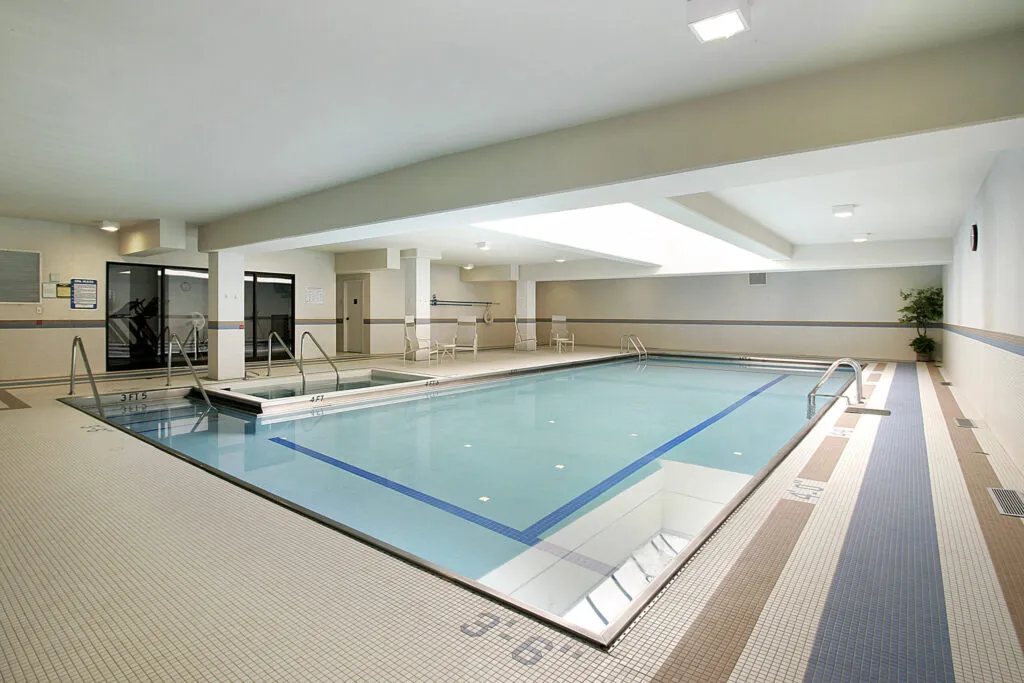
A swimming pool hall generates moisture from three simultaneous sources, all running at the same time during operating hours. Surface evaporation from the pool itself is the largest contributor, driven by water temperature, air temperature differential, and air movement across the surface.
Occupant activity adds to the load. Swimmers entering and exiting the water carry surface moisture onto the pool deck, where it evaporates into the air. Wet floors, wet seating areas, and splashing all contribute.
- Pool surface evaporation accounts for 70-80% of the total moisture load in most facilities
- Wet deck surfaces and splash zones add continuous secondary evaporation
- Occupant respiration and perspiration contribute measurable vapour, especially in busy public pools
- Showering and change areas adjacent to the pool hall feed additional moisture into the space if not separately ventilated
These loads compound throughout the day. Relative humidity climbs continuously unless active dehumidification is running. Intermittent operation does not work in pool applications.
What Happens When Humidity Exceeds 60% RH
The American Society of Heating, Refrigerating and Air-Conditioning Engineers (ASHRAE) sets the benchmark for indoor pool spaces at 50-60% relative humidity. Once humidity consistently exceeds that band, the consequences are structural, and they accelerate fast. Moisture migrates into colder adjacent spaces, condensation forms on steel and glass, and the building envelope begins to deteriorate.
| Problem | Cause | Consequence |
|---|---|---|
| Condensation on steelwork | Warm moist air contacts cooler metal surfaces | Corrosion, stress cracking, structural failure risk |
| Mould on walls and ceilings | Sustained RH above 65% on porous surfaces | Health hazard, remediation costs, facility shutdowns |
| Window and skylight fogging | Dewpoint exceeded at glazing surfaces | Reduced visibility, water pooling, frame deterioration |
| Insulation saturation | Vapour diffusion through envelope gaps | Loss of thermal performance, hidden structural rot |
| Chloramine concentration | Poor air exchange traps off-gassed chloramines | Respiratory irritation for swimmers and staff |
The Australian Stainless Steel Development Association documents the corrosive effects of pool atmospheres on structural metals. The Australian Institute of Sport Aquatic Centre in Canberra has required its roof to be replaced three times since 1984, largely due to corrosion from inadequate humidity control. That is not an unusual outcome for facilities that underspecify dehumidification.
How a Ducted Dehumidifier Protects the Building Envelope
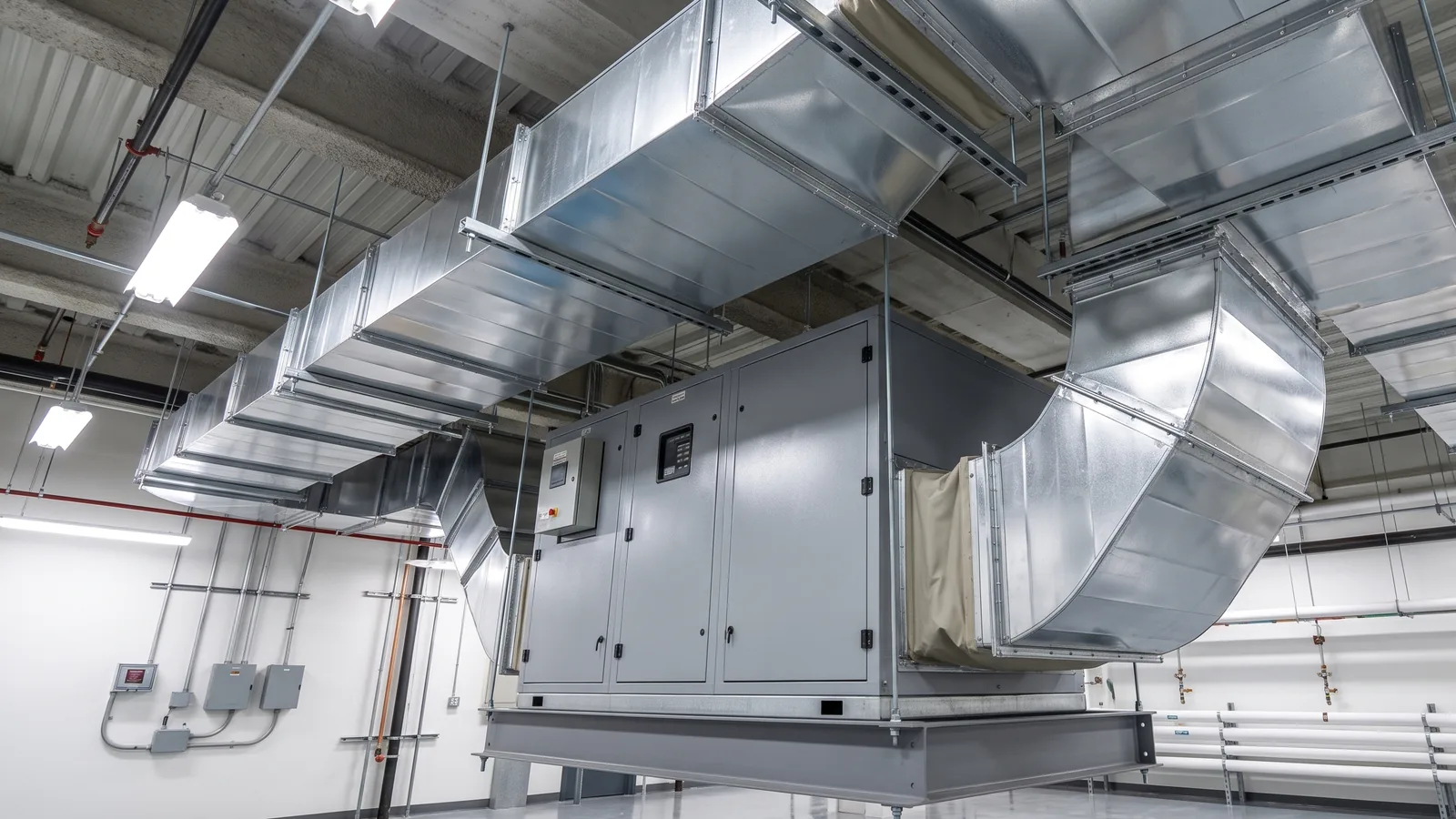
A ducted dehumidification system removes moisture at the source and distributes conditioned air evenly across the pool hall through purpose-built ductwork. Unlike wall-mounted or portable units, ducted systems handle the high airflow volumes that large aquatic spaces demand. They maintain consistent humidity levels across the entire enclosure, eliminating the cold spots and dead zones where condensation forms.
The dehumidifier unit typically sits in an adjacent plant room, connected to the pool hall via galvanised steel or PVC ductwork. This keeps the mechanical equipment out of the corrosive pool atmosphere, extending service life and simplifying maintenance access.
- Even air distribution prevents localised humidity spikes near walls and roof structures
- Continuous operation maintains the 50-60% RH target throughout the day and overnight
- Heat recovery reclaims energy from extracted air, reducing heating costs by up to 50%
- Positive pressure management stops moist pool air from being pushed through wall cavities into adjacent spaces
- Remote plant room installation protects the unit from chloramine exposure and pool splash
Moisture Cure Commercial supplies ducted dehumidification systems sized for commercial aquatic facilities, with airflow capacities matched to pool hall volume and expected moisture loads.
Why Ducted Dehumidification Outperforms Ventilation Alone
Some older pool facilities rely on exhaust ventilation or “waste air” systems to manage humidity. These work by exhausting moist indoor air and replacing it with outdoor air. The approach has a fundamental problem: it dumps conditioned air outside and forces the HVAC system to heat or cool the replacement air from scratch.
Mechanical dehumidification recirculates and treats the pool hall air, removing moisture while retaining heat energy. Published data from ASHRAE’s HVAC Applications handbook indicates this approach saves 50-75% on energy costs compared to ventilation-only strategies.
| Factor | Ventilation Only | Ducted Dehumidifier |
|---|---|---|
| Humidity control | Inconsistent, weather-dependent | Maintains 50-60% RH year-round |
| Energy efficiency | High energy waste from exhausting heated air | Heat recovery reduces running costs 50-75% |
| Building envelope protection | Poor, moist air still contacts structure | Continuous protection, even distribution |
| Outdoor air dependency | Fails in humid climates or wet seasons | Independent of outdoor conditions |
| Chloramine management | Dilution only, no removal | Filtered recirculation reduces concentration |
For Australian pool halls, ventilation-only systems are particularly unreliable. Coastal and subtropical locations regularly exceed 80% outdoor RH, meaning the replacement air is already saturated. A ducted dehumidifier operates independently of outdoor conditions.
Sizing a Ducted Dehumidifier for a Pool Hall
Pool hall dehumidification sizing is more complex than standard commercial applications. The primary variable is the pool surface area, but water temperature, air temperature, expected bather load, and the hall’s total volume all affect the calculation. ASHRAE provides evaporation rate formulas that account for these factors.
Key Variables in Pool Hall Sizing
- Pool surface area and water temperature (heated pools above 28°C produce significantly higher evaporation rates)
- Air temperature relative to water temperature (a smaller differential reduces evaporation)
- Activity factor from the ASHRAE Activity Factor table (competitive swimming = 1.0, water polo = 1.5, wave pools = 1.5+)
- Hall volume determines airflow requirements for adequate distribution
- Ventilation rate required for fresh air supply and chloramine dilution
- Target relative humidity (typically 50-60% per ASHRAE guidelines)
Get it right first time: Undersized dehumidification is the most common and most expensive mistake in pool hall design. Moisture Cure Commercial provides free sizing consultations based on your pool dimensions, water temperature, and expected usage. View the full equipment range or contact the team for a specification review.
Negative Pressure and Why It Matters
All properly designed pool halls operate under slight negative pressure. This means more air is exhausted than supplied, preventing warm, moist pool air from migrating into adjacent corridors, offices, or change rooms through gaps in the building envelope.
If the pool hall runs at positive pressure, the opposite happens. Moist, chloramine-laden air pushes through wall cavities, ceiling voids, and service penetrations. This accelerates corrosion in hidden steelwork, saturates insulation, and causes mould growth in spaces that are difficult to inspect or remediate.
- Negative pressure keeps moisture inside the controlled pool environment where the dehumidifier can manage it
- Positive pressure pushes moisture into the building structure where it causes hidden damage
- Ducted systems allow precise control of supply and return airflow to maintain the correct pressure differential
- Vapour barriers on the warm side of the envelope work with, not instead of, mechanical dehumidification
A well-designed ducted system integrates supply, return, and exhaust air paths to maintain the target pressure differential automatically. This is something portable or wall-mounted units simply cannot achieve.
Choosing Between Desiccant and Refrigerant Technology
Pool halls present an unusual operating environment. Air temperatures are typically maintained at 26-30°C, which is well within the operating range of both refrigerant and desiccant dehumidification technologies. The choice depends on facility-specific factors.
Refrigerant-based ducted units work efficiently at the warm temperatures found in pool halls. They condense moisture by cooling air below its dewpoint, then reheat it before returning it to the space.
Desiccant units use a moisture-absorbing rotor and regeneration heat to remove water vapour. They excel in applications where the target relative humidity needs to be very low, or where temperatures drop below 15°C. For pool halls with cold-water therapy pools or facilities in cooler climates, desiccant dehumidifiers offer reliable performance across the full -20°C to +50°C operating range.
- Refrigerant ducted units: cost-effective for standard heated pools at 26-30°C air temperature
- Desiccant ducted units: better for cold plunge pools, therapy facilities, or sites in cool/cold climates
- Hybrid systems: combine both technologies for facilities with mixed pool types
Protecting Your Facility Investment
A swimming pool hall is one of the most aggressive moisture environments in any commercial building. Without purpose-built ducted dehumidification, the building envelope will deteriorate. Steelwork corrodes, insulation fails, mould establishes, and remediation costs dwarf the original equipment investment.
Moisture Cure Commercial has over 28 years of experience specifying humidity control systems for commercial and industrial applications across Australia. The team provides free sizing advice and can recommend the right ducted dehumidifier configuration for your pool hall, whether it is a council aquatic centre, a hotel pool, or a private therapy facility.
Contact Moisture Cure Commercial for a consultation or site assessment. Getting the specification right at the design stage prevents years of structural problems and costly retrofits.