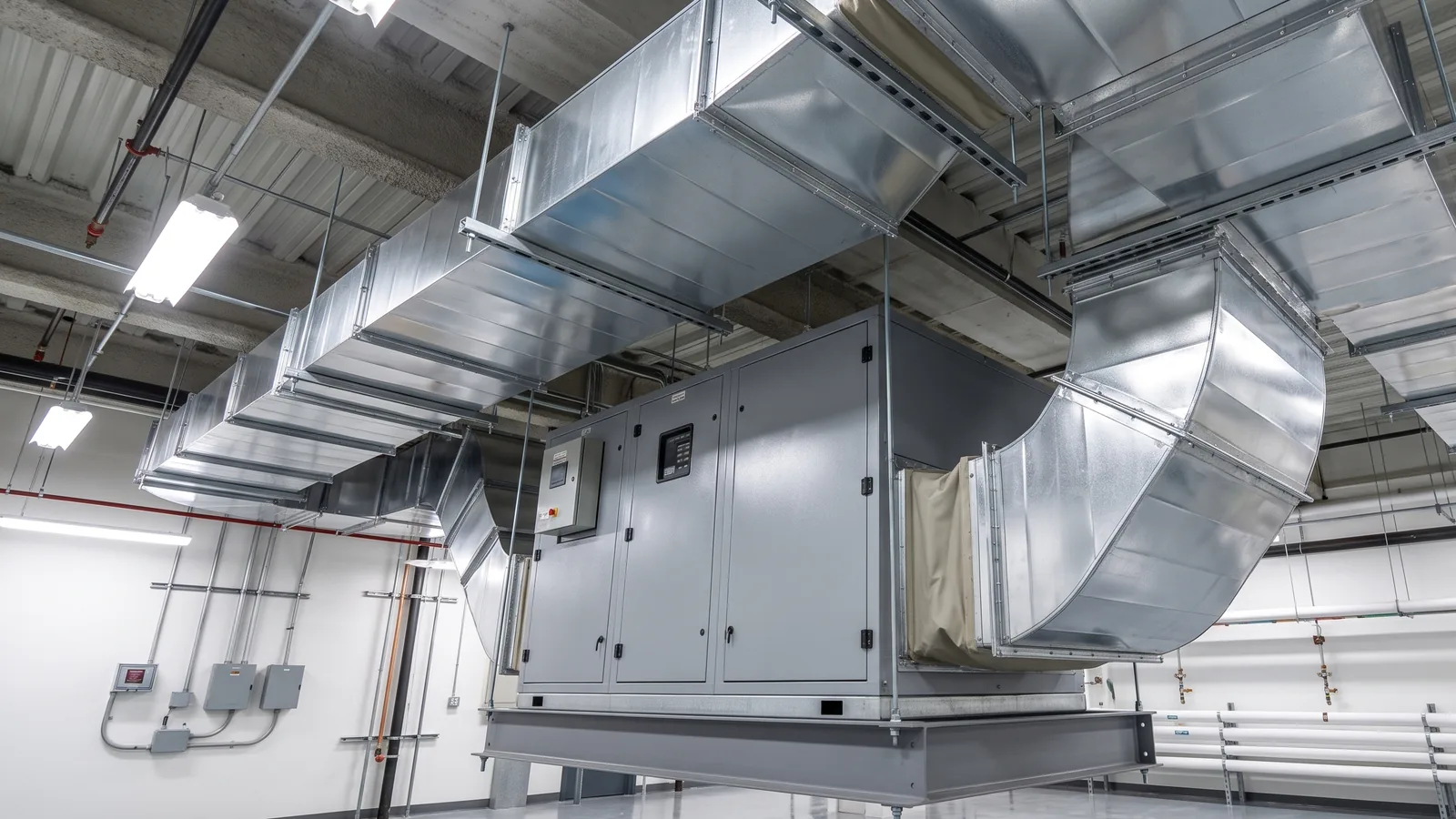
A ducted dehumidifier suits permanent installations where humidity must stay within a tight range continuously, while a portable unit suits temporary projects or multi-site operations.
That one-sentence answer covers the broad strokes, but the wrong choice costs real money. A ducted dehumidifier installed where a portable commercial unit would have done the job ties up capital and ductwork in a building you might vacate in three years. A portable unit asked to do continuous duty in a 2,000m² warehouse will burn through its compressor in half the time.
This article breaks down the practical differences between ducted and portable commercial dehumidifiers. It covers capacity, installation, operating costs, and the specific scenarios where each type earns its keep.
Moisture Cure Commercial supplies both ducted dehumidifiers and portable commercial units across Australia. If you are weighing up the two options for a specific facility, contact the team for sizing advice before you buy.
How Ducted Dehumidifiers Work in Commercial Settings
A ducted dehumidifier sits in a plant room, ceiling void, or mechanical area and connects to the space via supply and return ductwork. Humid air is drawn in through the return duct, passes over the dehumidification coil (either refrigerant or desiccant), and dry air is pushed back into the space through the supply duct. The unit never sits in the occupied area.
This matters because ductwork distributes dry air evenly across the entire space. A single ducted unit with properly designed ductwork can maintain uniform conditions across a 1,500m² warehouse floor. Try doing that with portable units and you end up with dry spots near the machines and damp corners 30 metres away.
- Hidden installation: unit sits in a plant room or ceiling void, out of the way of operations
- Even distribution: ductwork delivers dry air across the full floor area
- Continuous operation: designed for 24/7 duty cycles without overheating
- Integrated controls: humidistat-controlled, often tied into the building management system (BMS)
- Condensate drainage: plumbed directly to a drain, no tanks to empty
Ducted units are sized in litres per day (L/day) of moisture removal at specific temperature and humidity conditions. A mid-range commercial ducted dehumidifier might extract 100-300 L/day, while larger industrial units exceed 500 L/day.
How Portable Commercial Dehumidifiers Work
A portable commercial dehumidifier is a self-contained unit on wheels or a frame. It draws air in from one side, processes it, and blows dry air out the other. Some models have short duct connections for directing airflow, but they do not integrate into building ductwork the way a permanent installation does.
Portable units range from 30 L/day to over 150 L/day depending on the model. They plug into a standard or three-phase power outlet and start working immediately. Most have onboard tanks with an auto-shutoff, plus an option for continuous drain via a gravity hose.
- Immediate deployment: plug in and run, no installation required
- Relocatable: move between sites, rooms, or buildings as needed
- Lower upfront cost: no ductwork, no plumbing, no electrical fit-out
- Self-contained: built-in humidistat, tank, and sometimes a pump
- Rental friendly: easy to hire for short-term projects
The trade-off is coverage. A portable unit dehumidifies the air immediately around it. In a large open space, you need multiple units positioned strategically. In a small server room or archive store, a single portable unit handles the job without the expense of ducting.
Ducted vs Portable Dehumidifier Comparison
The table below compares the two types across the factors that matter most to facility managers and engineers. Every line item here affects either upfront cost, ongoing cost, or operational reliability.
| Factor | Ducted Dehumidifier | Portable Commercial |
|---|---|---|
| Installation | Requires ductwork, drainage plumbing, electrical | Plug-and-play, no installation |
| Coverage area | 500-5,000+ m² per unit | 50-300 m² per unit |
| Duty cycle | 24/7 continuous rated | Intermittent to continuous (model dependent) |
| Noise in workspace | Low (unit is remote from occupied area) | Moderate to high (unit sits in the space) |
| Upfront cost | Higher (unit + ductwork + install) | Lower (unit only) |
| Operating cost per m² | Lower for large spaces | Higher when multiple units needed |
| Maintenance access | Requires access to plant room | Direct access, easy filter changes |
| Flexibility | Fixed to one location | Move between sites or rooms |
| BMS integration | Standard on most models | Rare, usually standalone |
| Condensate handling | Plumbed to drain | Tank or gravity hose |
The pattern is clear: ducted wins on performance and operating cost for permanent facilities. Portable wins on flexibility and upfront cost for temporary or multi-site use.
When a Ducted Dehumidifier Is the Right Choice
A ducted system earns its higher upfront cost in facilities where humidity control is a permanent requirement and downtime is not an option. If your operation depends on maintaining specific humidity levels 365 days a year, a ducted unit is the only serious option.
- Food manufacturing and storage: hygiene standards require consistent conditions across the full production floor, not just near a portable unit
- Pharmaceutical production: GMP compliance demands documented, verifiable humidity control tied to a BMS
- Data centres and server rooms: condensation on equipment costs far more than ductwork ever will
- Indoor pools and aquatic centres: massive moisture loads need high-capacity extraction with ductwork to manage airflow patterns
- Museums and archives: collection preservation requires stable RH within 2-3% tolerance, which portable units cannot guarantee
- Cold storage facilities: temperatures below 15°C rule out refrigerant portables entirely. Desiccant dehumidifiers operate down to -20°C.
Below 15°C, refrigerant dehumidifiers lose capacity rapidly because the evaporator coil ices up. If your facility operates at low temperatures, a ducted desiccant unit is the only reliable option. Moisture Cure Commercial supplies YAKE desiccant units rated from -20°C to +50°C.
When a Portable Dehumidifier Makes More Sense
Portable units are not a compromise. For the right application, they are the correct tool. Spending $15,000 on ductwork for a 200m² space you might vacate next year is poor capital allocation. A portable unit covering that same space costs a fraction and leaves with you when the lease ends.
- Flood restoration and water damage: temporary deployment, move to the next job site when done
- Construction drying: concrete curing, plastering, painting in new builds or renovations
- Seasonal humidity spikes: warehouses that only need dehumidification 3-4 months per year
- Small dedicated rooms: a single server rack room, archive store, or electrical switch room under 100m²
- Multi-site operations: one unit rotated between locations as needed
- Rental properties: landlords managing humidity complaints without permanent modification to the building
For temporary commercial projects, Moisture Cure Commercial can advise on the right portable capacity for your specific floor area and moisture load.
Common Sizing Mistakes
The most expensive mistake in commercial dehumidification is under-sizing. An under-sized unit runs at 100% capacity continuously, consumes maximum power, and still fails to hit the target RH. Over-sizing wastes capital but at least the unit works. Under-sizing wastes capital AND fails to control the environment.
- Ignoring fresh air loads: if the HVAC system introduces outside air, that moisture load must be added to the calculation. A warehouse with loading dock doors open 8 hours a day has a completely different moisture load to a sealed cleanroom.
- Using residential ratings: residential dehumidifiers quote extraction rates at 30°C and 80% RH. Real commercial environments are often 18-22°C and 60-70% RH. Actual extraction at those conditions can be 40-60% of the headline number.
- Counting floor area instead of volume: a 500m² warehouse with 12m ceiling height holds far more moisture than the same footprint with 3m ceilings.
- Forgetting heat loads: every dehumidifier adds heat to the space. In temperature-sensitive environments, the heat output must be factored into the HVAC design.
A proper sizing calculation accounts for room volume, ambient temperature, target RH, fresh air infiltration rate, internal moisture sources (people, processes, product), and building envelope leakage. Moisture Cure Commercial includes expert sizing advice with every consultation.
Making the Decision for Your Facility
Start with two questions. First: is this a permanent requirement or a temporary one? If permanent, ducted. If temporary, portable. Second: how large is the space? Anything over 300-400m² with a continuous duty requirement almost always lands on ducted, because the operating cost per square metre drops significantly at scale.
- Permanent facility + large area = ducted
- Permanent facility + small room = portable (unless BMS integration required)
- Temporary project of any size = portable
- Cold environment below 15°C = ducted desiccant
- Multi-site operation = portable fleet
If you are unsure, a site assessment takes the guesswork out of it. Moisture Cure Commercial’s team can evaluate your facility, calculate the moisture load, and recommend the right unit type and capacity. Contact them for a consultation or quote.