Most office HVAC systems control temperature well but leave humidity unchecked, and that gap costs you in mould remediation, sick leave and energy waste.
Office buildings across Australia face a persistent humidity problem. Longer humid seasons, higher occupancy loads and constant door traffic push indoor moisture levels well above the 40 to 60 per cent relative humidity (RH) range recommended by SafeWork NSW.
Standard air conditioning handles temperature. It rarely handles moisture with any precision.
This article breaks down why a dedicated commercial dehumidifier belongs in your office building’s mechanical plant, what type suits different building profiles, and how to size one correctly for your floor area.
Related reading: Already know you need desiccant technology? See our full range of desiccant dehumidification systems or compare refrigerant units for milder conditions.
Why Office Buildings Struggle with Humidity
An office building is not a sealed box. Every time a lobby door opens, humid outside air floods the ground floor.
Lifts act as pistons, drawing moist air up through shafts. Meeting rooms packed with 20 people generate moisture from breathing and perspiration that the local fan coil unit was never sized to remove.
Australian commercial building HVAC systems are typically designed to AS/NZS 1668.2 ventilation standards, which set minimum fresh air rates. Those fresh air rates bring outside moisture in by design.
In subtropical cities like Brisbane, Sydney’s western suburbs or Darwin, the latent load from ventilation air alone can overwhelm the cooling coil’s dehumidification capacity.
- Lobby and ground floor infiltration from foot traffic and automatic doors
- Ventilation air loads mandated by AS/NZS 1668.2 introducing outside moisture
- Occupant moisture from breathing, perspiration and kitchenette steam
- Poorly calibrated CO₂ sensors triggering excessive outside air intake
- Negative building pressurisation from unbalanced exhaust fans pulling humid air through gaps
A.G. Coombs, one of Australia’s largest building services firms, notes that poorly maintained outside air dampers and uncalibrated CO₂ sensors are among the most common causes of elevated humidity in commercial buildings.
Mould remediation in a single tenancy can run into tens of thousands of dollars.
What Uncontrolled Humidity Does to an Office
The effects go beyond foggy windows. When indoor RH climbs above 60 per cent, the building itself starts to suffer.
Ceiling tiles sag. Carpet adhesive fails. Metal door frames and structural fixings corrode faster than expected.
Research from the University of Arizona found that workers spending most of their time in RH conditions between 30 and 60 per cent were 25 per cent less stressed than those exposed to drier or more humid conditions.
Above 60 per cent, the body’s ability to cool itself drops, concentration fades and sick building syndrome complaints rise.
| Humidity Range | Effect on Office Environment |
|---|---|
| Below 30% RH | Dry eyes, static discharge, respiratory irritation |
| 30 to 60% RH | Optimal comfort zone, lowest sick leave rates |
| 60 to 70% RH | Musty odours, dust mite growth accelerates |
| Above 70% RH | Active mould growth, corrosion, carpet delamination |
SafeWork NSW recommends maintaining indoor RH between 40 and 70 per cent for sedentary office work. The tighter 40 to 60 per cent band is where occupant comfort and building protection overlap.
When Your HVAC Needs a Dedicated Commercial Dehumidifier
Not every office building needs a standalone dehumidifier. If your chilled water plant handles latent load comfortably and your BMS logs show RH staying between 40 and 55 per cent year round, you are in good shape.
The problems start when any of the following conditions apply.
- BMS humidity logs regularly exceed 60 per cent RH during summer months
- Tenants report musty smells, condensation on glass or mould on ceiling tiles
- The building sits in a coastal or subtropical climate zone
- Ground floor lobbies or basement car parks have persistent dampness
- NABERS Indoor Environment ratings are slipping due to moisture complaints
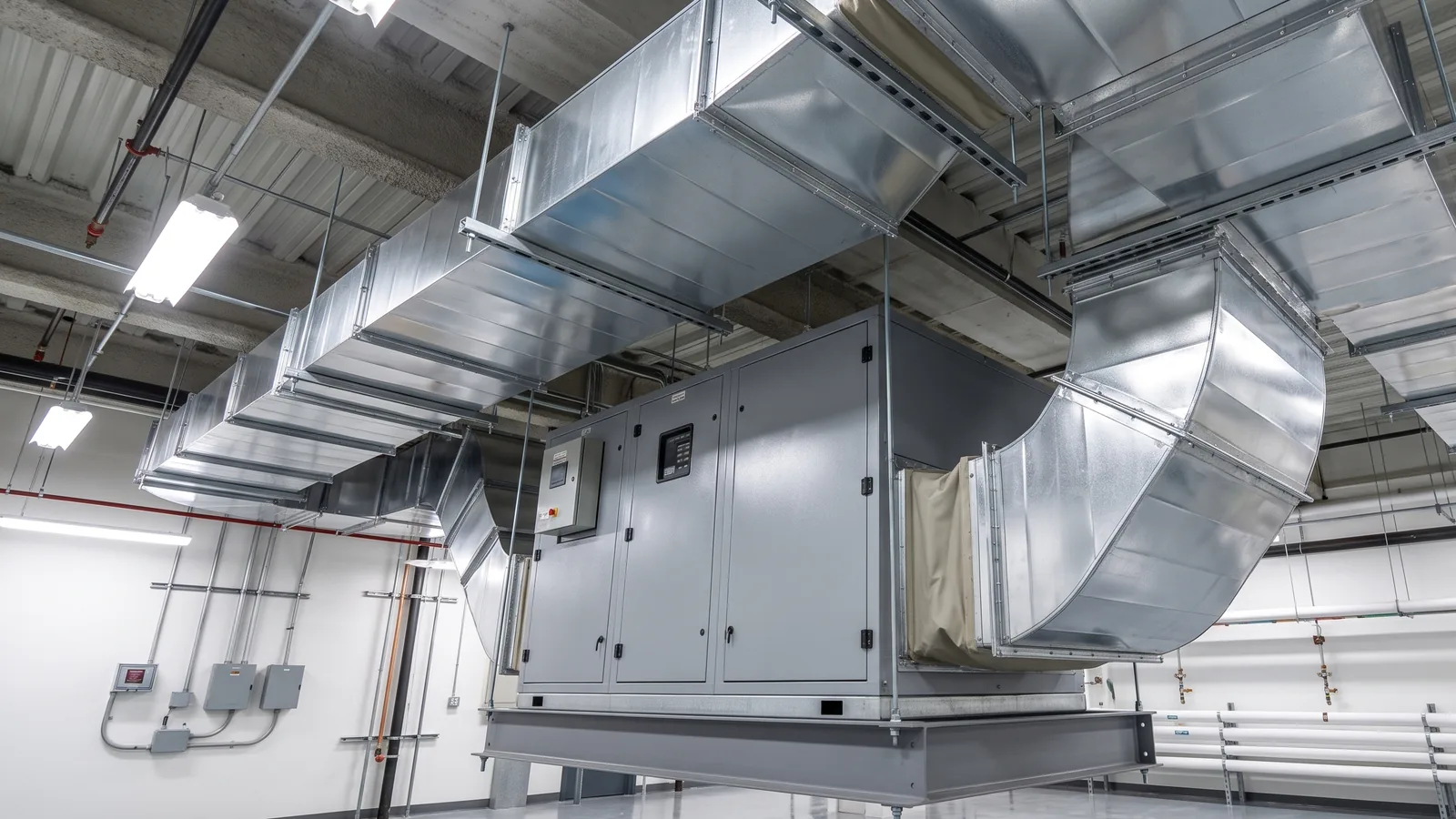
If two or more of those apply, bolting a ducted dehumidification system onto your existing air handling units is usually the most cost-effective fix. It lets the chiller focus on sensible cooling while the dehumidifier handles the moisture independently.
Common mistake: Facility managers often drop the chilled water setpoint to force more dehumidification from the cooling coil. This over-cools the supply air, triggers reheat energy use and pushes up electricity bills without actually solving the humidity problem.
Desiccant vs Refrigerant for Office Buildings
Two core technologies dominate commercial dehumidification. Refrigerant units cool air below its dew point to condense moisture out.
Desiccant units pass air through a moisture-absorbing rotor, stripping water vapour without cooling. Each suits different office building scenarios.
| Factor | Refrigerant Dehumidifier | Desiccant Dehumidifier |
|---|---|---|
| Best operating range | Above 15°C, moderate humidity | Any temperature from -20°C to +50°C |
| Energy source | Electrical compressor | Electrical heater or gas for regeneration |
| Ducting integration | Straightforward with AHU | Excellent, often process/regen split duct |
| Low-temp performance | Drops off sharply below 15°C | Full capacity maintained |
| Typical office use case | Standard CBD office towers | Mixed-use, cold climates, 24/7 server areas |
| Moisture removal precision | Moderate (limited by coil temp) | High (can target specific RH setpoints) |
For a standard office tower in a temperate climate, a refrigerant unit integrated with the AHU often does the job. But for buildings with underground plant rooms, cold-climate locations or sections that need precise humidity control (server rooms, archives, medical suites), desiccant dehumidifiers are the better option.
Moisture Cure Commercial supplies YAKE desiccant units rated from -20°C to +50°C. That range matters for offices with loading docks, basement storage or plant rooms where temperatures drop below the threshold where refrigerant units lose capacity.
How to Size a Commercial Dehumidifier for Your Office
Under-sizing is the single most common mistake in commercial dehumidification. A unit rated for a warehouse will not suit an office with high ventilation rates.
The variables that drive sizing for office buildings differ from industrial applications.
- Floor area and ceiling height to calculate total air volume in cubic metres
- Ventilation rate per AS/NZS 1668.2, typically 10 L/s per person for office space
- Occupancy density, which ranges from 10 m² per person in open plan to 20 m² in private offices
- Ambient conditions, specifically the design wet bulb temperature for your climate zone
- Target RH setpoint, usually 50 per cent for general office, 45 per cent for server rooms
- Infiltration load from doors, loading docks and lift shafts
A 5,000 m² office floor in Sydney with standard occupancy and 10 L/s per person ventilation might need a unit removing 40 to 80 litres per hour, depending on the season and how much latent load the existing chiller already handles.
Get it right first time: Moisture Cure Commercial provides free sizing consultations. Send through your floor plans, BMS humidity logs and mechanical drawings, and our team will recommend the right unit capacity for your building.
Installation Options for Office Buildings
Where the dehumidifier sits in your mechanical system depends on the building’s age, plant room layout and whether you are retrofitting or designing from scratch.
Ducted Integration with Existing AHUs
The most common approach for existing buildings. A ducted dehumidifier sits in the plant room and connects to the supply air ductwork downstream of the AHU. Process air passes through the dehumidifier before reaching the occupied floors.
Standalone Units for Problem Zones
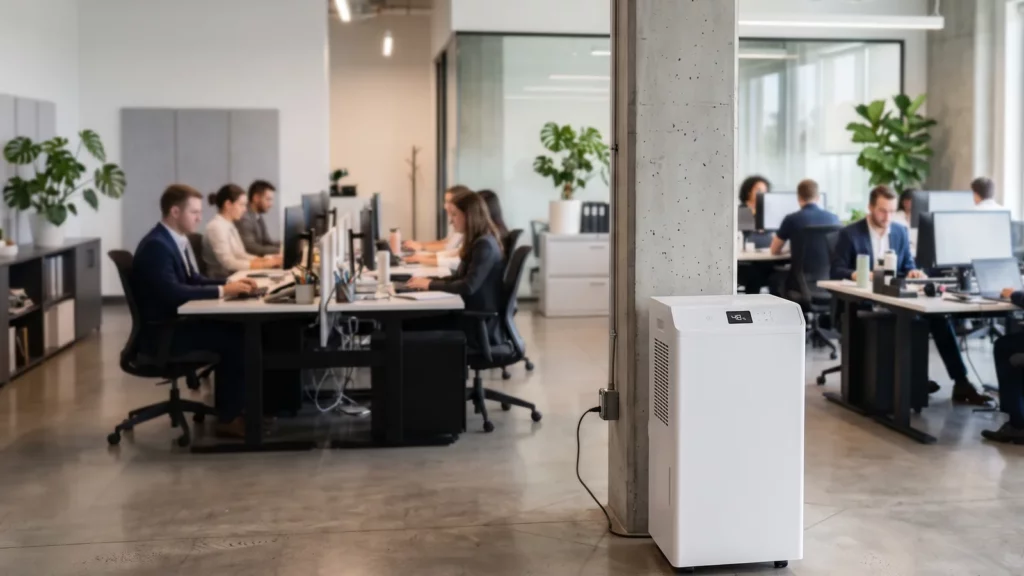
Ground floor lobbies, basement archives and server rooms often need localised humidity control. A standalone unit with its own ductwork can target a single zone without touching the central plant.
Fresh Air Pre-treatment
In humid coastal locations, treating the fresh air intake before it enters the AHU removes moisture at the source. This reduces the latent load on the chiller and improves overall system efficiency.
- Ducted integration suits multi-floor buildings with central plant rooms
- Standalone units work for isolated problem areas like archives or server rooms
- Fresh air pre-treatment is ideal for coastal or subtropical buildings with high outside air loads
Running Costs and Energy Considerations
Adding a dehumidifier to an office building does increase energy consumption. But the net effect is often positive.
When the dehumidifier handles latent load independently, the chiller runs more efficiently because it is no longer over-cooling air just to wring out moisture.
- Chiller energy drops because the supply air setpoint can rise by 2 to 4°C
- Reheat energy drops because supply air is no longer sub-cooled
- NABERS Energy ratings often improve as total HVAC energy falls
- Mould remediation costs (tens of thousands per incident) are avoided entirely
Desiccant units use thermal energy for regeneration, so operating costs depend on whether you use electric heating, gas or waste heat recovery.
In buildings with gas-fired boilers or cogeneration, the regeneration heat can come at minimal marginal cost.
Moisture Cure Commercial has over 28 years of experience sizing humidity control systems for Australian commercial buildings. We help facility managers match the right technology to the building’s load profile, not just pick the biggest unit on the spec sheet.
Next Steps for Your Office Building
If your BMS logs show RH regularly exceeding 60 per cent, or tenants are reporting musty smells and condensation, the building needs dedicated dehumidification. Waiting for mould to appear means waiting for a remediation bill.
- Pull your BMS humidity logs for the last 12 months and identify the worst-performing floors
- Check whether your outside air dampers and CO₂ sensors have been calibrated recently
- Contact Moisture Cure Commercial with your floor plans and humidity data for a free sizing recommendation
Our team will recommend the right unit type, capacity and installation approach for your building. Every enquiry includes expert sizing advice at no charge. Get in touch to discuss your office building’s humidity control requirements.