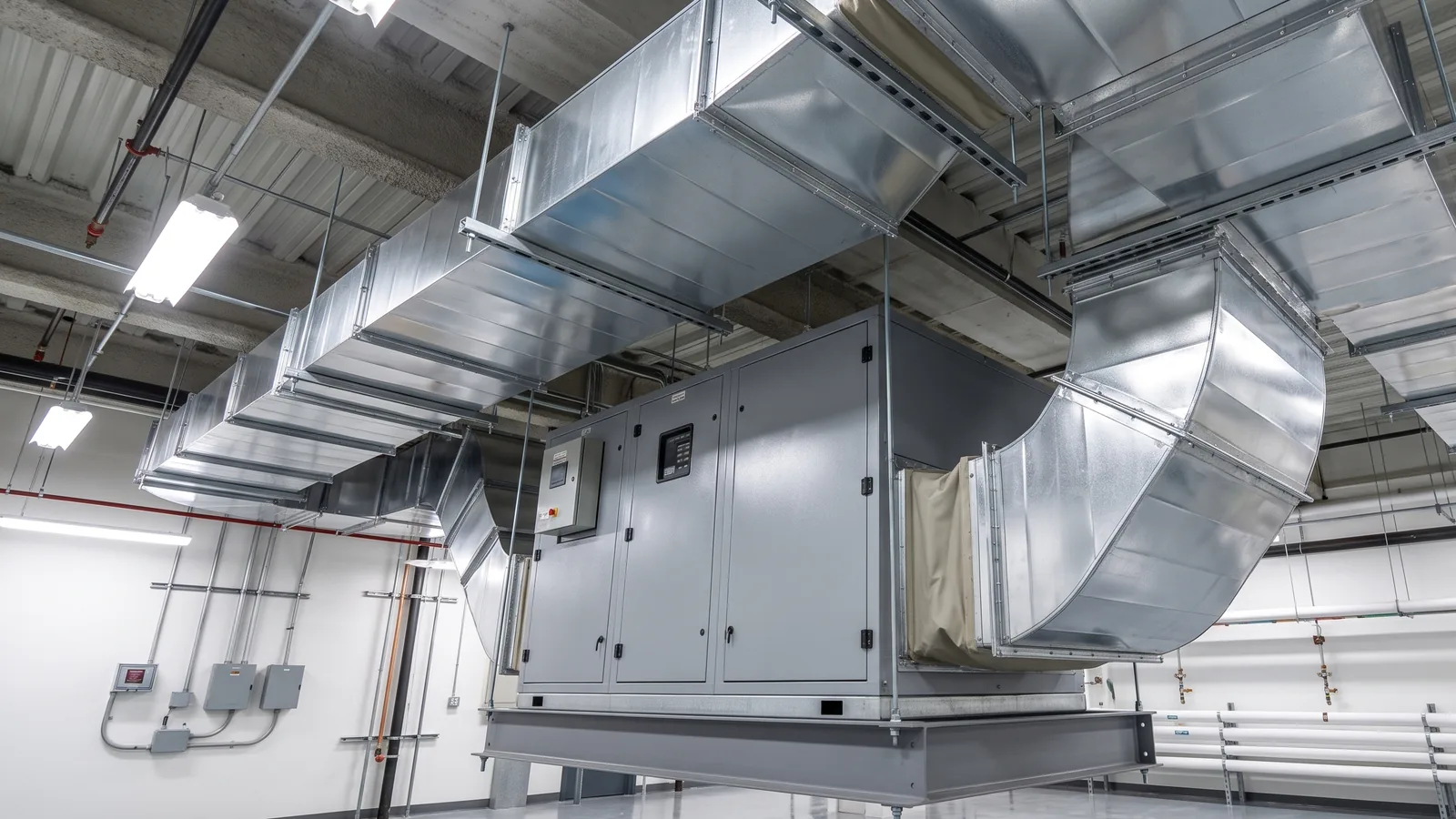
A ducted dehumidifier connects directly to your existing HVAC ductwork, giving you building-wide humidity control without a second distribution system.
Most commercial facilities already have extensive ductwork running through ceilings and risers. Adding a standalone dehumidifier means duplicate runs, extra penetrations, and wasted plant room space.
This article covers the three main ways to tie a ducted dehumidifier into an existing HVAC layout, how to pick between desiccant and refrigerant units for integrated setups, and the sizing and control details that make or break the project.
Already comparing unit types? Read our guide on desiccant dehumidifiers or browse the full commercial dehumidifier range.
Why Integrate a Ducted Dehumidifier with Your HVAC System
Tapping into existing ductwork cuts installation cost and time significantly. You avoid running a parallel set of ducts through an already crowded ceiling cavity, and the dehumidified air reaches every zone your HVAC already serves.
Integration also simplifies controls. A single building management system (BMS) can coordinate temperature and humidity together rather than running two independent systems that fight each other.
- Lower capital cost by reusing existing supply and return ductwork
- Smaller footprint because no second duct network is needed
- Unified controls through your existing BMS or building thermostat
- Better air distribution since conditioned air reaches every zone the HVAC covers
- Reduced maintenance with fewer duct runs to inspect and clean
For facilities like warehouses, pharmaceutical cleanrooms, and food production plants, this approach keeps relative humidity within tight tolerances without doubling your mechanical services budget. ASHRAE’s HVAC Systems and Equipment Handbook covers the engineering principles behind integrated dehumidification in detail.
Three HVAC Integration Configurations for Ducted Dehumidifiers
There are three common ways to connect a ducted dehumidifier to existing HVAC ductwork. Each suits different building layouts, airflow volumes, and control requirements.
Choosing the wrong configuration leads to pressure imbalances, short-cycling, or uneven humidity across zones.
Return-to-Supply
The dehumidifier draws air from a dedicated return grille (or a tap off the main return plenum) and discharges treated air into the supply plenum downstream of the air handling unit. This is the preferred method for most commercial retrofits because it keeps the dehumidifier’s airflow separate from the AHU fan.
Return-to-Return
Both the intake and discharge connect to the return side. The dehumidifier pre-treats return air before it reaches the AHU coil, reducing the latent load on the cooling system.
This works well in facilities where the AHU is already struggling with high moisture loads.
Bypass Configuration
The dehumidifier sits across the AHU, pulling from the return side and injecting into the supply side through a bypass duct. Motorised dampers control how much air passes through the dehumidifier versus the standard cooling path.
| Configuration | Best For | Key Consideration |
|---|---|---|
| Return-to-Supply | Most commercial retrofits | Requires supply plenum access |
| Return-to-Return | High latent load facilities | Two fans in series, watch static pressure |
| Bypass | Variable humidity zones | Needs motorised dampers and controls |
Desiccant or Refrigerant for HVAC Integration
The type of dehumidifier you integrate matters as much as how you connect it. Refrigerant units cool air below its dewpoint, condensing moisture on a coil.
Desiccant units take a different approach, passing air through a chemical rotor that adsorbs water vapour directly. For HVAC integration, the operating temperature of your facility is the deciding factor.
Refrigerant dehumidifiers lose effectiveness below about 15°C because the coil frosts up. YAKE desiccant units, like those supplied by Moisture Cure Commercial, operate from -20°C right through to +50°C.
- Cold stores and freezer entries: desiccant is the only viable option
- Climate-controlled offices and retail: refrigerant works well above 18°C
- Factories with wide temperature swings: desiccant handles the full range
- Indoor pools and aquatic centres: either can work, but desiccant handles chlorine-laden air better
Browse the refrigerant dehumidifier range for standard commercial environments, or the desiccant range for cold or variable-temperature facilities.
Sizing a Ducted Dehumidifier for Existing Ductwork
Undersizing is the most common mistake in HVAC-integrated dehumidification. A unit that handles the latent load on paper may not keep up once you factor in duct losses, infiltration air, and process moisture from equipment or products.
Start with these variables before requesting a specification.
- Room volume and air change rate: larger spaces or high air-change facilities need proportionally more capacity
- Target relative humidity: a pharmaceutical cleanroom at 35% RH demands far more extraction than a warehouse at 60% RH
- Ambient conditions: coastal Australian cities like Sydney and Brisbane push outdoor humidity above 80% RH for months at a time (the Bureau of Meteorology humidity maps show regional patterns)
- Internal moisture sources: people, cooking, washing, open water, wet products on the production line
- Existing duct static pressure: the dehumidifier adds resistance, and your AHU fan must handle the combined load
Rule of thumb: if your existing AHU already runs above 80% of its rated static pressure, a return-to-supply configuration is safer than return-to-return, because it avoids stacking fan pressures in series.
Moisture Cure Commercial provides specification advice on every enquiry, drawing on 28 years of sizing units for Australian commercial and industrial conditions.
Control System Integration and BMS Compatibility
Plugging a dehumidifier into your ductwork is the mechanical half of the job. The controls side determines whether the system actually holds your target humidity or just runs flat out and wastes energy.
Modern ducted dehumidifiers accept standard control signals (0-10V, 4-20mA, Modbus, BACnet) that let your BMS manage them alongside chillers, AHUs, and VAV boxes.
- Humidistat control: a duct-mounted humidity sensor triggers the dehumidifier when RH exceeds the setpoint
- BMS integration: the BMS sends a run signal and modulates capacity based on zone demand
- Interlock with AHU: the dehumidifier only runs when the AHU fan is active, preventing dead air in the ductwork
- Alarm and fault relay: filter blockage, high discharge temperature, or condensate overflow flags back to the BMS
Without an AHU interlock, the dehumidifier can push treated air into static ductwork. That creates localised dry spots near the discharge point while the rest of the building stays humid.
Common Mistakes When Connecting to Existing HVAC
Facility managers and mechanical contractors regularly make the same errors when retrofitting a ducted dehumidifier into an existing system. Most of these are avoidable with proper planning.
- Ignoring static pressure: adding a dehumidifier to the return path increases resistance, reducing airflow through the AHU
- No condensate drain plan: ducted units mounted in ceiling cavities need a reliable gravity or pump drain, not a bucket
- Oversized duct taps: connecting with duct sizes larger than the dehumidifier’s rated port causes turbulence and noise
- Skipping the filter: the dehumidifier’s intake needs its own filter stage, even if the AHU has filtration downstream
- Forgetting maintenance access: a ceiling-mounted unit with no access panel means filters never get changed
Every one of these issues shows up in the first six months of operation. Getting a proper site assessment before installation catches them early.
When Standalone Installation Makes More Sense
HVAC integration is not always the right call. Some buildings have ductwork that is too small, too old, or too restricted to handle additional airflow.
- The existing AHU fan is already at maximum capacity
- Ductwork runs are inaccessible (e.g. cast-in-slab or asbestos-lined)
- Only one zone needs dehumidification while the rest of the building does not
- The facility operates at temperatures below 5°C throughout, requiring a dedicated desiccant system with its own air path
In these cases, a standalone ducted unit with its own short duct runs, or even a portable industrial unit, may deliver better results for less money.
Get the Integration Right the First Time
A well-integrated ducted dehumidifier disappears into your HVAC system. You get consistent humidity control across every zone without duplicate ductwork, extra plant room space, or a second set of maintenance schedules.
Get it wrong, and you end up with pressure imbalances, noise complaints, and a unit that runs constantly without hitting target. The difference comes down to choosing the right configuration, sizing for real-world conditions, and wiring controls properly.
Need specification advice? Moisture Cure Commercial provides free sizing consultations for all ducted dehumidifier HVAC integration projects across Australia.
Moisture Cure Commercial has been specifying and supplying humidity control solutions for Australian commercial and industrial facilities for over 28 years. Contact the team for a site assessment or specification advice on integrating a ducted dehumidifier with your existing HVAC system.