Industrial dehumidifier noise levels range from around 50 dB(A) for compact refrigerant units to 85 dB(A) or more for large-capacity plant systems.
For facility managers and engineers specifying dehumidification equipment, noise is a practical constraint that affects where units can be installed, how they are ducted, and whether additional acoustic treatment is needed. Getting this wrong means employee complaints, OH&S issues, or expensive retrofits.
This guide covers how industrial dehumidifier noise is measured, what levels to expect from different technologies, Australian workplace noise regulations, and practical methods for reducing noise impact on your site.
How Dehumidifier Noise Is Measured
Dehumidifier noise is expressed in decibels using the A-weighted scale, written as dB(A). A-weighting adjusts the raw measurement to reflect how the human ear perceives sound, reducing the contribution of very low and very high frequencies that we hear less clearly.
Manufacturers typically test noise output at 1 metre distance from the unit in controlled conditions. Real-world readings in a facility will differ based on room acoustics, reflective surfaces, and background noise from other equipment.
| Sound source | Approximate dB(A) |
|---|---|
| Quiet library | 30 to 40 |
| Normal office conversation | 50 to 60 |
| Compact refrigerant dehumidifier | 50 to 60 |
| Mid-range desiccant dehumidifier | 55 to 70 |
| Busy workshop or factory floor | 70 to 80 |
| Large industrial dehumidification plant | 70 to 85 |
| Angle grinder at 1 metre | 95 to 105 |
The decibel scale is logarithmic, not linear. A 10 dB increase represents a tenfold increase in sound intensity and roughly a doubling of perceived loudness. The difference between a 55 dB unit and a 75 dB unit is not marginal. It is the difference between normal conversation and a noisy factory floor.
Spec sheet tip: Always check whether the manufacturer quotes noise at 1 metre or at 3 metres, and whether the figure is for free-field conditions or a reverberant room. These testing differences can account for 6 dB to 10 dB variation between comparable units.
Sound pressure level (SPL) decreases with distance according to the inverse square law. In open conditions, doubling the distance from the source reduces the level by approximately 6 dB. A unit rated at 70 dB(A) at 1 metre will read around 64 dB(A) at 2 metres and 58 dB(A) at 4 metres, assuming no reflections.
Industrial Dehumidifier Noise Levels by Type
The two main dehumidification technologies used in commercial and industrial settings produce different noise profiles. Understanding the source of noise in each type helps when comparing specifications and planning installations.
| Dehumidifier type | Typical range dB(A) at 1 m | Primary noise sources |
|---|---|---|
| Refrigerant (compressor-based) | 50 to 65 | Compressor, condenser fan, evaporator fan |
| Desiccant (rotor-based) | 55 to 70 | Process fan, regeneration fan, rotor drive |
| Large industrial plant (either type) | 70 to 85 | High-volume fans, ducting turbulence, multiple compressors |
Refrigerant dehumidifiers generate noise primarily from their compressor and fan motors. Compressor noise tends to be a steady low-frequency hum, while fan noise adds higher-frequency airflow sound. Smaller commercial units in the 50 to 100 L/day range typically sit between 50 and 60 dB(A).
Desiccant dehumidifiers use a rotating silica gel wheel and two separate airflows, the process air stream and the regeneration air stream. Both require fans, and the regeneration side often includes a heater and its own exhaust fan. This dual-fan arrangement means desiccant units are commonly a few decibels louder than refrigerant units of similar capacity.
- Low-noise desiccant units (55 to 62 dB): Smaller industrial units with insulated casings and low-speed fans, suitable for occupied spaces
- Standard industrial desiccant (62 to 70 dB): Mid-range units for warehouses, storage facilities, and plant rooms where moderate noise is acceptable
- High-capacity plant systems (70 to 85 dB): Large centralised systems handling thousands of cubic metres per hour, typically housed in dedicated plant rooms with acoustic isolation
Fan speed is the single biggest factor in noise output. Units with variable-speed drives can reduce fan speed during low-demand periods, dropping noise levels significantly. A unit that runs at 68 dB(A) on full speed may drop to 58 dB(A) at half speed.
Why Noise Matters in Commercial Facilities
Noise is more than a comfort issue. In Australia, workplace noise exposure is regulated under harmonised Work Health and Safety legislation, with specific limits that employers must not exceed.
Safe Work Australia sets the exposure standard at 85 dB(A) averaged over an 8-hour time-weighted average (TWA). The peak noise limit is 140 dB(C) for any single event. Employers must eliminate or minimise noise exposure so far as is reasonably practicable.
| Noise level dB(A) | Maximum permitted daily exposure (TWA) | Practical implication |
|---|---|---|
| 85 | 8 hours | Hearing protection mandatory if this cannot be reduced |
| 88 | 4 hours | Noise exposure halves for every 3 dB increase |
| 91 | 2 hours | Significant engineering controls needed |
| 94 | 1 hour | Very limited exposure without full PPE programme |
Even below 85 dB(A), noise affects productivity and communication. Studies consistently show that sustained noise above 65 dB(A) reduces concentration and increases errors in cognitive tasks. For office environments, healthcare facilities, archives, and food processing areas with adjacent office spaces, noise from dehumidification equipment matters well below the regulatory threshold.
- Healthcare and aged care: Patient recovery areas, operating theatres, and consulting rooms require background noise below 40 to 45 dB(A) per AS/NZS 2107 guidelines
- Libraries and archives: Reading rooms and collection storage areas typically specify 35 to 45 dB(A)
- Offices adjacent to plant rooms: Noise transmission through walls and floors can push office levels above 50 dB(A) if the dehumidifier is not properly isolated
- Food manufacturing: Processing floors may tolerate 70 to 80 dB(A), but adjacent packing and quality control areas often need quieter conditions
- Warehouses: Forklift operators and warehouse staff can tolerate higher noise levels, but voice communication should remain clear at 3 to 5 metres
How to Reduce Dehumidifier Noise on Site
The most effective noise reduction strategies are decided at the planning stage, not after the unit is installed. Relocating a 200 kg dehumidifier because it is too loud in its current position costs time and money that proper planning avoids.
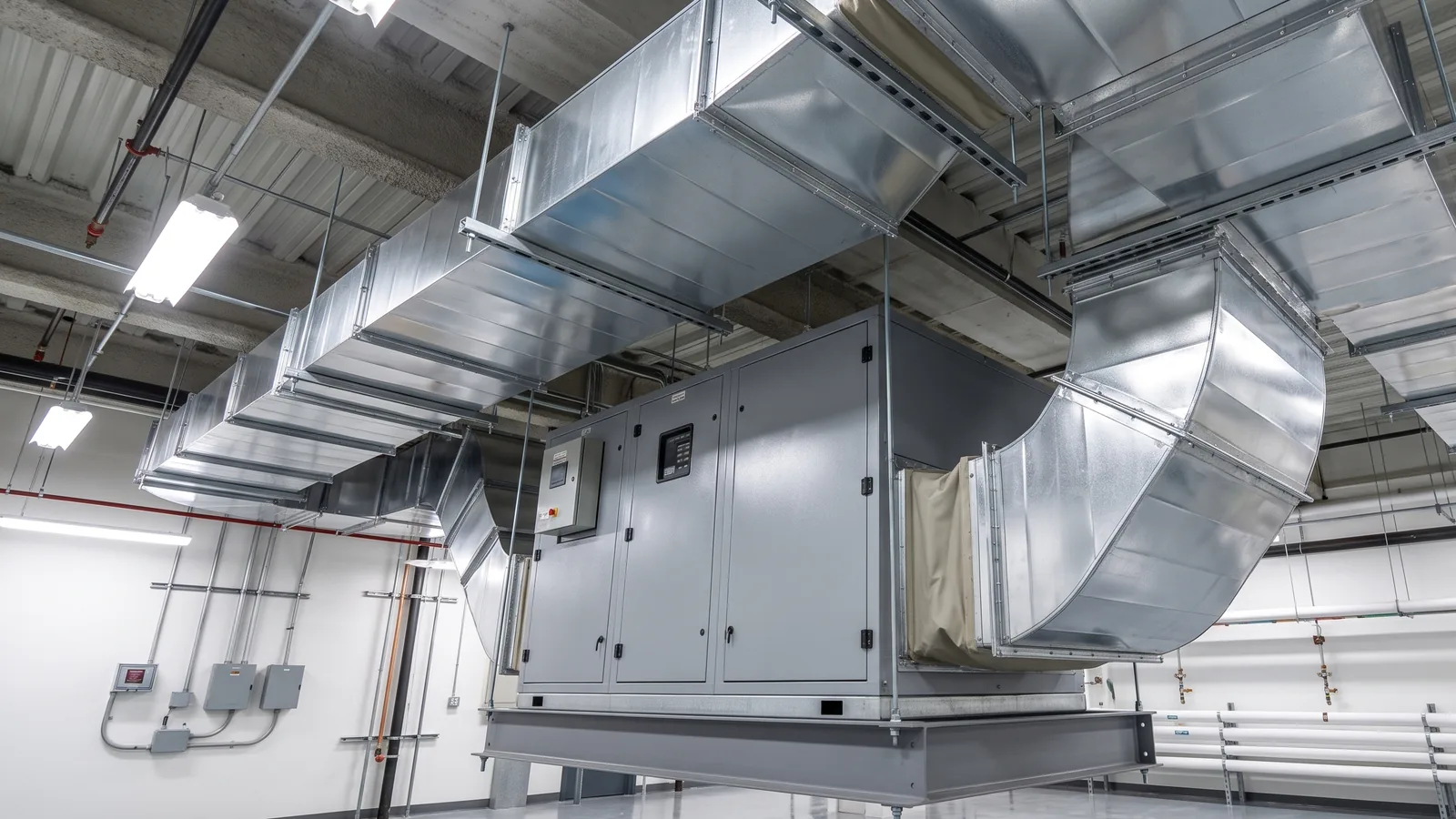
- Ducted installation to a plant room: Ducted dehumidifiers move the noise source away from occupied areas entirely. The unit sits in a plant room, mechanical services area, or external enclosure, with only quiet ductwork entering the conditioned space. This is the single most effective noise control method.
- Acoustic enclosures: Purpose-built enclosures lined with acoustic absorption material can reduce transmitted noise by 15 to 25 dB. The enclosure must allow adequate airflow for the unit’s process and regeneration air streams.
- Anti-vibration mounts: Rubber or spring mounts between the unit and the floor prevent structural vibration from transmitting through the building. This addresses low-frequency hum that travels through concrete slabs and steel frames.
- Distance from occupied areas: Every doubling of distance reduces noise by approximately 6 dB in open conditions. Placing a unit 8 metres from workstations instead of 2 metres reduces the perceived level by about 12 dB.
- Correct unit sizing: An oversized unit running at full capacity produces more noise than necessary. A correctly sized unit, or one with variable-speed fans, runs at lower speeds more of the time, reducing both average noise exposure and energy consumption.
- Flexible duct connections: Rigid connections between ductwork and the unit transmit vibration directly into the duct system. Flexible canvas or rubber sections at the unit connection break this transmission path.
Planning checklist: Before specifying a unit, measure the background noise level in the intended location and determine the maximum acceptable noise contribution from the dehumidifier. A common target is for the dehumidifier to add no more than 3 dB to the existing background level, which means the unit’s noise rating at the nearest occupied position must be at least 10 dB below the background.
For retrofit installations where a unit is already in place and too loud, acoustic lagging on exposed ductwork and partial barriers between the unit and occupied areas can reduce impact without relocating the equipment. These are compromise solutions. They will not match the results of a properly ducted installation from the start.
Choosing a Quiet Dehumidifier for Your Application
The right noise level depends entirely on the application. There is no point paying a premium for an ultra-quiet unit in a warehouse that already runs at 75 dB(A) from forklift traffic. Equally, installing a standard industrial unit in a library archive is a costly mistake.
| Application | Target noise level at nearest occupied position | Recommended approach |
|---|---|---|
| Archive and museum storage | Below 45 dB(A) | Ducted unit in a remote plant room, or low-noise desiccant with acoustic enclosure |
| Healthcare facility | Below 45 dB(A) | Ducted installation mandatory for patient-facing areas |
| Commercial office with server room | Below 50 dB(A) | Ducted or enclosed unit, anti-vibration mounts |
| Food processing floor | 55 to 70 dB(A) acceptable | Standard industrial unit, positioned away from QC and packing areas |
| Warehouse and logistics centre | 65 to 75 dB(A) acceptable | Standard unit with anti-vibration mounts, variable-speed fans preferred |
| Mining equipment storage | No occupancy limit applies | Full-capacity industrial plant, noise is not a constraint in unoccupied facilities |
Moisture Cure Commercial’s humidity control range includes units from compact low-noise models for sensitive environments through to high-capacity industrial systems for warehouses, plant rooms, and remote storage facilities. Every recommendation accounts for the noise constraints of your specific site.
- Variable-speed fans are the single most effective feature for noise management, allowing the unit to run quieter during low-demand periods without sacrificing peak capacity
- Insulated casings on premium units reduce radiated noise by 3 to 8 dB compared to standard sheet metal housings
- Ducted configurations separate the noise source from the conditioned space entirely, making even high-capacity units compatible with noise-sensitive areas
- Manufacturer noise data should specify the measurement distance, weighting, and test conditions. If the data sheet does not include these details, the figure is unreliable for comparison purposes
When comparing units from different suppliers, insist on dB(A) figures measured at the same distance and under the same test conditions. A 3 dB difference is the smallest change most people can perceive. A 10 dB difference sounds roughly twice as loud.
Get Expert Advice on Noise-Appropriate Dehumidification
Moisture Cure Commercial has supplied commercial and industrial humidity control equipment for 28 years across every type of facility in Australia and New Zealand. Noise is one of the most common factors our team helps clients navigate during system specification.
We size every system based on the full picture: moisture load, ambient conditions, airflow requirements, and the acoustic constraints of your environment. Whether you need a near-silent solution for a heritage archive or a high-capacity plant system for a mining storage shed, we will match the right unit and installation approach to your site.
- Free site assessment including ambient noise survey and moisture load calculation
- Access to data sheets with verified noise ratings at standardised test conditions
- Ducted, enclosed, and standalone installation options for every noise requirement
- Variable-speed and low-noise unit options from leading industrial manufacturers
- 28 years of experience across healthcare, food processing, archives, mining, and general commercial facilities
Contact Moisture Cure Commercial for a consultation or site assessment tailored to your facility’s noise and humidity requirements.