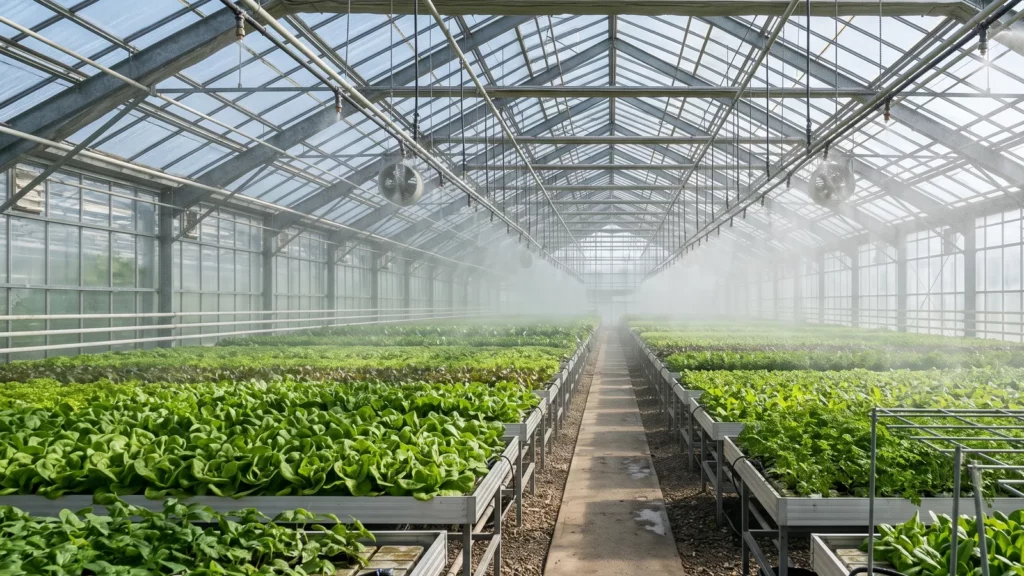
Large greenhouses need industrial humidifiers sized to their airflow volume, crop demands, and local climate conditions.
Getting humidity wrong in a commercial greenhouse costs real money. Below 50% relative humidity, photosynthesis rates drop by up to 30% and fruit set suffers noticeably.
This article covers how to size an industrial humidifier for a large greenhouse, which system types work at commercial scale, and what Australian growers need to factor into their specification.
Already exploring options? Browse our range of commercial humidifiers or read our overview of greenhouse humidity control.
Why Large Greenhouses Need Industrial Humidification
A 1,000 m² greenhouse holds roughly 4,000 m³ of air that needs to sit within a narrow humidity band. Standard portable units cannot move enough moisture to cover that volume, especially during winter when heating systems strip humidity fast.
Plants lose water through transpiration at rates determined by temperature, light intensity, and the vapour pressure deficit around the leaf surface. When the surrounding air is too dry, stomata close to conserve moisture and growth stalls.
- Photosynthesis reduction of 15–30% when RH drops below 50%
- Transplant shock increases significantly in dry conditions
- Tip burn on leafy greens becomes common below 55% RH
- Pollination rates fall when humidity swings exceed 20% within a single day
Industrial humidification systems solve these problems by delivering consistent, high-volume moisture output matched to the greenhouse’s actual air exchange rate.
Humidity Targets by Crop and Growth Stage
There is no single correct humidity level for all greenhouse operations. The target depends on what you are growing and where the crop sits in its lifecycle.
| Crop Type | Ideal RH Range | Risk Threshold |
|---|---|---|
| Tomatoes | 60–80% | Botrytis above 85% |
| Cucumbers | 70–80% | Powdery mildew below 60% |
| Lettuce and leafy greens | 50–70% | Tip burn below 55% |
| Strawberries | 60–75% | Grey mould above 80% |
| Orchids | 60–80% | Root rot above 85% |
| Cannabis (vegetative) | 50–70% | Mould above 75% |
| Cannabis (flowering) | 40–50% | Bud rot above 55% |
Growth stage matters just as much as crop type. Seedlings and propagation cuttings thrive between 70–85% RH, while flowering and fruiting stages typically need 40–60% to reduce fungal pressure.
If your greenhouse runs both propagation and flowering zones, each zone needs independent humidity control. A single system set to one target will underperform in at least one area.
How to Size an Industrial Humidifier for Your Greenhouse
Sizing is where most greenhouse operators get it wrong. The calculation involves three variables: the moisture deficit between current and target conditions, the total air volume, and the number of air changes per hour your ventilation delivers.
- Calculate your greenhouse volume in cubic metres (length × width × average height)
- Determine the moisture deficit in grams per cubic metre (target humidity minus ambient)
- Multiply by air changes per hour (typically 20–40 for ventilated greenhouses)
- The result gives you the required humidifier output in litres per hour
A worked example: a 2,000 m² greenhouse with a 5 m ceiling holds 10,000 m³ of air. With 30 air changes per hour and a moisture deficit of 5 g/m³, the required humidification capacity is 1,500 litres per hour.
Always add a 20–30% buffer above the calculated minimum. Undersized equipment running at full capacity wears out faster and cannot respond to sudden drops in ambient humidity.
Comparing Industrial Humidifier Types for Large Greenhouses
Three system types dominate commercial greenhouse humidification, each with specific strengths depending on greenhouse size, crop sensitivity, and water quality.
| System Type | Output Range | Droplet Size | Energy Use | Best For |
|---|---|---|---|---|
| Ultrasonic | 1–50 L/hr per unit | 1–5 microns | Low | Propagation, sensitive crops |
| High-pressure fogging | 10–200+ L/hr | 5–15 microns | Medium | Large open structures |
| Evaporative pad | Varies by pad area | N/A (evaporation) | Low | Hot, arid climates |
Ultrasonic humidifiers produce an extremely fine mist that absorbs into the air before settling on leaf surfaces. This makes them well suited to operations where leaf wetness causes disease problems, such as tomato and strawberry production.
High-pressure fogging systems push water through nozzles at 70–100 bar, creating a fine mist that provides both humidification and evaporative cooling. They scale well for large greenhouses but require filtered water to prevent nozzle blockage.
Evaporative pad systems draw air through a wet cellulose pad. They work well in hot, dry regions but cannot independently control humidity without also lowering temperature.
For large Australian greenhouse operations, Moisture Cure Commercial typically recommends ultrasonic systems. They offer precise output control, low energy consumption, and minimal leaf wetness risk across a wide range of crops.
VPD and Why It Matters More Than Relative Humidity
Vapour pressure deficit (VPD) is the actual driver of plant transpiration, not relative humidity alone. VPD measures the gap between how much moisture the air holds and how much it could hold at saturation, accounting for temperature and humidity simultaneously.
The FAO’s reference guide on crop evapotranspiration covers the science behind this relationship and how it affects irrigation and humidity management decisions.
- Seedlings and cuttings: target VPD 0.4–0.8 kPa
- Vegetative growth: target VPD 0.8–1.2 kPa
- Flowering and fruiting: target VPD 1.2–1.6 kPa
- Below 0.4 kPa: transpiration stalls and nutrient uptake drops
- Above 1.6 kPa: stomata close and growth slows
The practical consequence is this: 70% RH at 20°C produces a very different plant response than 70% RH at 30°C. Operating by RH alone means your humidity targets shift every time the temperature changes.
Modern industrial humidifiers with VPD-capable controllers adjust output based on both temperature and humidity sensor readings. This keeps the actual transpiration environment stable rather than chasing a fixed RH number.
Australian Climate Zones and Greenhouse Humidity
Australia’s climate diversity creates very different humidification demands depending on where your greenhouse sits. A grower in tropical Queensland faces the opposite problem to one in the Adelaide Hills.
- Tropical north (QLD, NT): Ambient humidity is already high for much of the year. The primary need is dehumidification during wet seasons, with humidification only during dry winter months.
- Arid interior (SA, western NSW, WA): Extremely low ambient humidity year-round. Industrial humidifiers run near full capacity daily, and water efficiency becomes the deciding factor.
- Temperate south (VIC, TAS, southern NSW): Seasonal swings between humid summers and dry heated winters. Greenhouses here often need both humidification and dehumidification depending on the season.
- Coastal regions: Salt-laden air accelerates equipment corrosion. Stainless steel or marine-grade components are worth the upfront cost.
The Australian Bureau of Agricultural and Resource Economics tracks regional climate data that can inform your baseline humidity assumptions.
Moisture Cure Commercial has supplied humidity control systems across all of these zones for over 28 years. The right specification depends on your location, crop cycle, and existing ventilation setup.
Water Quality and Maintenance at Scale
Water quality is the single biggest maintenance variable for industrial humidification systems. Hard water with high mineral content clogs nozzles, coats transducers, and leaves white residue on plants and greenhouse surfaces.
- Ultrasonic systems need water below 50 ppm total dissolved solids (TDS) for reliable long-term operation
- Fogging systems require filtration to at least 5 microns, preferably 1 micron
- Reverse osmosis pre-treatment is standard for most large installations
- Untreated bore water causes rapid scale buildup and shortened equipment life
Maintenance schedules scale with output volume. A system running 12 hours a day in an arid climate needs transducer or nozzle inspection every 4–6 weeks.
Budget for water treatment upfront. The Australian Drinking Water Guidelines provide TDS benchmarks, but humidifier-grade water typically needs stricter filtration than potable standards require.
Getting the Right System for Your Greenhouse
Choosing an industrial humidifier for a large greenhouse comes down to three things: accurate sizing based on your actual air volume and climate conditions, selecting the right technology for your crop’s sensitivity, and factoring in your water quality.
Moisture Cure Commercial provides free sizing consultations for commercial greenhouse operations across Australia. Contact the team with your greenhouse dimensions, crop type, and location for a system recommendation matched to your requirements.