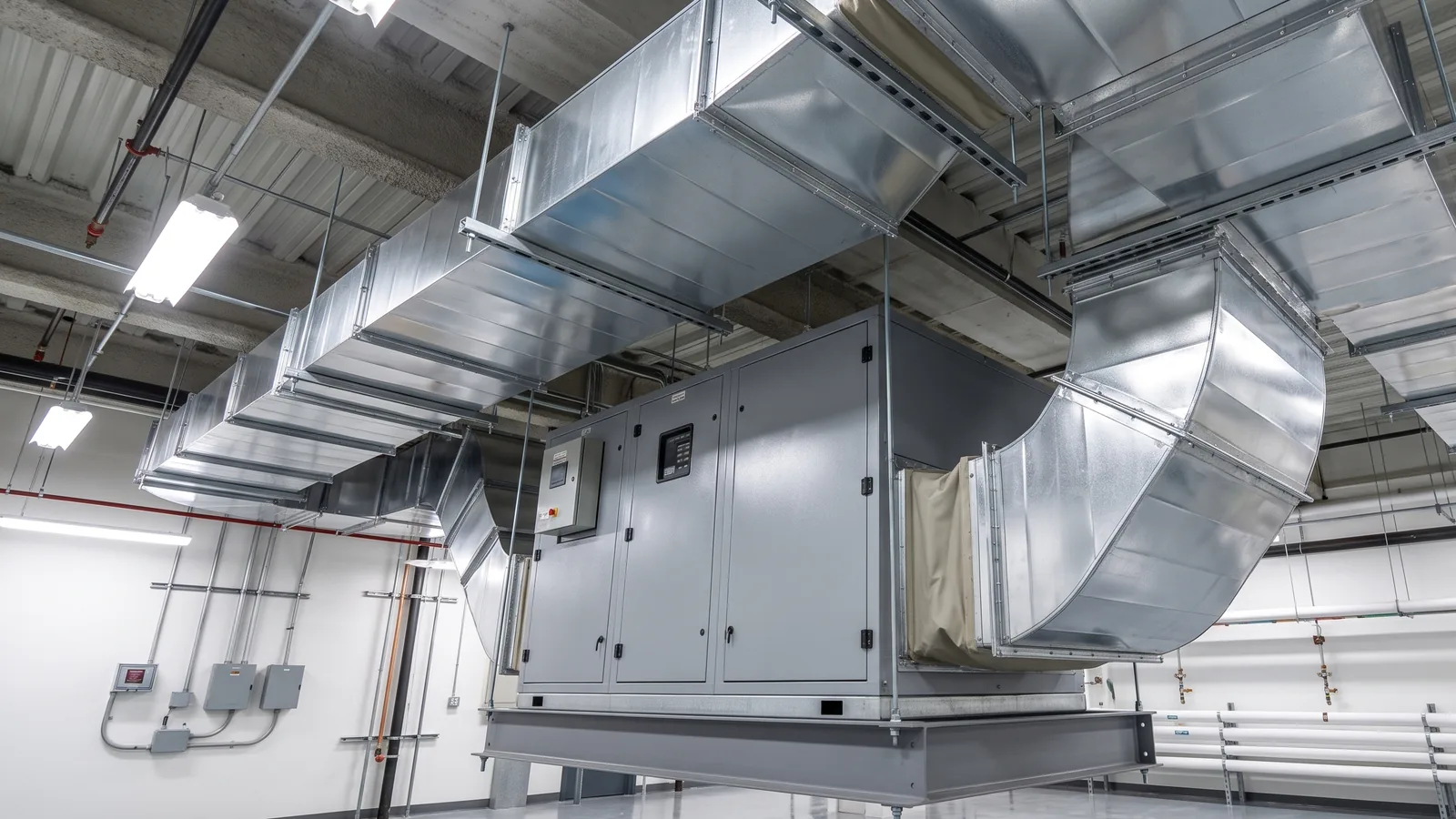
Textile mills need industrial humidifiers to hold relative humidity between 55% and 80% during production.
Dry air wrecks fibre quality. When humidity drops in a spinning room or weaving shed, yarn loses moisture, turns brittle, and snaps under tension. Static builds on synthetic fibres, dust flies off carding machines, and every loom stoppage costs production time.
This article covers why a textile mill needs controlled humidification, the target humidity ranges for each production stage, and how to pick the right system. Moisture Cure Commercial has supplied humidity control equipment to Australian industrial operations for over 28 years.
Why Textile Mills Need Controlled Humidity
Textile fibres are hygroscopic. They absorb and release moisture from surrounding air, and when ambient relative humidity (RH) drops, fibres dry out, shrink, and lose tensile strength.
Cotton at standard conditions holds about 8.5% moisture by dry weight. Wool holds 16%. Polyester holds just 0.4%, so synthetic fibres rely almost entirely on ambient humidity to dissipate static charges.
The consequences of running a mill in dry air go beyond yarn breakage:
- Yarn breakage rates on synthetic fibre can increase 300% to 500% when RH falls from 55% to 30%
- Each break stops the loom, requires rethreading, and leaves a visible defect in finished fabric
- Dry fibres shed more short fragments (fly), creating airborne dust that raises fire risk in lint-heavy rooms
- Fibres sold by weight lose commercial value as moisture content drops below standard regain levels
On a production line processing 80 tonnes per day, a 4% drop in fibre moisture represents roughly 3,200 kg of product weight given away at no charge. That is a direct revenue loss, not a rounding error.
Target Humidity Ranges for Each Textile Process
Different stages of textile production need different humidity levels. Getting these wrong by even 10% affects product quality and machine efficiency.
| Process | Target RH | Temperature | Notes |
|---|---|---|---|
| Blowroom and mixing | 45–60% | Above 25°C | Too high impairs fibre cleaning |
| Carding | 50–55% | 26–30°C | Lower RH aids fibre separation |
| Ring spinning (cotton) | 50–65% | 26–30°C | Higher end reduces end-breaks |
| Ring spinning (wool) | 65% | 20–22°C | Wool needs more moisture for elasticity |
| Weaving (cotton) | 75–80% | 27°C | Highest RH in the mill |
| Weaving (synthetics) | 55–65% | 25°C | Static control is the priority |
| Knitting | 60–70% | 20–22°C | Prevents dropped stitches from static |
| Finishing and inspection | 55–65% | 20–22°C | Standard conditions per ISO 139 |
The weaving shed is always the most demanding room. Warp yarns sit under constant tension, and any loss of fibre elasticity leads to breakage and visible stop marks in finished cloth.
Below 45% RH, static electricity problems begin for all fibre types. Below 40%, expect severe processing failures across every department.
What Low Humidity Costs a Textile Mill
Production losses from poor humidity control are measurable. End-breaks during spinning are the most common symptom, and each break creates a weaver’s knot that shows as a visible defect.
Accumulate enough of them and entire runs get downgraded or rejected. But static buildup causes a different, sometimes less obvious, set of problems.
- Fibres cling to rollers and cylinder clothing during carding instead of travelling cleanly through the drafting zone
- Uneven fibre distribution produces thick and thin spots in the sliver, increasing yarn irregularity
- Short fibres tangle into neps (small knots) that show as white specks in dyed fabric
- In knitting mills, charged yarn jumps off needles, creating dropped stitch defects
Fabric dimensional instability is another hidden cost. Cloth cut to specification in a dry room changes dimensions once it absorbs moisture in storage or transit.
Every loom stoppage and restart also burns energy. A mill running 300 looms with a 5% breakage rate wastes significant electricity cycling machines on and off throughout each shift.
Types of Industrial Humidifier Suited to Textile Mills
Not all humidification systems suit every textile application. The right choice depends on mill size, ceiling height, fibre type, and energy budget.
Ultrasonic humidifiers
Piezoelectric transducers vibrating at ultrasonic frequencies break water into droplets of 1 to 5 microns. They produce a cool mist with no heating element, making them energy efficient.
Moisture Cure Commercial supplies industrial ultrasonic humidification systems suited to precise zone control in smaller mills or targeted areas within larger facilities.
High-pressure fogging systems
Water is pushed through precision nozzles at 70 to 100 bar, producing droplets that evaporate before reaching surfaces. These handle large air volumes (up to 1,200 litres per hour) and provide adiabatic cooling of 2 to 8 degrees Celsius.
Compressed air and water spray systems
Combining air pressure and water at lower pressures, these are well suited to localised humidification. A single bank of looms or a dedicated spinning area is a typical application.
Steam injection systems
Clean steam adds humidity without temperature change. Fastest response time and highest precision, but uses 7 to 10 times more energy than adiabatic alternatives.
Here is a quick comparison of the main system types:
- Best for large mills: high-pressure fogging (handles big volumes, provides cooling)
- Best for precision zones: ultrasonic (energy efficient, fine droplet control)
- Best for localised areas: compressed air and water spray (lower capital cost)
- Best for temperature-sensitive rooms: steam injection (no cooling effect)
Water Quality and System Maintenance
The number one reason humidification systems fail in textile mills is poor water quality. Mineral deposits block nozzles, coat transducers, and leave white dust on fibres and fabric.
Each system type has specific water quality requirements:
- Ultrasonic systems need demineralised water with conductivity below 0.2 µS/cm
- High-pressure fog systems need softened water with hardness below 50 ppm CaCO₃
- Steam systems need softened or reverse osmosis treated water to prevent scale buildup
Maintenance intervals also vary:
- Nozzle inspection and cleaning: every 500 to 1,000 operating hours
- Water filter replacement: monthly to quarterly depending on supply quality
- Ultrasonic transducer replacement: approximately every 10,000 operating hours
Skipping water treatment is a false economy. A blocked nozzle in a weaving shed means an entire zone runs dry, and the production defects that follow cost far more than a water treatment unit.
Humidification vs Dehumidification in a Textile Facility
Some textile facilities need both. These are opposite problems solved by entirely different equipment, and confusing the two leads to poor specifications.
- Humidification needed: spinning rooms, weaving sheds, yarn storage, fibre preparation areas
- Dehumidification needed: dyehouses, wet finishing areas, fibre storage in humid climates
In Australia, this seasonal split is pronounced. Winter brings cold, dry air. Heating that air from 10°C to 25°C without adding moisture drops RH from 60% to around 25%.
Summer in subtropical regions can push ambient RH well above target levels, particularly in coastal areas. A well-designed facility addresses both sides with separate systems for each zone.
Moisture Cure Commercial supplies both humidification and desiccant dehumidification systems for industrial environments.
Getting the Specification Right
Undersizing is the most common mistake in textile humidification. A unit rated for a warehouse office will not maintain 75% RH in a weaving shed full of heat-generating looms.
Key sizing factors to work through with your supplier:
- Room volume in cubic metres
- Number and type of heat-generating machines
- Target RH and allowable variation (aim for ±5% across the working area)
- Ventilation rate and air changes per hour
- Ambient outdoor conditions at seasonal extremes
- Ceiling height (minimum 3.5 metres for fog systems to allow full droplet evaporation)
A generic sizing formula does not work here because the variables are too specific to each facility. A spinning shed with 100 ring frames in Geelong has completely different moisture loads to a weaving operation running 50 looms in western Sydney.
The Woolmark Company publishes fibre processing guidelines that include recommended humidity ranges for wool textile manufacturing.
Contact Moisture Cure Commercial for a site-specific assessment. With 28 years of experience in commercial and industrial humidity control, the team can recommend the right system and capacity for your textile production environment.