Water treatment plants lose equipment to corrosion caused by uncontrolled humidity, not by the water itself.
Cold water from bores, rivers, and reservoirs chills pipes, pumps, and tanks well below ambient air temperature. When warm, moisture-laden air contacts those cold surfaces, condensation forms and sits there, attacking steel, wiring, and concrete around the clock.
Below, we walk through the specific humidity risks in treatment facilities, which zones to prioritise, and how to match a dehumidifier to the moisture load.
Planning humidity control for an industrial facility? Read our guide on how to size an industrial dehumidifier for your facility for the full calculation method.
Why Water Treatment Plants Have Humidity Problems
Water treatment plants handle large volumes of cold water. Groundwater in Australia typically sits between 7°C and 16°C year-round, depending on depth and region (the Bureau of Meteorology groundwater portal maps bore temperatures nationally). Surface water drawn from rivers or dams can drop even lower in winter.
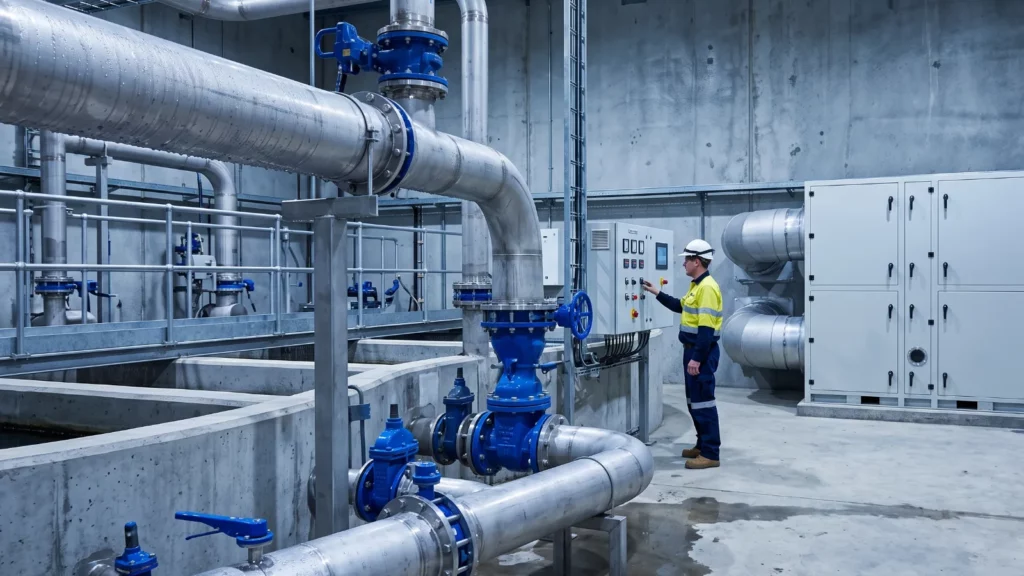
Every pipe, valve, pump housing, and storage tank carrying that water becomes a cold surface.
Condensation forms when the surface temperature of equipment drops below the dew point of the surrounding air. In a pump station processing 15°C groundwater on a 28°C day at 65% relative humidity, the dew point sits around 21°C. Every surface below 21°C sweats.
Enclosed spaces make it worse. Pump rooms, filter galleries, and below-grade chambers trap moist air with limited natural ventilation. Relative humidity climbs toward saturation.
- Cold pipework running at 7-16°C creates condensation targets across every room it passes through
- Open water surfaces in settlement tanks and filter beds continuously evaporate moisture into the air
- Below-grade pump stations trap humid air with minimal natural airflow
- Seasonal swings between cool water and warm ambient air create the widest dew point gaps in summer
Ventilation alone does not fix this. Bringing in outdoor air on a humid day just adds more moisture to the space.
What Happens When Humidity Goes Unchecked
Persistent condensation on ferrous metal surfaces initiates corrosion within days. Relative humidity above 60% accelerates oxidation on carbon steel. Above 70%, the corrosion rate increases sharply, as documented in the ISO 9223 atmospheric corrosion classification.
Pipes, pump casings, bolts, flanges, and structural steel all deteriorate faster than their design life allows.
Electrical switchboards, motor control centres (MCCs), and instrumentation panels are equally vulnerable. Moisture on internal contacts causes tracking, short circuits, and intermittent faults that are difficult to diagnose.
- Pipe corrosion forces annual sanding, repainting, and bolt replacement across the facility
- Electrical faults from moisture on relay contacts and terminal blocks cause unplanned shutdowns
- Mould growth on walls, ceilings, and cable trays creates workplace health hazards and triggers WHS obligations
- Concrete spalling from embedded moisture freeze-thaw cycles degrades structures over decades
- Instrument drift in flow meters and pressure sensors compromises process accuracy
Facilities without humidity control spend most of their maintenance budget repainting corroded pipes and replacing seized bolts. Staff hours go toward fighting corrosion rather than operating the plant. Treatment plants across major cities face this problem, from Sydney’s coastal plants dealing with salt-laden humid air to Brisbane facilities managing subtropical humidity year-round.
Chemical Exposure Makes the Problem Worse
Water treatment plants use chemicals that are corrosive on their own. Chlorine gas, sodium hypochlorite, ozone, and hydrogen sulfide (common in wastewater) all become far more aggressive in the presence of moisture.
Chlorine reacts with water vapour to form hydrochloric acid, which attacks metal surfaces, electrical enclosures, and even concrete at accelerated rates.
Chemical dosing rooms and chlorination areas are the worst-affected zones. These spaces combine chemical vapours with the moisture evaporating from dosing tanks and injection points. Without dehumidification, the environment becomes actively destructive.
Safe Work Australia identifies chlorine as a hazardous chemical that poses increased corrosion risk when combined with atmospheric moisture. Proper ventilation and humidity control are recommended controls for chemical storage and dosing areas.
Ozone generators create the same corrosion risk. Ozone is a strong oxidiser, and humid air accelerates its attack on rubber seals, gaskets, and wiring insulation. Keeping relative humidity below 50% in ozone contact rooms protects seals and wiring that would otherwise need replacing within a few years.
Which Areas of a Water Treatment Plant Need Dehumidification
Not every room in a water treatment facility needs active humidity control. Focus on zones where cold surfaces, chemical exposure, or enclosed geometry create conditions that ventilation cannot resolve.
| Zone | Primary Risk | Target RH |
|---|---|---|
| Pump stations (raw and treated) | Cold pipe condensation, motor corrosion | 50-55% |
| Chemical dosing rooms | Chemical + moisture corrosion acceleration | Below 50% |
| MCC and switchboard rooms | Electrical tracking and short circuits | 45-55% |
| Filter galleries | Open water evaporation, mould on structures | 55-60% |
| Below-grade chambers | Trapped humid air, zero natural ventilation | 50-55% |
| Membrane treatment buildings | Cold water surfaces, instrumentation drift | 50-55% |
MCC rooms and electrical switchboard areas often get overlooked. These spaces sit adjacent to pump rooms and absorb migrating moisture through doorways and cable penetrations.
A switchboard burnout from moisture tracking can shut a plant down for days. A dedicated dehumidifier in the MCC room is cheap insurance against that scenario.
Desiccant or Refrigerant Dehumidifier for Water Treatment
Most water treatment plants need both desiccant and refrigerant units across different zones. The deciding factor is operating temperature.
When desiccant units are the right choice
Desiccant dehumidifiers pass air through a moisture-absorbing rotor and regenerate using heat. Desiccant units work effectively from -20°C to +50°C and can achieve very low dew points.
This makes desiccant dehumidifiers the right pick for below-grade pump stations, unheated chemical stores, and any space that drops below 15°C in winter.
Moisture Cure Commercial supplies YAKE desiccant dehumidifiers rated from 60 to 3,000 m³/h airflow, covering everything from a small dosing room to a large treatment hall. YAKE units operate reliably across the full -20°C to +50°C range where refrigerant systems cannot.
When refrigerant units make sense
Refrigerant dehumidifiers cool air below its dew point to condense moisture, then reheat it. Refrigerant units are energy-efficient in warm, humid environments and work well in filter galleries and above-grade pump rooms where temperatures stay above 15°C.
Refrigerant units struggle in cold environments because ice forms on the evaporator coil, reducing capacity or shutting the unit down entirely.
- Desiccant suits cold environments (below 15°C), chemical exposure zones, and applications needing very low dew points
- Refrigerant suits above-grade spaces where temperature stays above 15°C and moderate RH targets (50-60%) are acceptable
- Hybrid approach uses refrigerant for general areas and desiccant for critical cold or chemical zones
For refrigerant dehumidifiers suited to warmer treatment areas, FRAL units handle high-capacity extraction in above-grade process buildings.
How to Size a Water Treatment Plant Dehumidifier
Sizing a dehumidifier for a water treatment facility requires more than just room volume. The moisture load from cold surfaces, open water, and chemical processes often exceeds what ventilation calculations alone would suggest.
An undersized unit runs flat out without reaching target RH. An oversized unit wastes energy. Both are common mistakes in water treatment sizing.
- Calculate room volume in cubic metres (length x width x height)
- Identify all moisture sources: cold pipe surface area, open water surfaces, number of air changes per hour, and door/penetration losses
- Determine the coldest surface temperature using the incoming water temperature
- Set the target dew point at least 2-3°C below the coldest surface to prevent any condensation
- Select a unit with enough extraction capacity (litres/day or m³/h airflow) to hold that dew point under peak load
Pump stations with large-diameter cold water mains generate more condensation per square metre than a filter gallery with open but still water. The surface area of cold pipework and the temperature differential between water and air are the two biggest variables in the calculation.
Moisture Cure Commercial provides free sizing consultations across their full range of commercial and industrial dehumidifiers, including site assessments for complex multi-zone facilities like water treatment plants.
Frequently Asked Questions
What humidity level should a water treatment plant maintain?
Most zones should target 50-55% relative humidity. Chemical dosing rooms and electrical switchboard rooms benefit from tighter control at 45-50% RH.
The key metric is dew point, not just RH. The dew point must stay at least 2-3°C below the coldest surface temperature in the space to prevent condensation.
Why do water treatment plants have condensation problems?
Cold water (typically 7-16°C from bores and rivers) chills pipes, pumps, and tanks below the dew point of the surrounding air. Enclosed pump rooms and below-grade chambers trap humid air with little ventilation, creating persistent condensation on every cold surface.
Can a refrigerant dehumidifier work in a water treatment plant?
Refrigerant dehumidifiers work well in above-grade areas where ambient temperature stays above 15°C. Below that temperature, ice forms on the evaporator coil and performance drops sharply. Below-grade pump stations and unheated spaces need desiccant dehumidifiers instead.
How do you size a dehumidifier for a pump station?
Measure the room volume, identify all cold pipe surface area, determine the incoming water temperature, and set a target dew point 2-3°C below that water temperature. The dehumidifier must have enough extraction capacity to maintain that dew point under the worst-case summer humidity load.
Does chlorine exposure affect dehumidifier equipment?
Chlorine vapour is corrosive to standard metal components. Dehumidifiers installed in chlorination or dosing rooms should use corrosion-resistant coatings and stainless-steel housings. Desiccant units are generally preferred in these environments because they have fewer exposed metal heat-exchange surfaces than refrigerant units.
What areas of a water treatment plant need dehumidification most?
Pump stations, chemical dosing rooms, MCC and switchboard rooms, and below-grade chambers are the highest-priority zones. These areas combine cold surfaces, chemical exposure, or sensitive electrical equipment with poor natural ventilation.
Protect Your Plant Before Corrosion Sets In
A properly sized industrial dehumidifier costs less than a single switchboard replacement. Facilities that control humidity stop repainting pipes every year and stop diagnosing phantom electrical faults caused by moisture on relay contacts.
Contact Moisture Cure Commercial for a consultation on humidity control for your water treatment facility. With 20+ years of experience in commercial and industrial dehumidification across Australia, Moisture Cure Commercial can assess your site and recommend the right equipment for each zone.