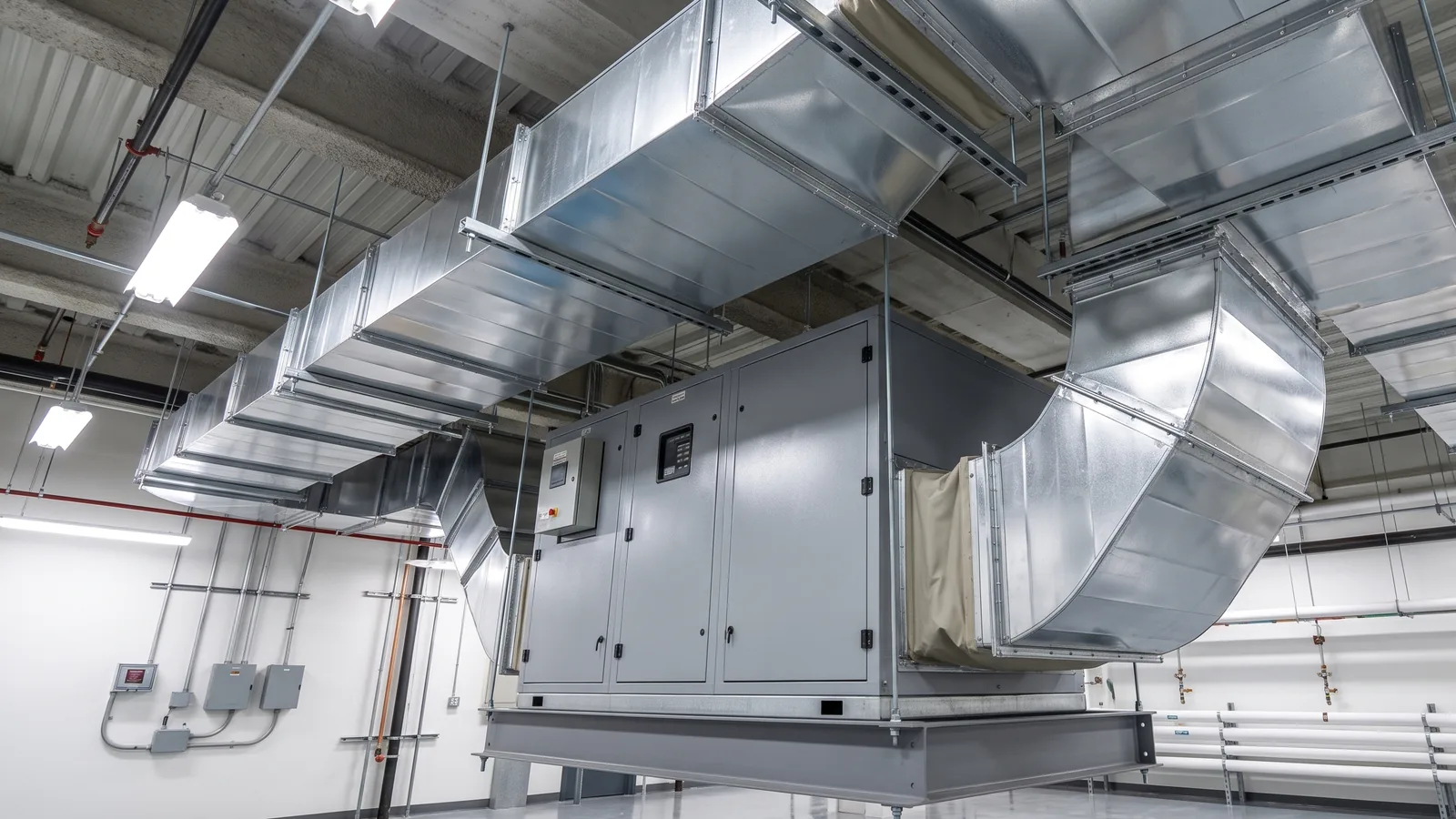
Choosing an industrial dehumidifier in Australia starts with the conditions inside your facility: its moisture load, operating temperature and required humidity. A model number or floor-area recommendation cannot tell you whether a unit will meet that duty.
For facilities managers, engineers and procurement teams, the aim is a system that reaches the specified conditions during normal production and periods of high outdoor humidity. Use the following checks to compare equipment and prepare a useful supplier brief.
Which industrial dehumidifier type suits your facility?
Refrigerant and desiccant units remove moisture differently, while ducted describes how air is distributed. Choose the drying technology first, then decide how to deliver dry air to the areas that need it.
| Option | When to consider it | What to confirm |
|---|---|---|
| Refrigerant | Warm, humid warehouses and production areas with moderate drying requirements. | Extraction at the lowest operating temperature, defrost behaviour and condensate drainage. |
| Desiccant | Cold spaces or processes needing a lower humidity or dew point. | Performance at the specified duty, regeneration energy and wet-air exhaust arrangements. |
| Ducted configuration | Permanent installations serving separated rooms or zones. | Air distribution, available fan pressure, return paths and controls. |
Moisture Cure’s refrigerant units for commercial moisture control suit applications where warm, humid air supports condensation-based drying. Its desiccant range for cold or low-humidity duties uses moisture adsorption and is worth assessing when the temperature or drying target makes refrigeration less suitable.
A ducted system for centralised humidity control can distribute treated air across a facility where a standalone unit cannot reach every zone. Check duct resistance and air balance rather than assuming existing HVAC ductwork will suit.
For a dry-air supply that also needs positive pressure, the RY-190M specification for dry-air and positive-pressure duties is relevant to the shortlist. Its published extraction is 14.4 litres/day at 20°C and 60% RH, rather than the capacity suggested by its model number.
What size industrial dehumidifier does your warehouse need?
Size for the moisture entering or being released into the space, at the conditions you need to maintain. Room volume matters, but volume and an assumed air-change rate alone do not establish the drying load.
- Record room dimensions, ceiling height, partitions and the zones requiring control.
- Log indoor and outdoor temperature and humidity during representative operations.
- Describe ventilation, exhaust systems, door openings and leakage paths.
- Identify moisture from washdown, exposed water, incoming products, occupants and wet processes.
- Specify the humidity or dew-point target, permitted variation and operating schedule.
- Ask for a load calculation, equipment selection and allowance for peak conditions.
Recirculating air through a dehumidifier is different from bringing outside air into the building. Treat ventilation and infiltration as moisture sources, and process airflow as part of distributing the drying capacity.
Do not infer extraction from the model name: the RY-400M desiccant unit’s published extraction rating is 60 litres/day at 20°C and 60% RH, rather than 400 litres/day. Its desiccant process is a candidate for cold or low-dew-point duties, subject to a calculation for the actual site.
The RY-200M specifications for low-humidity applications provide another starting point for a desiccant selection where cold or dry conditions matter. Ask for site-duty performance before assigning any model to a warehouse size.
Do industrial dehumidifiers work in cold temperatures?
Some do, but an operating-temperature limit is not a promise of unchanged extraction. Refrigerant capacity and defrost requirements vary with conditions; desiccant performance also depends on inlet conditions, airflow and regeneration.
- Use the coldest temperature in the treated zone, including overnight operation.
- Request capacity at that temperature and the required humidity.
- Confirm controls, installation location and any heat added to the space.
The RY-60M desiccant model for dry-air and positive-pressure duties is a candidate where those requirements accompany cold conditions. Its published capacity changes from 6 litres/day at 20°C and 60% RH to 7.2 litres/day at 30°C and 80% RH, so obtain a separate rating for a cool room.
Can an industrial dehumidifier work in a freezer room?
Freezer selection needs a specific engineering assessment of moisture ingress and the required dew point. A broad sub-zero operating range alone does not establish whether a unit can control frost in your installation.
- Check door-opening patterns, loading operations and air leakage.
- Specify inlet conditions and the required dry-air dew point.
- Confirm whether plant sits inside or outside the freezer and how ducts are insulated.
- Coordinate wet-air exhaust and regeneration with the refrigeration design.
Discuss the freezer’s operating conditions with Moisture Cure Commercial before selecting equipment. Resolve ingress and air-distribution problems alongside the drying load.
How should you compare purchase and ownership costs?
Request a site-specific quote covering a complete installation. Comparing the equipment price alone can hide electrical, ductwork, drainage and commissioning requirements.
- Separate equipment, installation, controls and commissioning in the proposal.
- Ask about service access, spare parts, warranty conditions and support arrangements.
- Include energy demand and maintenance in the evaluation.
- Agree how performance will be demonstrated after installation.
The RY-1500M desiccant model for larger industrial duties is designed for applications including manufacturing and power generation where dry air is needed. Confirm its electrical supply and rated performance with the supplier; do not interpret its name as an extraction figure.
How much electricity will an industrial dehumidifier use?
Compare energy use at the same temperature, humidity and moisture-removal duty. The maximum power input on the nameplate is useful for electrical design, but it does not establish daily consumption under humidity control.
- Obtain total electrical input, including fans and regeneration heating.
- Ask how capacity and power change as the space approaches its setpoint.
- Use the proposed operating schedule to estimate energy demand.
- Check whether monitoring can record consumption and achieved conditions.
Review the RY-600M specifications for cold and low-humidity process duties and the RY-800M specifications for demanding dry-air applications where desiccant drying suits the required conditions. Check capacity and electrical requirements at your specified operating conditions.
For a permanent installation, the factors behind ducted dehumidifier running costs help identify what belongs in the operating-cost assessment. Use your tariff and the selected equipment’s verified demand rather than a generic electricity-price assumption.
What humidity level should your warehouse maintain?
Set the target around product specifications, process requirements and condensation risk. There is no single humidity band that suits every pharmaceutical store, electronics area, museum or food warehouse.
| Application | Basis for the target |
|---|---|
| Food and pharmaceutical storage | Product storage instructions, packaging and the site’s quality requirements. |
| Electronics and manufacturing | Component handling, process limits and electrostatic-control requirements. |
| Museums and archives | Collection-specific conservation advice and acceptable fluctuations. |
| Warehouses with cold surfaces | Air dew point relative to the coldest relevant surface temperature. |
The Bureau of Meteorology explains that dew point identifies when cooling air produces condensation. Check the air conditions near cold surfaces, not just a central humidity reading.
TGA stability guidance for listed and complementary medicines relates storage conditions to product-specific evidence and labelling. Stability-test humidity conditions are not universal warehouse setpoints or a requirement to use one drying technology.
How do you maintain an industrial dehumidifier?
Follow the selected unit’s manual and adjust inspections to site conditions. Consider dust, contamination and service access when planning inspections.
- Inspect filters, intakes and air paths for obstruction.
- Check refrigerant-unit drains or desiccant-unit wet-air exhausts.
- Verify humidity sensors against a suitable reference.
- Record achieved conditions, faults and changes in energy demand.
- Have qualified personnel service electrical and refrigeration components.
Remote projects also need a realistic delivery and support plan: Moisture Cure’s Barrow Island LNG deployment began with a site trial before a bulk order. That example shows why procurement should test equipment in the intended environment before scaling a deployment.
Industrial dehumidifier selection FAQs
What distinguishes an industrial dehumidifier?
Assess the rated duty, controls, serviceability and installation requirements. The word industrial alone does not establish suitability for your process.
Which industrial dehumidifier is best for an Australian facility?
The best fit meets the specified moisture load and conditions with an installation your team can maintain. Ask the supplier to confirm performance in writing at your site’s operating conditions.
Can I size a warehouse unit from floor area?
Floor area is insufficient. Include volume, ventilation, infiltration, process moisture, temperature and the required drying target.
Does litres per day mean the same thing on every datasheet?
Only compare ratings at matching test conditions. Keep water-removal capacity separate from airflow and model numbers.
Should a cold room use desiccant equipment?
Desiccant equipment may suit cold rooms. Confirm extraction at the room’s actual conditions before selecting it.
Does a unit’s sub-zero rating guarantee freezer performance?
No. Freezer performance requires a moisture-load calculation, suitable dry-air dew point and a compatible installation.
Does every industrial unit need a water drain?
Refrigerant units need condensate disposal. Many desiccant systems discharge moisture in a wet-air stream, so check the selected unit’s exhaust requirements.
Can equipment run unattended?
Confirm its permitted duty and required safeguards. Specify alarms, drainage or exhaust arrangements and inspection responsibilities.
What should I send a supplier before requesting a quote?
Send dimensions, logged conditions, operating hours, moisture sources and the humidity target. Include available power, installation space and access constraints.