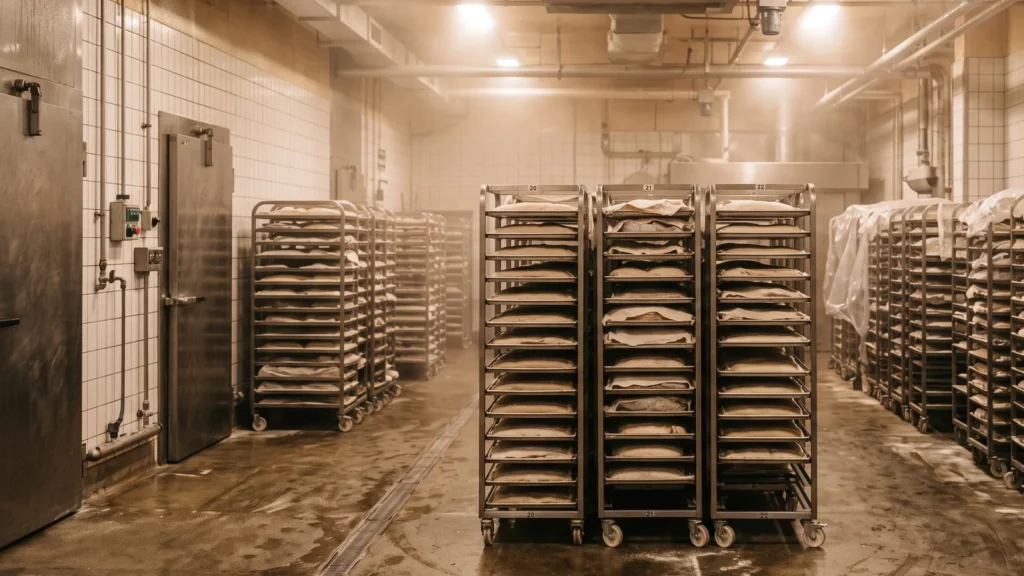
Bakery proving rooms need 75-85% relative humidity, and only a properly sized industrial humidifier can hold that range through a full production day.
Dough that dries out during proving develops a skin that restricts the rise. For commercial bakeries running multiple proving cycles daily, even small humidity swings translate directly to wasted batches and lost revenue.
This article covers target RH ranges for different proving stages, why ultrasonic humidifiers are replacing steam injection in modern bakeries, and how to size a unit for your room. We also cover the common proving room mistakes that Moisture Cure Commercial sees across Australian food production facilities.
Looking for commercial humidifiers for your bakery? Moisture Cure Commercial supplies YAKE ultrasonic humidifiers built for food production environments, with full-range humidity control solutions available.
Why Proving Rooms Need Precise Humidity Control
Yeast fermentation relies on specific temperature and humidity conditions, and during proving the yeast generates carbon dioxide that causes dough to rise. If the surrounding air is too dry, the outer surface loses moisture faster than the interior, forming a tough skin that traps gas unevenly.
The consequences show up on the production line within hours.
- Surface cracking on loaves before they reach the oven
- Uneven rise across batches, with some pieces proving faster than others
- Crust defects including blistering, pale spots and inconsistent colour
- Weight loss from excessive moisture evaporation during proving
- Increased waste from batches that fail quality inspection
A proving room without active humidification is gambling with every batch. The ambient humidity in an Australian bakery can swing from 30% RH on a dry winter morning to 80% on a coastal summer afternoon, making proving times completely unpredictable.
Target Humidity for Bakery Proving Stages
Not all proving happens at the same humidity. Bulk fermentation, intermediate proofing and final proofing each have different requirements, and getting them wrong produces different types of defects.
| Proving Stage | Target RH | Temperature | Typical Duration |
|---|---|---|---|
| Bulk fermentation | 70-75% | 24-27°C | 1-3 hours |
| Intermediate proof | 70-75% | Room temp | 10-20 minutes |
| Final proof (standard bread) | 80-85% | 32-38°C | 45-90 minutes |
| Final proof (enriched dough) | 85-90% | 30-35°C | 60-120 minutes |
| Retarded proof (cold) | 80-85% | 2-4°C | 8-18 hours |
Final proofing is where humidity matters most, because the dough has been shaped and any skin formation will show in the finished product. Most commercial bakeries target 80-85% RH for standard bread and up to 90% for enriched doughs like brioche.
Retarded proofing in cool rooms presents a separate challenge, because air holds less moisture at lower temperatures. Maintaining 80%+ RH at 2-4°C requires a humidifier that works efficiently in cold conditions, and this is where many bakeries get caught out with undersized equipment.
Steam Injection vs Ultrasonic Industrial Humidifiers
Traditional bakery proving rooms use steam injection, where a boiler generates steam that feeds directly into the proving chamber. This works, but it comes with real drawbacks for modern production environments.
Steam injection adds heat to the proving room. Every kilogram of steam raises the temperature, forcing the cooling system to work harder to maintain your target while the humidifier pushes it higher.
Steam boilers also require regular descaling, water treatment and safety inspections. In a bakery running proving cycles six or seven days a week, that maintenance overhead adds up fast.
Ultrasonic humidifiers vibrate water at high frequency to produce a fine cold mist that evaporates without adding heat. The practical advantages for bakery proving rooms are significant.
- No heat load on the proving room, so temperature and humidity can be controlled independently
- Lower energy consumption with no boiler required for steam generation
- Faster response time to humidity changes, typically reaching setpoint within minutes
- Minimal maintenance with no boiler descaling, no steam traps and no condensate management
- Precise control to within ±2% RH across the proving chamber
Moisture Cure Commercial supplies YAKE ultrasonic humidifiers that are purpose-built for food production environments. These units produce a dry fog that increases humidity without wetting surfaces, which is a food safety advantage in any bakery.
Sizing an Industrial Humidifier for a Proving Room
Under-sizing is the most common mistake. A humidifier that cannot keep pace with the moisture demand of a full proving room during peak production will let humidity drop exactly when it matters most.
The moisture load in a proving room depends on several measurable factors.
- Room volume in cubic metres
- Target RH relative to current ambient conditions outside the room
- Air exchange rate from ventilation, door openings and exhaust systems
- Product load including total dough mass and exposed surface area
- Temperature since warmer air holds more moisture per cubic metre
A rough starting point: a 50 m³ proving room running at 35°C and 85% RH with moderate ventilation typically needs 3-6 kg/hr of humidification capacity. Scale linearly for larger rooms, and add 30% capacity margin for peak production loads and door openings.
Catalogue specifications alone will not tell you the right unit. A site assessment from Moisture Cure Commercial accounts for your room layout, ventilation design, production schedule and local climate conditions.
For a room of that size, a unit like the YAKE RYJS-06D provides 6 kg/hr output. Larger proving rooms or high-throughput operations may need the RYJS-12D at 12 kg/hr, which handles rooms up to approximately 120 m³.
Common Proving Room Humidity Problems
Most proving room issues trace back to either equipment choice or installation. Here are the patterns seen regularly across Australian commercial bakeries.
- Relying on steam trays or water pans instead of controlled humidification, which provides inconsistent humidity that drops as the water cools
- Using residential-grade humidifiers that cannot handle continuous duty cycles or the elevated temperatures inside a proving room
- No humidity sensor in the proving room, meaning operators adjust by feel rather than measurement
- Poor air circulation creating dry spots and wet spots within the same chamber
- Ignoring cold proving and running retarder rooms without any humidification, leading to dried-out dough surfaces overnight
Residential-grade units deserve special mention. They are not rated for the 35°C+ temperatures inside a commercial prover, and most fail within weeks when run continuously in those conditions.
Each of these problems has a measurable impact on product quality. A bakery producing 2,000 loaves per day that rejects 3% due to proving defects loses 60 loaves daily, adding up to more than 15,000 loaves of waste per year.
The fix is straightforward in most cases. A properly sized industrial humidifier with a hygrostat controller holds the proving room at the target RH regardless of ambient conditions, production load or time of day.
Bakery Proving Room Humidity and Food Safety
FSANZ Standard 3.2.2 requires food businesses to maintain environmental conditions that minimise contamination risk. In a proving room, that means controlling both temperature and humidity to documented targets.
Auditors expect to see documented evidence of control.
- Written humidity and temperature targets for the proving room
- Continuous data logging rather than periodic spot checks
- Corrective action procedures when readings fall outside range
- Maintenance records for all humidification equipment
Too-low humidity dries dough surfaces, making them harder to clean and trapping contaminants. Too-high humidity causes condensation on walls and ceilings that drips onto product below.
An ultrasonic humidifier system with integrated logging provides the documentation trail that food safety auditors expect. The humidity data feeds directly into your HACCP records.
For broader bakery humidity management beyond the proving room, including storage, packaging and cooling zones, see our guide to managing bakery humidity for production quality.
Every bakery proving room is different. A small artisan operation running two cycles per day has different requirements to a plant bakery running continuous production, and room construction, insulation, ventilation and local climate all affect the load.
Moisture Cure Commercial has supplied humidity control solutions to Australian food production facilities for over 28 years. Contact the team for a consultation or quote on industrial humidifiers for your bakery proving room.