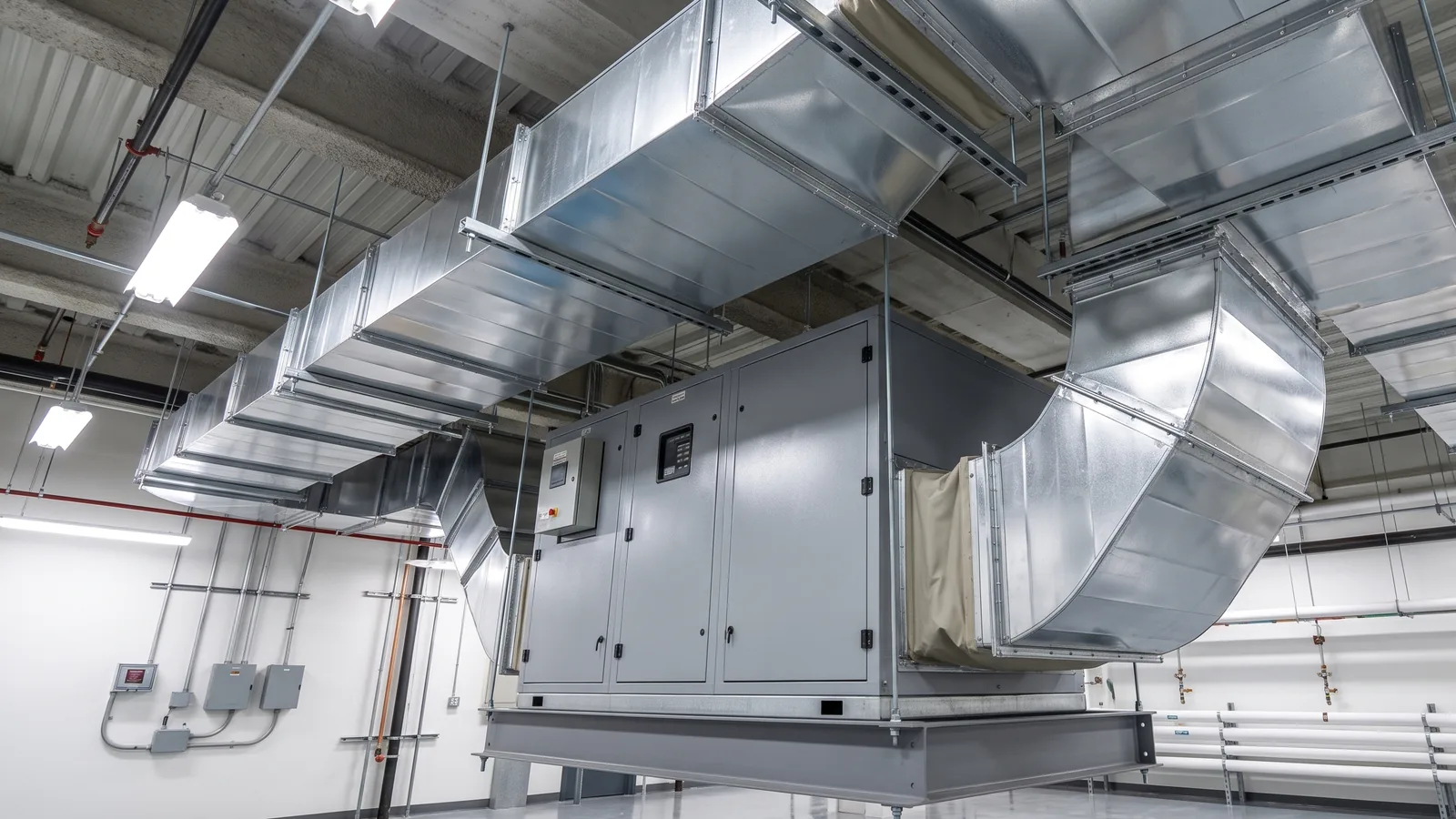
A dehumidifier for a data centre is needed when measured moisture loads exceed the humidity-control capacity of the existing cooling system. Check dew point, equipment inlet conditions and the source of moisture before specifying additional equipment.
Cooling and humidity equipment need a coordinated failure response. Include planning for dehumidifier redundancy when assessing how the facility will handle a drying-system outage.
Humidity deserves the same attention when condensation, persistent moisture ingress or recurring humidity alarms threaten equipment. The response should address the cause as well as the reading on the dashboard.
This article covers ASHRAE humidity guidance for data centres, where CRAC units may need support, how to size a dehumidifier for your data centre, and when desiccant technology fits the application.
Selection starts with operating conditions: desiccant dehumidifiers for low dew-point control suit applications requiring drying beyond the practical capability of cooling coils. The wider commercial dehumidifier range for engineered humidity control provides options to assess against your facility’s moisture load and cooling capacity.
What Humidity Level Should a Data Centre Maintain?
ASHRAE’s fifth-edition thermal guidelines reference card separates recommended conditions from wider allowable limits. For Classes A1 to A4, its recommended envelope combines temperature, dew point and relative humidity, rather than a universal 40% to 60% RH target.
The following is a selection summary, not a substitute for the equipment manufacturer’s specification. All conditions must remain non-condensing.
| Parameter | Recommended, Classes A1 to A4 | Allowable, Class A1 |
|---|---|---|
| Temperature | 18 to 27°C | 15 to 32°C |
| Dew point | −9 to 15°C | −12 to 17°C, subject to RH limits |
| Relative humidity | Upper limit of 70% or 50%, depending on corrosion assessment | 8% to 80%, subject to dew-point limits |
ASHRAE permits the higher recommended RH ceiling where corrosion testing supports it; elevated corrosion calls for 50% RH or lower. Allowable limits describe equipment functionality, not a preferred operating target or a reliability guarantee.
Agree the operating band with the IT supplier and facilities engineer, including any stricter tape-storage requirements. Avoid adopting a tighter band without an equipment-specific reason.
How Humidity Damages Data Centre Equipment
Humidity outside the specified envelope can expose data centre hardware to moisture damage or electrostatic discharge. Condensation occurs when a surface falls below the surrounding air’s dew point, not at a universal room RH threshold.
ASHRAE’s data centre environmental guidance addresses both corrosion and electrostatic precautions. Humidity control should work alongside grounding, maintenance procedures and contamination management.
- Condensation: Check chilled pipework, cold surfaces and equipment arriving from cooler spaces against the room dew point.
- Corrosion: Moisture and airborne contaminants can affect contacts and circuit boards; investigate contamination where corrosion is observed.
- Electrostatic discharge: Dry conditions require appropriate static-control measures, including grounding and personnel precautions.
- Storage media: Tape equipment may require a more restrictive, stable environment than the servers around it; check its supplier’s limits separately.
Intermittent faults have many possible causes. Record environmental trends alongside equipment alarms instead of assuming humidity explains every failure.
Why CRAC Units Alone Fall Short
Computer Room Air Conditioning (CRAC) units control temperature and may include humidity management. A correctly designed and commissioned system can provide all the humidity control a facility needs.
The core distinction is latent versus sensible cooling. Removing server heat does not necessarily remove water vapour, particularly when cooling coils operate above the air’s dew point.
- Cooling-based dehumidification requires a coil below dew point and a safe condensate drainage path; reheat may be needed to avoid overcooling.
- Air-side economisers can introduce a moisture load during humid weather, so outdoor-air controls must account for humidity as well as temperature.
- Separate CRAC controls can conflict, with one unit humidifying while another dehumidifies.
The US Department of Energy’s data centre operating guidance identifies opposing humidity controls as a source of unnecessary energy use. Correcting control sequences may solve the problem before another dehumidifier is required.
If humidity repeatedly leaves the agreed band, check sensor calibration, humidifier operation, outdoor-air dampers and coil performance first. Add dedicated drying only where the remaining moisture load or required dew point justifies it.
Does a high RH reading always mean excess moisture?
No: cooling air raises its relative humidity even when its moisture content stays unchanged. Compare temperature and dew point together before adjusting cooling or installing drying equipment.
ASHRAE’s humidity-control principles distinguish lowering RH by adding heat from removing moisture to lower dew point. Have an engineer review setpoints against equipment limits rather than changing temperature solely to suppress an RH alarm.
Desiccant vs Refrigerant Dehumidifiers for Data Centres
The desiccant dehumidifier range suits applications requiring low dew-point drying. These units remove moisture through an adsorbent rotor regenerated by a separate heated airstream. They suit low dew-point applications, but regeneration energy and heat added to the process air must be included in the design.
refrigerant dehumidifiers for warmer equipment rooms can be suitable where their performance at the actual inlet conditions meets the moisture load. They condense water on a cooling coil, and their capacity must be checked at the intended temperature and RH.
| Factor | Desiccant | Refrigerant |
|---|---|---|
| Operating conditions | Useful for cooler or low dew-point applications; verify model limits | Assess capacity and defrost behaviour at design conditions |
| Moisture removal | Adsorption with a regeneration airstream | Condensation on a cooling coil |
| Heat and energy | Include regeneration input and process-air heat gain | Include electrical input and discharge-air heat gain |
| Installation | Provide regeneration exhaust and suitable ductwork | Provide reliable condensate drainage and leak detection |
| Control precision | Depends on sensors, controls and system design | Depends on sensors, controls and system design |
| Maintenance | Inspect filters, rotor, seals and regeneration components | Inspect filters, coils, drains and refrigeration components |
ASHRAE’s mechanical dehumidifier guidance describes capacity limits, recovered reheat and coil-freezing considerations. Neither technology is automatically the lowest-energy choice: compare moisture removal, regeneration demand and additional cooling duty for the proposed operating conditions.
How to Size a Dehumidifier for Your Data Centre
Sizing a dehumidifier for a data centre requires calculating the moisture load in kilograms per hour, not just the room volume. The moisture load depends on fresh air infiltration, door openings, economiser intake, human occupancy and moisture entering through the building fabric.
Start with the total air volume in cubic metres, then establish the target dew point and design outdoor conditions. Relative humidity alone cannot describe the moisture difference between air streams at different temperatures.
- Fresh air intake: Establish outdoor-air flow in m³/h and the difference between outdoor and target indoor humidity ratios.
- Door openings: Estimate exchanged air from door size, opening duration, pressure differences and traffic.
- Building fabric: Investigate damp slabs, penetrations and leaks; repair moisture entry rather than assigning a generic load per square metre.
- Human occupancy: Include the expected occupancy, activity and duration using the engineer’s design assumptions.
- Recovery duty: Assess drying after maintenance or commissioning separately from the normal operating load.
A worked outdoor-air moisture-load example
For a simplified mass balance, moisture removal equals dry-air mass flow multiplied by the outdoor-to-indoor humidity-ratio difference. The following assumed values illustrate the calculation, not a capacity recommendation for a particular facility.
- Assume outdoor-air flow of 500 m³/h and an approximate dry-air mass of 1.2 kg per m³.
- Assume outdoor and target indoor humidity ratios of 0.014 and 0.008 kg of water per kg of dry air.
- The outdoor-air load is 500 × 1.2 × (0.014 − 0.008) = 3.6 kg of water per hour.
- Add other moisture sources, assess peak and recovery loads, then obtain equipment performance at the design inlet conditions.
The engineer must calculate actual air density and humidity ratios for the site’s temperature, pressure and humidity. Subtracting the indoor moisture content matters: all water vapour entering with outdoor air is not an additional removal load.
Size for the credible peak moisture load, including the chosen failure scenario. A high extraction rating measured in warm, humid test air does not prove the same capacity in a conditioned data hall.
For procurement, request the operating-condition checks used to select an industrial dehumidifier, including extraction capacity, airflow, heat output and service access. Compare candidate commercial dehumidifiers rated for your operating conditions; floor area alone cannot establish the required capacity.
Installation and Ducting for Data Centre Dehumidifiers
A data centre dehumidifier should integrate with the existing airflow pattern, not fight it. Many facilities use a hot aisle/cold aisle configuration, with conditioned air delivered through a raised floor plenum or overhead supply.
ducted dehumidifiers integrated with the air handling system suit layouts where dry air must reach designated zones while equipment sits in an accessible service area. Confirm supply temperature, airflow and pressure compatibility before connecting to the cold aisle.
- Select an intake and discharge arrangement that maintains aisle containment and avoids short-circuiting the dehumidifier’s airflow.
- Do not assume hot-aisle air contains more moisture simply because it is warmer; compare humidity ratios or dew points.
- For refrigerant systems, provide accessible condensate drains, leak detection and the required pump or drain-failure response.
- For desiccant systems, route regeneration exhaust safely outside and account for pressure balance and process-air heat gain.
- Connect temperature and humidity sensors at representative rack inlets and moisture-entry points.
- Wire compatible controls into the Building Management System (BMS) for alarms and coordinated operation.
Direct evaporative cooling adds moisture to the supply air, while indirect arrangements keep the evaporating water separate from that airstream. Account for the chosen arrangement when coordinating data centre humidity control and evaporative cooling.
Monitoring and Redundancy
A dehumidifier for a data centre needs monitoring that matches the criticality of the environment. This means humidity and temperature trending, automated alerts and a failure response agreed with the operations team.
The Department of Energy’s data centre design guide recommends coordinated CRAC/CRAH operation and monitoring humidity-control status. Sensor drift can cause control problems, so calibration belongs in the maintenance plan.
- Map representative rack inlet conditions and moisture-entry points; select sensor coverage from the layout and risks.
- Set warning and critical thresholds against the equipment envelope, allowing for sensor uncertainty and response time.
- Assess N+1 redundancy where availability requires it: the remaining units must meet the design load after one unit fails.
- Choose logging intervals that capture operating changes, door events and economiser transitions.
Commissioning checks before handover
- Verify extraction performance and supply-air conditions under representative operating loads.
- Test high-humidity, unit-fault and drain or regeneration-fan alarms, as applicable.
- Prove the agreed restart and standby sequence after power interruption.
- Confirm humidification and dehumidification cannot run against each other under normal control logic.
- Record setpoints, calibration dates, service access and the escalation procedure.
Data Centre Dehumidifier FAQs
- Use these answers alongside your IT equipment specifications and the site’s HVAC design.
Does every data centre need a separate dehumidifier?
No. Dedicated drying is justified when the existing HVAC cannot meet the agreed moisture limits under design conditions, after control faults and moisture ingress have been addressed.
Can a dehumidifier replace server-room air conditioning?
No. It removes moisture but does not replace the cooling needed to remove server heat; include its discharge-air heat gain in the cooling assessment.
Is 60% RH always unsafe for servers?
No single RH value defines safety for every installation. Check dew point, surface temperatures, contamination and the manufacturer’s limits, using the ASHRAE recommended and allowable envelopes.
Is desiccant or refrigerant drying better for a data centre?
Desiccant drying suits low dew-point requirements, while refrigerant equipment may suit warmer conditions with a sufficient moisture-removal capacity. Compare actual-condition performance and total system energy rather than assuming one type always wins.
Can I size a server-room dehumidifier by floor area?
Floor area alone is insufficient. Outdoor-air flow, moisture difference, infiltration, occupancy, target conditions and recovery duty determine the required capacity.
Where should humidity sensors be installed?
Use representative equipment inlet locations and points where moisture may enter. Keep control sensors away from local discharge jets unless that measurement is deliberately part of the control design.
Can a data centre dehumidifier run continuously?
Specify equipment suitable for the required duty and unattended operation, with maintenance and fault monitoring. Continuous availability does not mean running moisture removal when conditions are already within the agreed band.
What if the data centre air is too dry?
Check unnecessary dehumidification, outdoor-air entry and sensor accuracy before adding moisture. Where humidification is required, commercial ultrasonic humidifiers for controlled moisture addition are an option for engineered systems, with appropriate water treatment and controls.
What information is needed for a site assessment?
Provide room dimensions, HVAC details, outdoor-air rates, equipment limits and temperature/humidity trends. Include alarm history, drainage or exhaust options, availability requirements and planned capacity changes.
Next Steps for Your Data Centre
Humidity control in a data centre requires correct sizing based on actual moisture loads, placement within the airflow architecture and monitoring that catches excursions. Start with measurements and the equipment envelope before deciding whether additional drying is needed.
- Prepare environmental trends and equipment limits.
- Identify moisture sources and existing control capacity.
- Confirm installation constraints and the required failure response.
If you are specifying a dehumidifier for a data centre build, or retrofitting humidity control into an existing facility, contact Moisture Cure Commercial for a consultation or site assessment. The team can assess your moisture load, recommend the right unit capacity, and advise on integration with your HVAC and BMS systems.