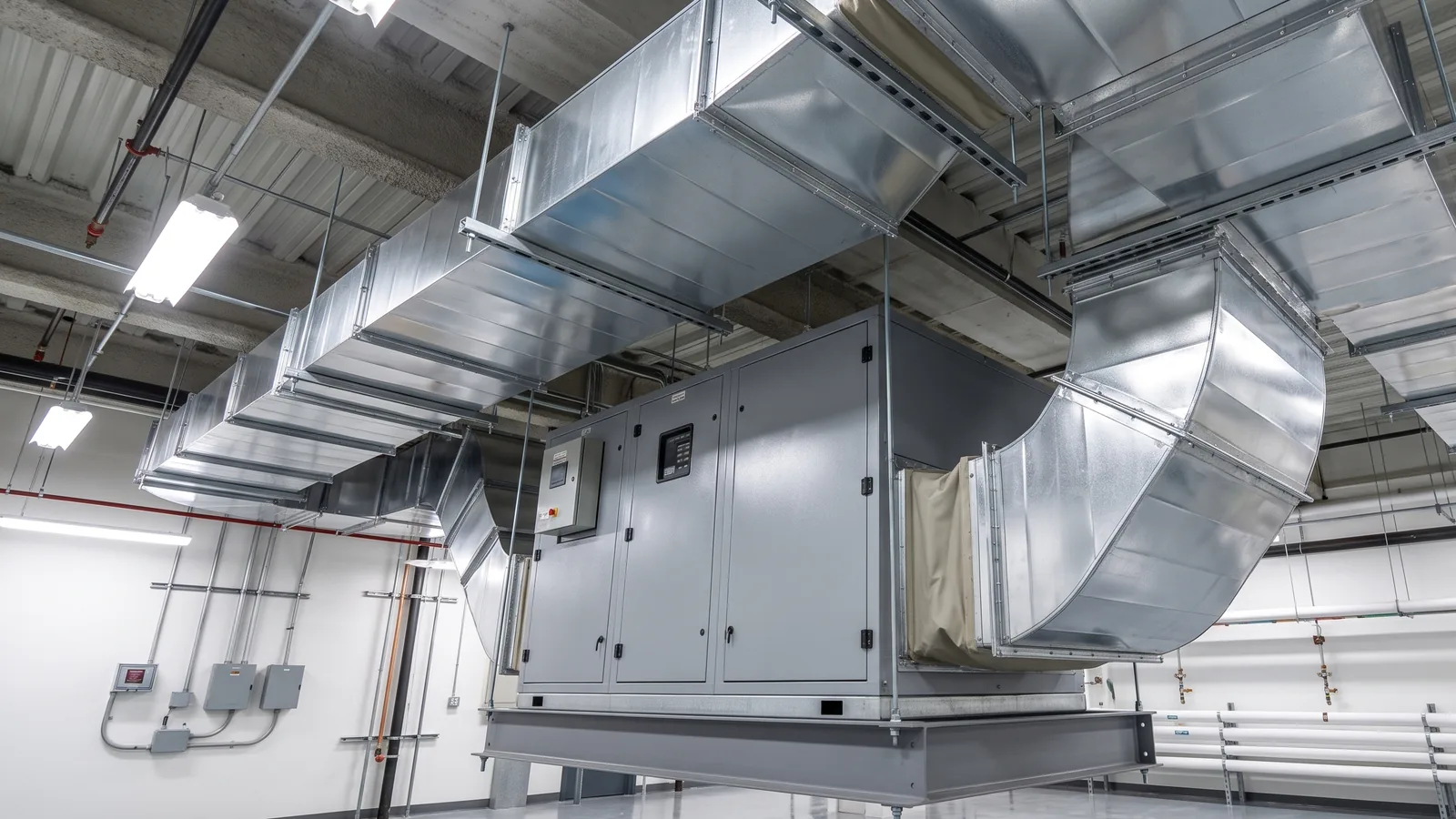
A desiccant wheel dehumidifier removes water vapour from process air with a slowly rotating desiccant rotor, then uses heated reactivation air to dry the rotor so the cycle can continue.
The method does not depend on cooling air below its dew point. It is one of the commercial dehumidifier options suited to low-temperature or low-dew-point duty.
How a desiccant wheel dehumidifier removes moisture
The core of the unit is a honeycomb rotor coated or impregnated with a desiccant such as silica gel. The housing divides the rotor face into the process and reactivation zones described in the ASHRAE handbook on desiccant dehumidification equipment.
Water molecules adhere to the desiccant surface as humid process air passes through the rotor. This is adsorption, with a “d”, because the moisture collects on the material’s surface rather than being taken into its volume.
- Process air enters: A fan draws humid air through the process side of the rotor.
- Moisture is adsorbed: Water vapour adheres to the desiccant while drier air leaves the unit.
- The rotor turns: The moisture-laden section moves slowly into the reactivation zone.
- Heat regenerates the rotor: A separate heated airstream releases the retained moisture.
- Wet air is exhausted: Reactivation air carries the water vapour outside the controlled space.
- The cycle repeats: The regenerated section returns to the process zone and can adsorb moisture again.
Why the rotor can dry air continuously
The reactivation heater supplies the energy needed to release moisture from the desiccant. The correct temperature and airflow depend on the rotor material, unit design and required outlet condition, so they should be taken from the selected unit’s performance data rather than a generic rule.
- Rotor speed sets the time available for adsorption and regeneration.
- Reactivation heat determines whether the wet section is dried before it returns to the process zone.
- Airflow balance affects contact time, pressure and the risk of leakage between zones.
- Rotor seals keep the two airstreams from mixing around the wheel face.
Because moisture leaves as vapour in the exhaust air, the core desiccant process does not produce a condensate stream. The installation still needs a safe, weatherproof route for the warm, humid exhaust.
Desiccant wheel and refrigerant systems compared
Refrigerant dehumidifiers cool air below its dew point so water condenses on a coil. Their performance depends on inlet temperature and humidity, and low coil temperatures may require defrost control.
Commercial desiccant systems remove moisture by adsorption and regeneration. This method suits facilities that need low dew points, have cool operating areas or cannot accept interruptions caused by icing and defrost.
| Design question | Desiccant wheel | Refrigerant |
|---|---|---|
| How is moisture removed? | Adsorbed onto a rotor and carried out in reactivation air | Condensed on a cold coil and drained away |
| Where does it tend to fit? | Low dew point or cool-process applications | Moderate humidity control in warmer conditions |
| What services are required? | Reactivation heat, two air paths and exhaust ducting | Electrical supply, refrigeration circuit and condensate drainage |
| What heat must be managed? | Adsorption heat and heat carried over from regeneration | Heat rejected by the refrigeration circuit |
| What drives selection? | Target dew point, process temperature and moisture load | Inlet condition, target relative humidity and sensible heat load |
A detailed comparison of desiccant and compressor dehumidification can help facilities teams assess the two methods. For warmer spaces with moderate humidity targets, commercial refrigerant dehumidifiers may provide the better operating fit because they remove condensate directly and do not need a reactivation airstream.
Where desiccant wheel units are used
Selection should follow the required air condition rather than the industry name alone. A site may need different humidity control solutions for zones with different temperatures, infiltration rates and dew point targets.
- Cold stores and freezer anterooms: Low dew point supply air reduces frost and condensation around frequently opened doors and product transfer points.
- Food and pharmaceutical production: Specified dry air conditions protect powder handling, drying and moisture-sensitive packaging processes.
- Water infrastructure: Controlling condensation protects pipes, tanks and electrical equipment; see the practical considerations for dehumidification in water treatment facilities.
- Archives and museums: Stable moisture conditions avoid rapid humidity changes around sensitive materials.
- Battery and electronics production: Specified dry rooms often need dew points beyond the practical range of a conventional refrigerant unit.
- Construction and industrial drying: Desiccant equipment continues removing moisture while the space or material is cool.
Specify temperature with humidity: A target relative humidity is incomplete without temperature. Engineers should define the design temperature, required dew point and allowable variation before comparing unit capacities.
Components that affect performance
- Desiccant rotor: The honeycomb matrix provides a large surface area for moisture transfer.
- Process fan: It moves humid air through the rotor and delivers dry air to the controlled space.
- Reactivation fan and heater: They provide the hot airstream that regenerates the rotor.
- Perimeter and sector seals: They limit bypass and mixing between the two airstreams.
- Pre-filters: They keep dust and process contamination out of the narrow rotor channels.
- Drive motor and belt: They turn the wheel at the speed set by the unit controls.
- Humidity or dew point sensor: It gives the controller the measurement used to stage or modulate capacity.
Rotor life cannot be reduced to a fixed number of years because contamination, thermal cycling, seal condition and operating hours vary between sites. A condition-based inspection and planned maintenance schedule for the rotor and filters gives maintenance teams better evidence for deciding when to replace the rotor.
Where one plant serves several rooms, ducted dehumidification can distribute controlled air across multiple zones. A central unit can sit in a plant room and serve the process areas through dedicated supply and return ducts.
How to size and specify the system
Floor area alone cannot establish dehumidifier capacity. The calculation must account for room volume, outdoor-air infiltration, product moisture, people, process releases and the difference between inlet and target moisture content.
- Record the design conditions: Measure or specify dry-bulb temperature, relative humidity and pressure at the inlet.
- Set the required outlet condition: Use dew point or moisture content where the process has a specified maximum moisture level.
- Quantify every moisture source: Include ventilation air, door openings, wet products, washdown and combustion or process loads.
- Define the air path: Confirm supply, return, purge and exhaust routes, including the effect of building pressure.
- Check heat effects: Allow for adsorption heat and carry-over from the reactivation zone.
- Review part-load control: Decide how the heater, fans and rotor respond as the moisture load changes.
Capacity tables must be read at the proposed inlet condition, not at a convenient nominal test point. A commercial dehumidifier site assessment and sizing review is needed when infiltration, process moisture or duct pressure cannot be estimated reliably.
Energy use and heat management
Reactivation heat is usually the main energy input in a desiccant system, while both fans and the rotor drive also consume electricity. Actual demand changes with inlet moisture, airflow, target dew point and the control sequence.
| Design or control measure | Why it matters |
|---|---|
| Modulating reactivation heat | Reduces heat input when the measured moisture load falls |
| Variable-speed fans | Allows airflow to follow process demand where the fan and rotor limits permit |
| Heat recovery in the regeneration path | Can reduce cooling load and the reactivation energy required |
| Clean filters and sealed ductwork | Protects design airflow and prevents untreated humid air entering the system |
| Sensor calibration | Prevents needless drying caused by a drifting humidity or dew point reading |
For facilities with long operating hours, review the controls against logged moisture conditions rather than relying on a fixed schedule. The article on energy efficiency in commercial dehumidification systems explains the broader plant and control considerations.
Common causes of poor drying performance
A unit that cannot reach setpoint is not automatically undersized. Air leakage, blocked filters, a weak reactivation heat source or an inaccurate sensor can create the same symptom.
- Dirty process filter: Low airflow reduces the amount of dry air delivered to the space.
- Blocked reactivation path: The rotor returns to the process zone without being fully regenerated.
- Worn or misaligned seals: Wet reactivation air bypasses into the dry-air side.
- Incorrect rotor rotation: A broken belt, slipping drive or wrong speed interrupts the cycle.
- Open doors or uncontrolled ventilation: The actual infiltration load exceeds the design allowance.
- Sensor location or calibration error: The controller responds to a reading that does not represent the process space.
Before increasing capacity: Confirm sensor accuracy and airflows, then check filters, heater output, rotor movement and seals. Recalculate the moisture load only after the installed system has been shown to operate as designed.
Frequently asked questions
What are the disadvantages of a desiccant dehumidifier?
The unit needs energy for reactivation heat and requires separate process and exhaust air paths. Supply-air temperature, duct routing, filtration and seal maintenance also need attention during design and operation.
Are desiccant dehumidifiers worth it for commercial facilities?
They can be the right choice when low temperatures or low dew point targets make refrigerant performance impractical. Compare the calculated moisture load, annual energy use, maintenance needs and cost of process interruptions.
How long does a desiccant wheel typically last?
There is no reliable universal service life. Dust loading, chemical contamination, operating hours, reactivation temperature and seal condition determine whether the rotor still meets its specified outlet condition.
Why does the wheel need reactivation air?
Reactivation air is heated and passed through the moisture-laden part of the rotor. It releases the adsorbed water and carries the vapour out of the system so that section of the wheel can dry process air again.
When should a facility choose desiccant over refrigerant dehumidification?
Desiccant is usually considered when the space is cool, the target dew point is low or uninterrupted moisture removal matters. Refrigerant equipment often suits warmer spaces with moderate humidity targets, but the design conditions should be checked against manufacturer performance data.
Get the system design checked
A sound specification defines the inlet condition, target dew point, moisture load, airflow, reactivation service and exhaust route. It also allows for access to filters, seals, sensors and the rotor.
- Bring representative temperature and humidity logs, room dimensions, ventilation details and the required process condition to the assessment.
- Identify door openings, washdown, wet products and other intermittent moisture loads.
- Confirm where reactivation air can be drawn from and safely discharged.
Contact Moisture Cure Commercial for a dehumidification consultation or site assessment. Send the inlet temperature, humidity logs, target dew point and airflow requirements for selection of a commercial desiccant system suited to low dew point or cool-process duty and a review of the proposed ducting.