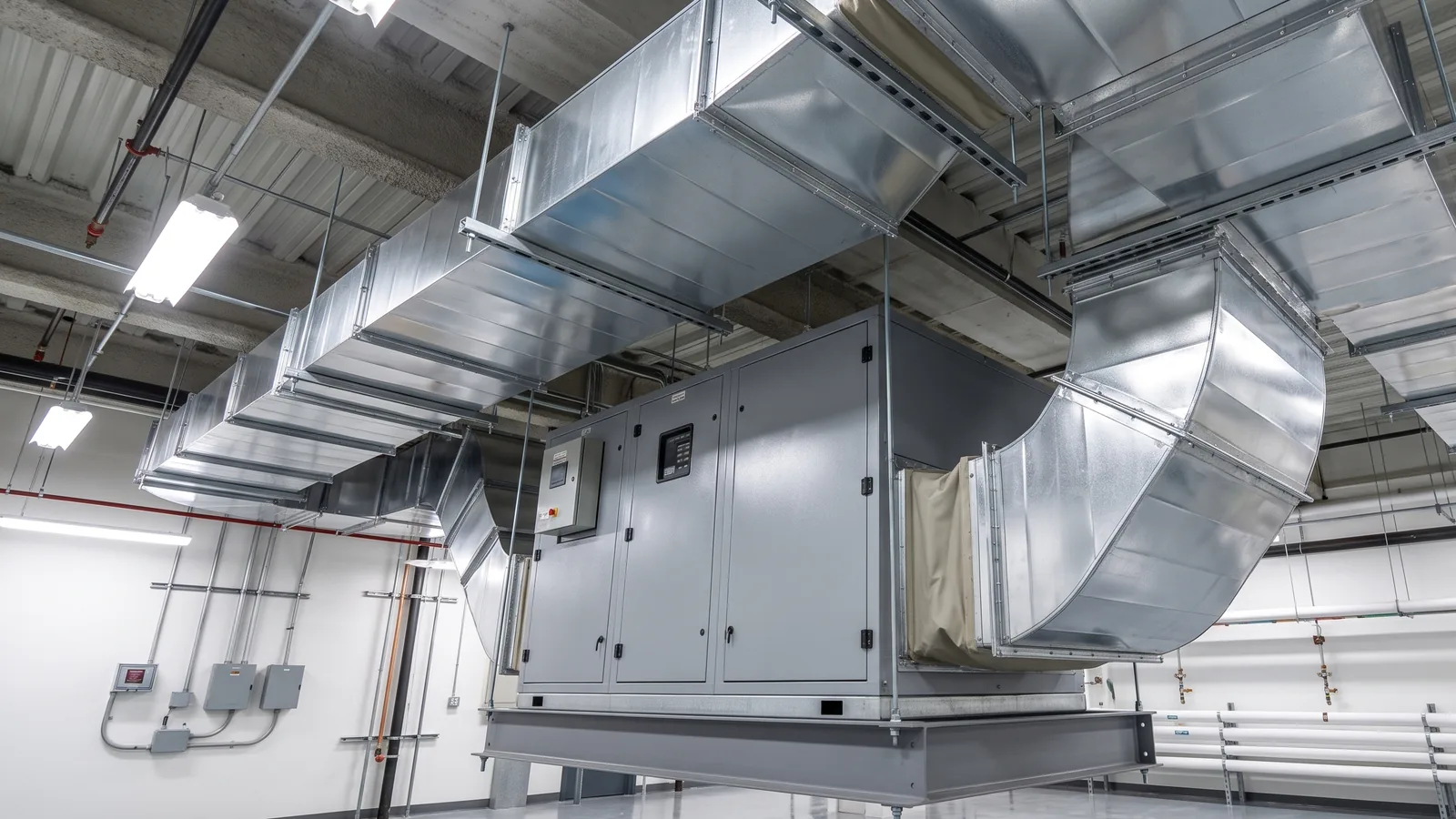
To maintain your mushroom humidifier, keep its water circuit clean, inspect the mist outlet and verify the humidity sensor against a reliable reference. For commercial growing rooms, the maintenance schedule must also account for water quality, operating hours and access between crops.
A room that looks foggy can still have poor moisture distribution. Record how the system performs after cleaning so you can distinguish an equipment fault from a change in ventilation or crop load.
Essential cleaning schedule for commercial systems
Plan cleaning around crop cycles and the deposits found during inspections. Use the equipment manual to set cleaning intervals, then shorten them when inspections show deposits or contamination developing earlier.
| Component | What to inspect | Maintenance decision |
|---|---|---|
| Water reservoir | Film, sediment, scale and stagnant pockets | Clean at the specified interval and investigate unexpected fouling promptly |
| Distribution lines | Deposits, sagging hoses and trapped water | Drain and clean using the approved method; replace inaccessible fouled sections |
| Transducers or atomisers | Scale, damage and uneven output | Use the model’s cleaning procedure before considering replacement |
| Sensor and protective filter | Dust, wetting and damaged protection | Follow the sensor manual; avoid applying solvents to the sensing element |
Check alarms, leaks and water supply each shift. Arrange deeper inspections around crop transitions, but do not leave a dirty unit running just to reach the next scheduled shutdown.
- Notify affected staff and isolate the equipment under the site’s procedure, including automatic restart commands and any stored pressure.
- Drain the reservoir and remove accessible debris before applying an approved cleaner.
- Clean removable wetted parts with tools suitable for their materials; avoid scraping delicate transducer surfaces.
- Complete any specified descaling and disinfection steps separately, following product instructions.
- Rinse as directed, reassemble and inspect for leaks before returning the unit to service.
A controller’s off button is not an isolation point. Safe Work Australia’s plant maintenance guidance addresses isolation before cleaning and maintenance, including control of hazardous stored energy.
Water quality management and treatment
Start with the humidifier’s feed-water specification and a source-water analysis. There is no universal dissolved-solids threshold that determines whether every mushroom humidifier needs reverse osmosis.
- Compare hardness, conductivity and other specified parameters with the equipment’s acceptance limits.
- Check treatment performance at the humidifier inlet, including after filter changes or a water-source change.
- Record results alongside cleaning observations so recurring scale has an identifiable cause.
- Follow the specified water-temperature range and drainage arrangement.
The US EPA explains how ultrasonic humidifiers disperse minerals from tank water. Check feed-water quality if white residue appears; the EPA’s small-unit cleaning timetable is not a commercial maintenance specification.
Moisture Cure Commercial’s commercial ultrasonic humidifier range produces a fine mist for applications that need added moisture, including mushroom growing rooms. Confirm the proposed unit’s treatment, drainage and cleaning requirements instead of assuming filtration or automatic flushing is included.
Filter replacement and performance monitoring
Identify which filters your installation actually has. A water cartridge, humidifier air filter and growing-room ventilation filter perform different jobs and need separate service records.
| Filter or treatment stage | Useful checks | Replacement basis |
|---|---|---|
| Water pre-filter | Flow, pressure loss where monitored, sediment | Supplier limit and maximum service interval |
| Demineralisation cartridge or membrane | Treated-water quality against specification | Performance trend and treatment supplier’s instructions |
| Air filter, where fitted | Loading, damage, seals and pressure difference | Equipment-specific final resistance or scheduled limit |
Record the clean-filter baseline so later readings have meaning. Do not wash a disposable filter or install a different grade without checking airflow and compatibility.
Preventing microbial contamination
Cleaning removes deposits; disinfection is a separate step with its own product compatibility and contact-time requirements. Write down both steps where the equipment’s hygiene procedure requires them.
- Inspect the entire wetted path, including the tank lid, fittings and distribution hoses.
- Drain unused sections and investigate water that remains after the normal drain cycle.
- Use only cleaning and disinfection products approved for the equipment and intended application.
- Keep cleaning tools separate from crop-handling tools and store them clean.
Ultrasonic operation does not sterilise water: the EPA notes that these units can disperse microorganisms from their tanks. Its humidifier cleaning guidance also stresses rinsing cleaning agents away before operation.
Do not add a sanitiser to operating mist water as an improvised fix for slime. Stop the affected equipment, follow the approved cleaning procedure and obtain technical advice if contamination returns.
Calibration and control system verification
Checking a sensor against a reference reveals disagreement; calibration establishes its measurement performance. Do not adjust an offset simply because two probes read differently in different parts of the room.
- Place a suitable reference instrument beside the installed probe and allow both to stabilise.
- Check that the probe sits in representative air, away from direct mist or a wet wall.
- Record temperature, humidity, reference identification and the difference between readings.
- Apply the process tolerance and sensor specification when deciding whether calibration or replacement is needed.
- Have a competent technician test alarms and interlocks using the manufacturer’s procedure.
After maintenance, confirm the controller calls for mist and stops or modulates output as intended. Review the setpoint for the crop stage, taking account of how humidity control fits commercial mushroom production.
Troubleshooting common performance issues
Record the fault before changing settings. Start with accessible checks and leave electrical testing or dismantling beyond operator instructions to a qualified technician.
| Symptom | First checks | Next action |
|---|---|---|
| No mist or reduced output | Demand signal, alarms, water supply and permitted water level | Inspect for scale under isolation; service persistent faults |
| Uneven distribution | Blocked outlets, disconnected ducts and pooled water | Restore the approved distribution arrangement |
| White residue | Feed-water quality and treatment performance | Correct treatment and clean affected components |
| Water leaks or unusual noise | Location of the leak or noise, visible damage | Isolate when necessary and arrange inspection |
| Room remains too wet | Probe location, controller demand and mist direction | Check controls, sensor readings and ventilation |
A humidifier running continuously may be responding to increased ventilation demand. If cleaning restores output but the room still misses its target, reassess capacity through the criteria for selecting humidifiers for commercial mushroom production.
Energy efficiency and operating cost reduction
Compare energy use under similar room conditions. A longer operating period after a ventilation change is not, by itself, evidence that the humidifier has become inefficient.
- Track operating hours alongside humidity, temperature and ventilation settings.
- Investigate restricted airflow and water supply before replacing equipment.
- Confirm the fan and distribution settings match the commissioned arrangement.
- Check whether output returns to its recorded baseline after cleaning.
Keep spare parts for components whose failure would interrupt production, subject to supplier storage requirements. Record part numbers and support contacts where the maintenance team can find them.
Documentation and return to service
Maintain equipment manuals and safety data sheets on-site. A useful maintenance log records what was found and whether the corrective work restored normal operation.
- Record the unit identifier, date, technician and observed fault or deposits.
- Log water results, parts replaced and any approved cleaning products used.
- Confirm guards, covers and connections are restored before restart.
- Observe filling, drainage, mist distribution and controller response.
- Assign the next inspection date and any unresolved work to a named person.
At shutdown, follow the manual’s draining and cleaning procedure. Inspect and recommission it before the next crop cycle rather than restarting with old water.
Mushroom humidifier maintenance questions
- Keep the model manual available when applying these answers; component designs differ.
How often should a commercial mushroom humidifier be cleaned?
Use the manufacturer’s interval, adjusted for water quality and observed fouling. Shift inspections help identify when cleaning is needed sooner than planned.
Can I use vinegar to clean the humidifier?
Only where the manual permits it for the affected materials and components. An approved descaler does not automatically replace a specified disinfectant.
Can bleach or sanitiser go in the water tank?
Do not improvise chemical dosing while the unit produces mist. Follow the equipment’s approved offline cleaning procedure and its rinsing requirements.
Does treated water remove the need for cleaning?
No. Water treatment and equipment cleaning are separate maintenance tasks, so continue reservoir and line inspections even when feed-water results meet specification.
Why has mist output fallen after cleaning?
Check reassembly, water level, supply valves and controller demand against the manual. Stop and seek service if the unit leaks, alarms or makes unusual noise.
Should the humidifier run continuously?
Runtime should follow the approved control strategy and equipment duty rating. Investigate continuous demand against room conditions and sensor readings before changing settings.
When should ultrasonic discs be replaced?
Follow the supplier’s inspection and replacement criteria. Persistent low output after approved cleaning needs diagnosis before ordering replacement discs.
How do I check whether the humidity reading is wrong?
Compare it with a suitable reference at the same location under stable conditions. Check placement and wetting before treating a discrepancy as calibration drift.
Can water remain in the humidifier between crop cycles?
Follow the shutdown procedure for draining, cleaning and storage. Do not leave an idle tank full until the next crop and assume it is ready to operate.
Contact Moisture Cure Commercial for a site assessment or consultation on your mushroom humidifier’s maintenance requirements. Provide the model, water-treatment details and service records.