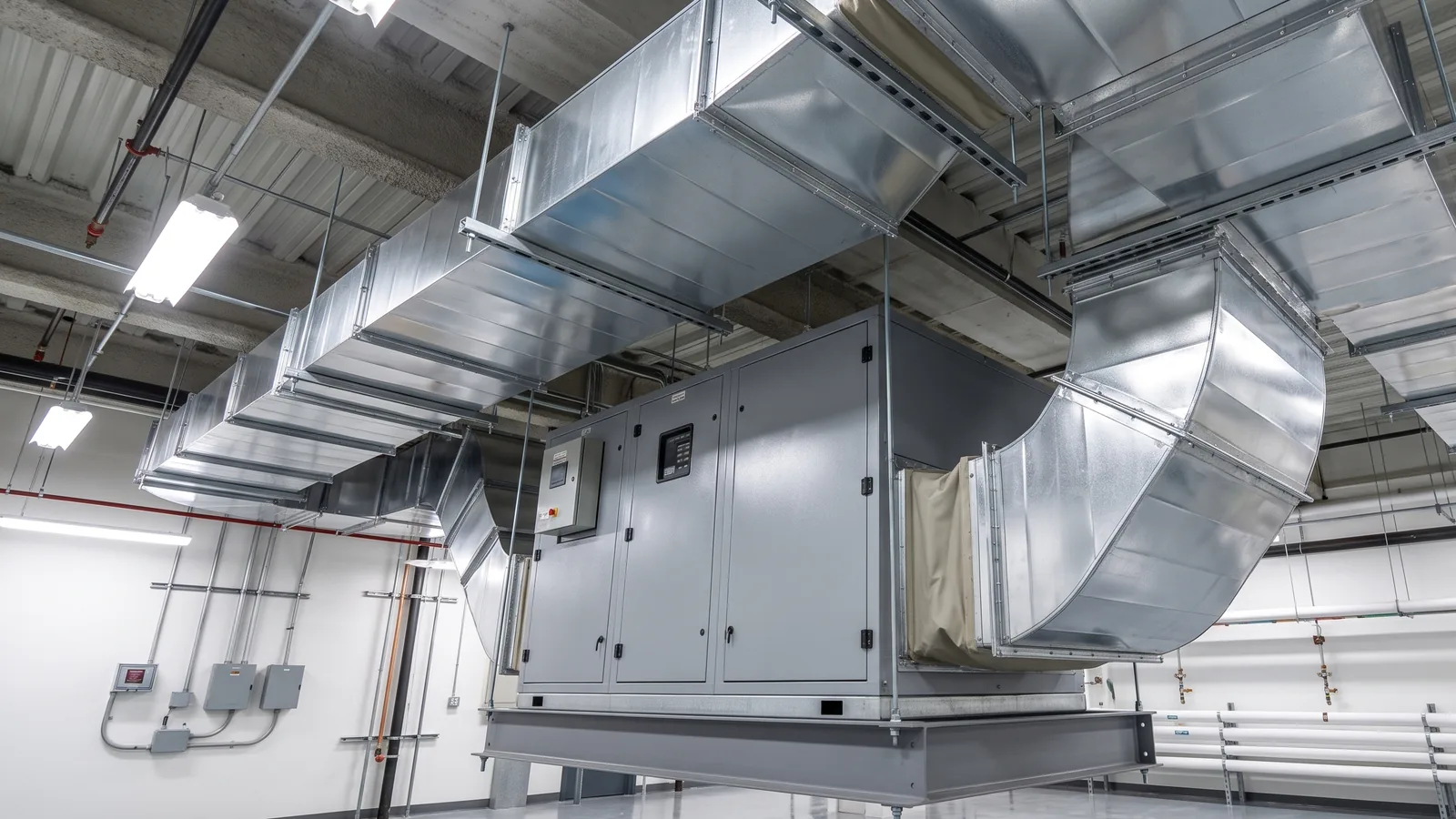
Humidification for mushroom houses depends on the moisture duty, not a room-area rating. A commercial system must hold the crop’s required relative humidity while ventilation removes moist air, without wetting caps, racks or building surfaces.
This guide is for mushroom-house operators, facility managers and engineers comparing commercial humidification equipment for controlled environments. It covers setpoints, technology, water quality, controls, sizing and commissioning.
How to choose a humidifier for commercial mushroom growing
The right system must recover after each fresh-air cycle without creating wet zones around loaded racks. Start with the production brief and assess the following factors together.
- Species, strain and cultivation-stage setpoints supplied by the grower or block supplier
- Peak extract and make-up airflow in cubic metres per hour
- Incoming-air temperature and moisture content at the design condition
- Required recovery time after door openings and ventilation cycles
- Water analysis, treatment method, drainage and cleaning access
- Controls, alarms, service isolation and standby capacity
Room volume is useful for describing the space, but it does not reveal how much water the ventilation system removes. A commercial humidifier selected against a calculated moisture load can then be matched to a documented control sequence.
Humidity requirements at each cultivation stage
No single relative-humidity setpoint applies to every mushroom crop. Cornell Small Farms notes that strain and cultivation method affect operating parameters, while its commercial cultivation guidance places particular emphasis on humidity during early initiation and pinning.
| Stage | Setpoint basis | Humidifier implication |
|---|---|---|
| Incubation | Substrate and strain process sheet | Avoid using room RH as a substitute for substrate moisture control |
| Initiation and early pinning | Crop specification; Cornell’s commercial cultivation guidance describes above 85% RH during the first four days after initiation | Provide fast recovery without direct wetting |
| Fruiting | Strain target confirmed by crop observation | Coordinate humidity with fresh-air demand and temperature |
| Between flushes | Farm operating procedure | Use a separate recipe rather than carrying over the pinning setpoint |
Relative humidity is only one part of the brief. Temperature changes alter relative humidity, and fresh-air exchange changes both the moisture load and the carbon-dioxide concentration, so these controls need to operate as one sequence.
How humidity loss affects mushroom quality and yield
Fresh mushrooms are roughly 90% water by weight. Without adequate humidification in the growing room, that water evaporates through the cap surface faster than the mycelium can replace it.
- Measurable weight loss occurs every hour the room sits below target humidity, compounding across a multi-day flush
- Caps crack, curl or discolour when surface evaporation outpaces moisture transport from the substrate
- Pinning can stall or abort entirely if humidity drops below the strain’s initiation threshold
- Uneven humidity across racks produces inconsistent sizing, which complicates grading and packing
These losses are not recoverable once the fruit body has been stressed. Keeping the humidifier properly maintained and serviced on a documented schedule is the most direct way to protect yield over repeated flushes.
Humidifier technologies compared for mushroom farms
Commercial mushroom operations usually need low-heat, controllable output and good distribution. The comparison below is a screening tool; the final selection still depends on water quality, ventilation duty and the room layout.
| Technology | Where it can fit | Design checks |
|---|---|---|
| Ultrasonic | Direct-room or ducted installations needing fine, cool mist and responsive modulation | Low-mineral water, tank hygiene, drainage and droplet evaporation distance |
| High-pressure fog | Large spaces with engineered nozzle distribution | Pump arrangement, nozzle maintenance, water treatment and drip prevention |
| Steam | Applications where absorbed heat and electrical demand are acceptable | Heat gain, power capacity, condensate management and safe service access |
| Evaporative | Applications where the available capacity and response rate meet the duty | Media hygiene, pressure drop and replacement access |
For many Australian mushroom houses, an ultrasonic humidifier system designed for commercial duty is a practical fit because it adds little process heat and can respond quickly to a humidistat or building controller. That product type still needs treated water and enough residence time for the mist to evaporate before it reaches the crop.
Operators running other controlled-environment facilities may find parallels in humidity control approaches used in vertical farms and CEA operations, where airflow management and rapid recovery face similar constraints.
Humidification for mushroom houses
Humidification for mushroom houses must replace moisture lost through ventilation and distribute it evenly through a changing rack load. A unit that can raise RH in an empty sealed room may still fall behind once extract fans run and fruiting blocks obstruct airflow.
Design rule: assess the humidifier with the mushroom house loaded, ventilating and operating at the most demanding outdoor-air condition in the project brief.
- Introduce mist into moving air rather than directing it at caps or substrate
- Keep spray paths clear of sensors, lights, walls and cold surfaces
- Check upper, middle and lower rack levels for persistent RH differences
- Provide drainage where a shutdown or fault could leave residual water
- Allow safe access to tanks, filters and transducers without entering crop zones unnecessarily
Before finalising the equipment schedule, account for how humidity interacts with temperature, airflow and each stage of mushroom production.
Sizing a humidifier for a mushroom grow room
Size the system from the peak mass of moisture it must add each hour. Floor area alone cannot account for ventilation, outdoor conditions or recovery time.
- Record the room dimensions and the maximum supply and extract airflow in cubic metres per hour.
- Set the outdoor-air design condition and the required room temperature and RH.
- Use a psychrometric calculation to find the difference in humidity ratio between incoming air and room air.
- Multiply that difference by the dry-air mass flow to obtain the ventilation moisture duty in kilograms per hour.
- Add quantified door-opening and process losses, then apply an engineering margin that reflects measurement uncertainty.
- Check minimum turndown, not just peak output, so the system can hold a stable band under light load.
Cold racks, walls or ductwork can reach dew point even when the room-average RH appears acceptable. Our explanation of why dew point matters when commissioning humidity-controlled facilities helps teams distinguish an air setpoint from a condensation risk.
Redundancy: where a humidifier fault would interrupt production, split the duty across independently serviceable units and confirm what capacity remains during maintenance.
The sizing approach here applies to any enclosed growing space. Operators designing greenhouse humidification systems face a similar calculation, with the added variable of solar heat gain and natural ventilation losses. Our guide on selecting commercial greenhouse humidifiers in Australia covers that overlap.
Water quality and contamination control
Ultrasonic equipment can carry material from its water supply into the air. The US Environmental Protection Agency’s humidifier guidance documents dispersal of minerals and microorganisms from tank water and recommends low-mineral water plus regular cleaning.
- Test the incoming water and specify treatment against the humidifier manufacturer’s limits
- Use reverse osmosis or another suitable demineralisation method where dissolved minerals would create scale or airborne residue
- Do not treat reverse osmosis as a complete sanitation program
- Eliminate stagnant sections and make wetted components accessible for inspection
- Document cleaning, flushing, filter replacement and post-maintenance verification in the farm’s food-safety system
Cleaning frequency should come from the equipment instructions, water results and observed fouling, then be verified on site. A generic weekly or quarterly interval is not a substitute for that evidence.
Controls and commissioning checks
A commercial humidifier needs a dedicated control point, sensible deadband and alarms that operators can act on. Sensor placement often matters as much as sensor accuracy because a probe in the mist path will not represent conditions at the crop.
- Use a calibrated, condensation-tolerant RH sensor suitable for the operating range
- Position the control sensor in representative return air and away from direct mist
- Use independent logging sensors to test rack-level uniformity
- Interlock humidification with ventilation and airflow where the design requires it
- Alarm for sustained high RH, low RH, water fault and equipment failure
- Trend temperature and RH through complete fan, door and production cycles before handover
Commissioning should test an occupied production layout as well as the empty room. Confirm stable conditions across the crop zone and check for persistent wet surfaces.
YAKE ultrasonic humidifiers for commercial mushroom farms
Moisture Cure Commercial supplies the YAKE RYJS ultrasonic range for commercial humidification. Consider these units when the calculated load suits the equipment and treated water is available.
| Models to assess | Specification question |
|---|---|
| YAKE RYJS-03D commercial ultrasonic unit YAKE RYJS-06D commercial ultrasonic unit |
Would smaller units improve zoning, turndown or standby coverage for the calculated load? |
| YAKE RYJS-09D commercial ultrasonic unit YAKE RYJS-12D commercial ultrasonic unit |
Does the project need fewer units while retaining acceptable control at reduced demand? |
| YAKE RYJS-15D commercial ultrasonic unit | Can the room use this output without short cycling, poor distribution or loss of service redundancy? |
Confirm the model against its technical data, the site water analysis and the control design. Compare those requirements with the commercial ultrasonic models available from Moisture Cure.
Frequently asked questions
The answers below are selection principles. Final setpoints and capacity should be checked against the strain, room and ventilation design.
What is the best humidity control system for mushroom growing?
For a commercial mushroom farm, the best system is one sized from the ventilation moisture load and able to modulate across each production stage. Ultrasonic equipment is often suitable where low heat gain and fast response are priorities, provided water treatment and sanitation are designed with it.
What type of hygrometer is best for mushroom cultivation?
Use an industrial RH sensor specified for sustained high-humidity service, with calibration records and a replaceable sensing element where practical. Confirm the control reading with independent loggers placed at representative rack positions.
Can manual misting replace a commercial humidifier?
Manual misting does not provide the repeatable output, distribution or logged control expected in a commercial mushroom house. It also makes it harder to coordinate moisture addition with ventilation cycles and production recipes.
Why can mushrooms dry out when the RH sensor reads high?
The sensor may sit in a locally wet pocket, too close to the mist discharge or outside the airflow serving the crop. Check calibration, probe position, rack-level distribution and fan operation before increasing output.
Can tap water be used in an ultrasonic humidifier?
Only if water testing and the manufacturer’s limits show it is suitable. Minerals in untreated water can produce scale and airborne residue, so commercial systems commonly require purpose-designed treatment.
How often should a mushroom-house humidifier be cleaned?
Set the interval from the manufacturer’s instructions, water quality and inspection results. Record each clean and shorten the interval if scale, film or output loss appears before the scheduled service.
How does fresh-air exchange affect humidity in a mushroom house?
Every cubic metre of outside air brought into the room carries its own moisture content, which is almost always lower than the room setpoint. The humidifier must replace that difference continuously while fans run. Higher ventilation rates, needed to manage CO2 during fruiting, increase the moisture load proportionally.
What size humidifier does a commercial mushroom farm need?
Size is determined by the peak moisture deficit, not by room volume. Calculate the mass of water the ventilation system removes per hour at the worst-case outdoor condition, add door-opening and process losses, then apply an engineering margin. The sizing section above walks through the full method.
What happens if humidity drops too low during mushroom fruiting?
Caps lose water faster than the mycelium can transport it from the substrate, producing weight loss, surface cracking and discolouration. In severe cases, pins abort. Once a fruit body has been stressed by a humidity drop, the damage cannot be reversed in that flush.
Should humidity targets differ between oyster and button mushrooms?
Yes. Each species and strain has its own optimal RH band at each growth stage, and differences of a few percentage points can change pinning behaviour and yield. Always use the setpoints from the strain supplier’s process sheet rather than a generic figure.
Specify the system against your facility
Moisture Cure Commercial has more than 20 years of commercial humidity-control experience. For a useful site assessment, prepare the following information before the consultation.
- Room dimensions, rack layout and crop species or strains
- Stage setpoints and acceptable control band
- Supply and extract airflow at minimum and maximum operation
- Incoming water analysis and available treatment
- Electrical, drainage, controls and redundancy requirements
Arrange a commercial mushroom-farm humidity assessment with the Moisture Cure Commercial team. The consultation can cover moisture-load calculations, equipment selection, placement and commissioning requirements.