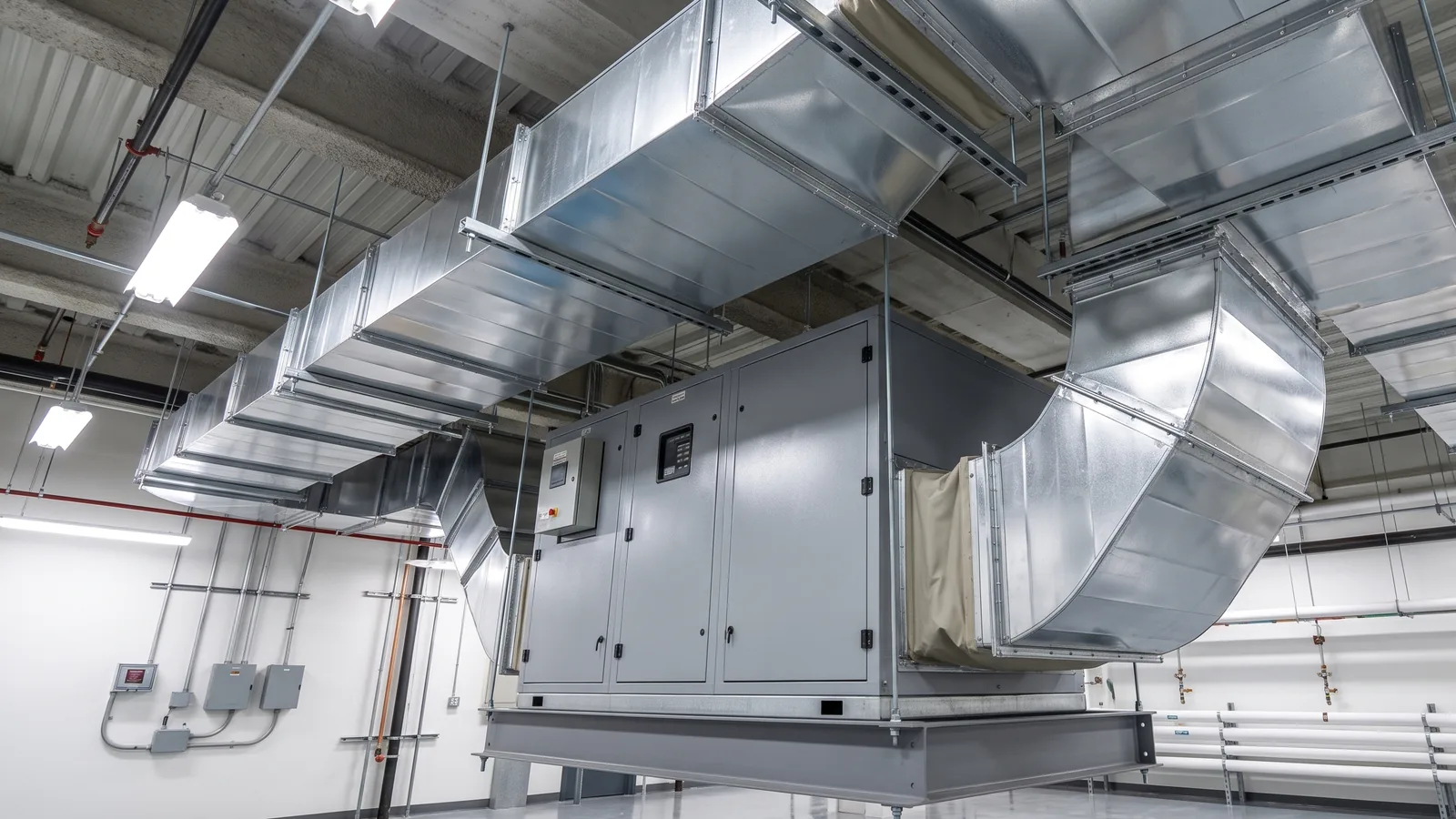
Dehumidifiers and air conditioners can both remove water from the air, but they are designed around different control objectives. An air conditioner responds primarily to temperature, while a dedicated dehumidifier responds to humidity and can keep drying when no cooling is required.
For a commercial facility, the right choice depends on the moisture load, setpoint and operating conditions. Moisture Cure Commercial supplies commercial dehumidifiers built for planned moisture control.
Dehumidifier vs air conditioner at a glance
Air conditioning fits a space where cooling is the main requirement and incidental water removal keeps conditions within limits. A dedicated dehumidifier fits a space where RH or dew point must be controlled after the cooling demand has stopped.
| Decision factor | Dedicated dehumidifier | Air conditioner |
|---|---|---|
| Primary control | Relative humidity or dew point | Dry-bulb temperature |
| Moisture removal | Purpose-designed and rated at stated test conditions | Occurs while the cooling coil is cold enough and the compressor is running |
| Low-temperature spaces | Desiccant equipment can suit cold conditions | Standard comfort cooling is usually a poor fit |
| Typical commercial role | Process control, asset protection and persistent moisture loads | Occupant comfort and sensible heat removal |
The job determines the equipment. Condensation on warehouse stock, evaporation from an indoor pool and a summer cooling load in an office each place a different demand on plant.
How each system removes moisture
Most refrigerant dehumidifiers and cooling air conditioners use the same basic physical process. Humid air passes over a surface colder than its dew point, water condenses on that surface, and the condensate drains away.
- Air conditioner: the evaporator coil cools the air and removes some moisture during the cooling cycle. Dehumidification falls away when the compressor cycles down or stops because the temperature setpoint has been reached.
- Refrigerant dehumidifier: the unit cools air to condense water, then reheats the air before returning it to the space. Its humidistat responds to a moisture target.
- Desiccant dehumidifier: a rotating desiccant medium captures water vapour from the process air and a separate heated airstream removes that moisture from the rotor. This arrangement suits low-temperature or low-dew-point duties where condensation equipment becomes less effective.
During cool, wet weather, the thermostat may stop the air conditioner even though ventilation air, wet materials, cleaning processes or open doors continue to add water vapour.
Temperature control and humidity control are different jobs
Relative humidity changes when air temperature changes, even if the amount of water vapour stays the same. The Bureau of Meteorology’s explanation of relative humidity notes that warmer air can hold more moisture than cooler air, so an RH reading must always be interpreted alongside temperature.
A temperature setpoint answers, “How warm is the space?” An RH or dew-point setpoint answers, “How much moisture is present relative to the operating condition?”
Commercial specifications often need both.
Cooling a room can reduce RH while the coil is operating, but it does not prove that the latent moisture load is under control. If the air conditioner satisfies the thermostat quickly, humidity can remain high or rebound between cooling cycles.
Dew point is often more useful when the aim is to prevent condensation on cold pipework, tanks or products. Establish it from the coldest relevant surface, not a generic comfort setting.
When air conditioning is enough
Air conditioning may be sufficient where heat and moisture loads occur together, comfort is the main objective and the cooling system has been selected to manage both loads. The controls, coil temperature, airflow and run time still need to support moisture removal.
- Occupied offices and retail areas where cooling demand is consistent during humid periods
- Spaces where short humidity excursions do not threaten stock or processes
- Applications where the HVAC designer has explicitly allowed for the latent load rather than assuming cooling capacity will cover it
An AC dry mode may help with a short humidity spike, but its capacity and control behaviour depend on the equipment and operating sequence.
When a dedicated dehumidifier is the better choice
Dedicated dehumidification is usually the better fit when moisture control is a process or asset-protection requirement. It is also appropriate when the humidity load continues outside the cooling season or in spaces that should not be overcooled.
- Condensation appears on cold surfaces, stored goods, walls or services
- Production quality, corrosion risk or material stability depends on a validated humidity band
- Washdown, indoor water or outdoor air creates a persistent latent load
- The space operates at a low temperature or requires a low dew point
- Temperature is acceptable but RH rises after the air conditioner cycles off
Moisture control also needs to address water entry, leaks and ventilation faults. The US Environmental Protection Agency’s building moisture guidance explains that controlling indoor moisture is central to controlling mould growth, and lists leaks, condensation, poor drainage and inadequate ventilation among the causes that equipment alone cannot correct.
Commercial application examples
Facility type is a starting point, not a sizing method. Two buildings with the same floor area can have very different moisture loads because of outdoor-air rates, door openings, occupancy, washdown and production activity.
| Application | Likely approach | What must be checked |
|---|---|---|
| Warehouse or archive | Dedicated dehumidification where goods or records are moisture-sensitive | Outdoor-air infiltration, door cycles and surface temperatures |
| Food or pharmaceutical production | Purpose-designed dehumidification coordinated with HVAC | Process emissions, hygiene requirements and validated environmental limits |
| Cold room or low-temperature process | Often desiccant dehumidification | Required dew point, frost risk and regeneration-air arrangement |
| Indoor aquatic facility | Integrated temperature, ventilation and dehumidification control | Evaporation load, condensation risk and corrosive environment |
Facility teams assessing an aquatic centre can compare these criteria with Moisture Cure Commercial’s indoor pool condensation-control project in Hobart.
Energy use and operating cost
Running cost cannot be judged by technology alone. It depends on the water-removal load, operating hours, equipment efficiency and control strategy.
- Compare moisture-removal capacity at the same entering-air temperature and RH
- Check part-load behaviour, fan power, defrost or regeneration energy and standby consumption
- Model how the dehumidifier’s heat output affects the cooling system
- Assess annual duty, not nameplate power alone
Published extraction capacity is meaningful only with its test condition. The US Government’s ENERGY STAR dehumidifier guidance also notes that capacity is expressed as water removed over a set period and that low air temperature can reduce the performance of refrigerant equipment through coil frosting.
A dedicated unit can avoid comfort cooling solely to chase an RH target, but it returns heat to the treated air. The HVAC design must account for that sensible load.
Can dehumidifiers and air conditioners work together?
Yes. In many commercial buildings, air conditioning handles the sensible cooling load while a dehumidifier handles the latent moisture load.
- Use separate temperature and humidity sensors at representative locations
- Set an agreed control sequence so the systems do not hunt or work against each other
- Confirm where dry air is supplied and how return air reaches the equipment
- Trend temperature, RH or dew point during different weather and production conditions
Two units placed in the same room can still fight each other if their sensors and setpoints call for conflicting operation. Facilities planning a retrofit can review how a ducted dehumidifier integrates with existing HVAC before finalising controls, ductwork and commissioning responsibilities.
How to specify the right system
Start the specification by quantifying the water-vapour load and defining the control setpoint. Floor area alone cannot capture outdoor-air moisture, wet processes, product release, people, door openings or vapour movement through the building envelope.
| Information to collect | Why it matters |
|---|---|
| Target temperature, RH and dew point | Defines the environmental outcome and the control variable |
| Outdoor and process design conditions | Establishes peak and routine moisture loads |
| Air volume and ventilation rate | Determines how much moist air enters and must be treated |
| Controls, alarms and data logging | Allows the facility to verify performance |
Ask suppliers to state the conditions behind every capacity figure and to explain how performance changes across the expected operating envelope. A site assessment can then match the load to suitable commercial humidity-control equipment for the required duty.
Choosing a dehumidifier configuration
If dedicated moisture control is justified, the configuration should follow the site’s temperature, dew-point target and air-distribution needs. Each product link below points to the type that fits the stated context.
- Refrigerant dehumidifiers for warm, humid commercial spaces suit duties where condensation-based extraction remains efficient and a moderate humidity target is required.
- Desiccant dehumidifiers for cold or low-dew-point applications suit cold storage, dry-air processes and conditions where refrigerant coils would lose capacity.
- Ducted dehumidifiers for distributed moisture control suit facilities that need dry air delivered across zones or coordinated with an existing air-handling system.
Facility teams comparing specific refrigerant units can review the FRAL FD360, FRAL FD520, FRAL FD750 and FRAL FD980 for warm, humid spaces where condensation-based water removal remains effective. Final selection should use rated capacity at the facility’s operating conditions.
Portable equipment can suit temporary drying or a localised issue. Fixed equipment is generally easier to drain, control and monitor for ongoing duty.
Frequently asked questions
-
Is it better to get a dehumidifier or an air conditioner?
Choose an air conditioner when cooling is the main objective and its moisture removal keeps the space within the approved humidity band. Choose a dehumidifier when moisture must be controlled independently of temperature.
Do you still need a dehumidifier if you have air conditioning?
You may need both if RH rises when cooling stops or if the facility has a process setpoint. Logged temperature and humidity data will show whether the existing system maintains it.
Can a dehumidifier replace an air conditioner?
No, not when the space needs active cooling. A typical dehumidifier removes moisture but releases heat into the treated air, so it does not perform the same comfort-cooling job.
Do dehumidifiers have lower running costs than air conditioners?
Not by default. Compare annual energy at the design water-removal load, including any cooling or reheating needed by the combined system.
What is the downside of a dehumidifier?
A dehumidifier adds heat, needs drainage and cannot repair leaks or ventilation faults. Poor sizing or air distribution can leave wet zones untreated.
Can an air conditioner and dehumidifier run at the same time?
Yes, provided the system is designed and controlled as a coordinated whole. The controls should allocate sensible cooling and latent moisture removal without unnecessary cycling, overcooling or reheating.
Moisture Cure Commercial can prepare a site moisture-load assessment and recommend equipment for the measured operating conditions. Request a commercial humidity-control consultation or site assessment for your facility.