Warehouse ceiling condensation is a moisture problem that damages stock, corrodes steel and creates dangerous working conditions.
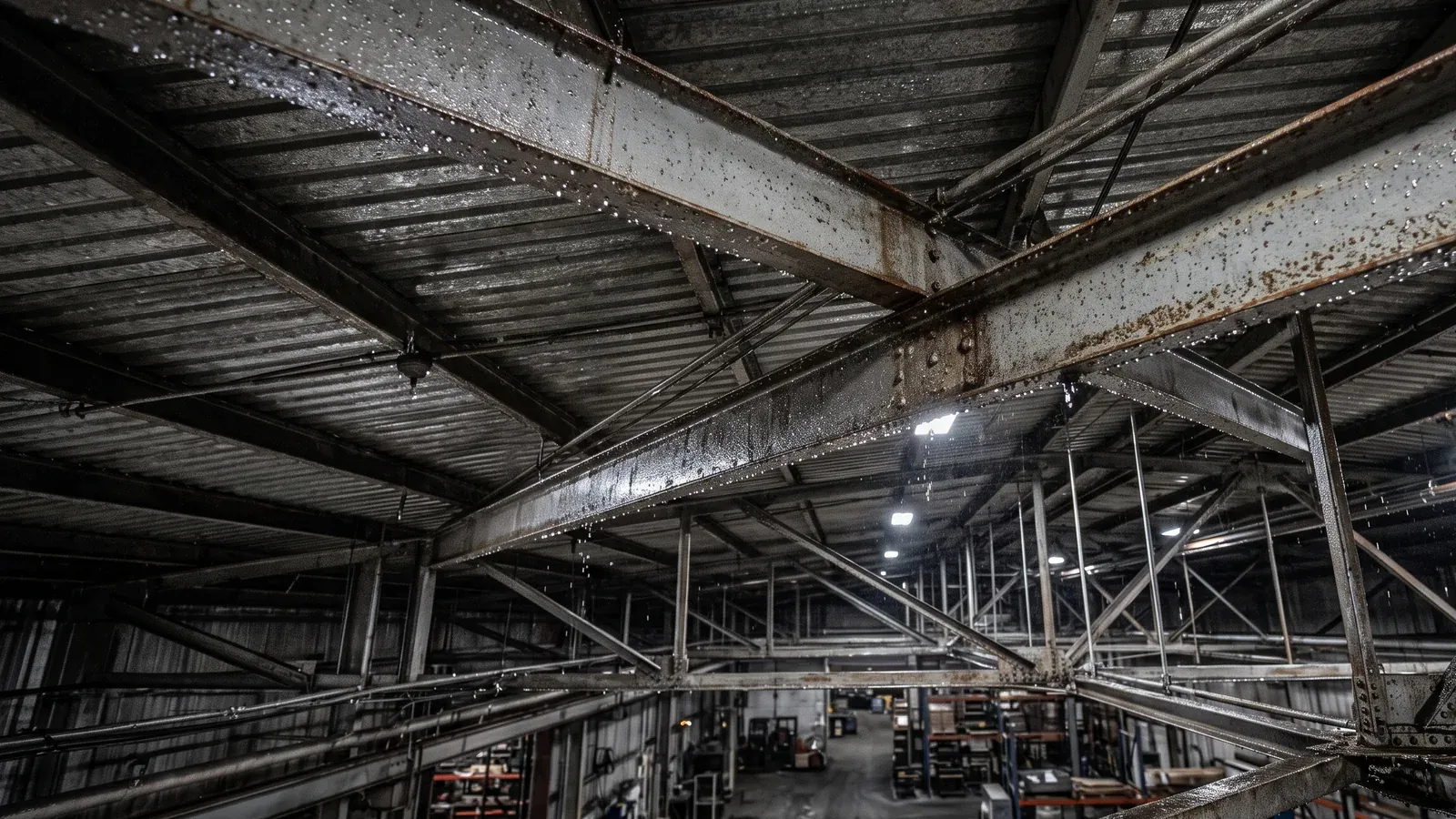
When warm, humid air inside a warehouse meets the cold underside of a metal roof, water forms. That water drips onto racking, packaging and floors, and the damage adds up fast.
This article explains why warehouse ceilings sweat, what it costs when left unchecked, and which solutions actually work for Australian conditions. We cover ventilation, insulation and dehumidification, with a focus on what facility managers get wrong.
If your warehouse has moisture problems beyond the ceiling, understanding humidity control across the full warehouse environment is the right starting point.
Why Warehouse Ceilings Sweat
Condensation forms when a surface drops below the dew point of the air around it. In a warehouse with a metal roof, the underside cools rapidly after sunset or during cold snaps.
Meanwhile, the air inside holds moisture from open loading docks, forklifts, stored goods and the concrete slab releasing stored water. The result is water droplets on the ceiling that drip onto everything below.
Key factors that accelerate the problem:
- Metal roofing (Colorbond, Zincalume) conducts heat quickly, so the underside cools faster than insulated surfaces
- Large roller doors left open during humid weather introduce moisture-laden outside air
- Warm air rises to the ceiling where it meets the coldest surface in the building
- Temperature swings between day and night widen the gap between air temperature and surface temperature
The ABCB condensation handbook confirms that metal-clad buildings without adequate vapour management are among the highest-risk structures for internal condensation in Australia.
What Warehouse Ceiling Condensation Actually Costs
The drips from a warehouse ceiling cause real financial and safety problems. Here is what facility managers typically report when the issue goes unaddressed.
| Impact | How it happens |
|---|---|
| Stock damage | Water drips onto cardboard packaging, electronics, textiles or raw materials |
| Structural corrosion | Persistent moisture corrodes steel purlins, racking and fasteners |
| Mould growth | Damp surfaces above 60% RH become breeding grounds for fungal colonies |
| Slip hazards | Pooling water on concrete floors creates a WHS liability under Safe Work Australia guidelines |
| Electrical risk | Moisture reaching wiring, switchboards or lighting creates fault conditions |
Persistent dampness above 60% relative humidity also turns wall and ceiling surfaces into breeding grounds for mould across commercial and industrial spaces. The financial impact of stock write-offs and structural repairs almost always exceeds the cost of fixing the root cause.
Why Ventilation Alone Falls Short
Many warehouse operators install exhaust fans or open roof vents and assume the problem is solved. Ventilation helps by moving air, but it has a limitation: if the outside air is more humid than the inside air, you are pumping in more moisture.
This is the reality for warehouses in Brisbane, Sydney's western suburbs and anywhere north of the Tropic of Capricorn during the wet season. Running exhaust fans on a 28°C day at 85% relative humidity makes things worse, not better.
HVLS (high-volume, low-speed) ceiling fans reduce spot condensation by keeping air moving so warm pockets do not settle against the roof. But they redistribute moisture rather than removing it.
- Ventilation works when outside air is drier than inside air (cool, dry winter days in Melbourne or Adelaide)
- Ventilation fails when outside humidity exceeds 60% RH or when the building cannot be fully sealed
For warehouses that operate year-round in humid regions, ventilation is a partial fix at best.
Insulation and Vapour Barriers
Insulating the underside of the roof raises the surface temperature above the dew point. Closed-cell spray foam (25 to 35 mm) is the most common retrofit for metal-clad warehouses.
A vapour barrier on the warm side of the insulation prevents interior moisture from migrating through to the cold roof surface. Without the barrier, moisture can condense inside the insulation itself and cause hidden corrosion.
- Insulation stops condensation by keeping the roof surface warm enough to stay above dew point
- Vapour barriers prevent moisture from reaching the cold side of the assembly
- Retrofitting an existing warehouse is more expensive and disruptive than addressing it during construction
Insulation is a good preventive measure, but it does not address the root cause. If the air inside the warehouse holds too much moisture, insulation alone will not fix it.
Why Desiccant Dehumidification Stops Warehouse Condensation
Dehumidification tackles the root cause by removing moisture from the air itself. When indoor air stays below the dew point threshold of the coldest surface, condensation physically cannot form.
For warehouses, desiccant dehumidifiers built for industrial duty cycles outperform refrigerant units for one reason: they work across the full temperature range. Refrigerant dehumidifiers rely on cooling coils that ice up below roughly 15°C.
Most Australian warehouses are not heated, so overnight and winter temperatures regularly drop below that threshold. Desiccant units like the YAKE range operate from -20°C to +50°C using a silica gel rotor to adsorb moisture regardless of air temperature.
This makes them the standard choice for:
- Unheated or partially heated warehouses
- Cold storage facilities and loading docks
- Metal-clad buildings in coastal or tropical regions
- Any facility where temperature swings are a daily reality
Moisture Cure Commercial has been sizing desiccant systems for Australian warehouses for over 28 years. The difference between a unit that runs efficiently and one that wastes energy comes down to air volume, air changes per hour and target relative humidity, which is where expert sizing advice from the full humidity control range matters.
Desiccant dehumidifiers also play a direct role in preventing corrosion in steel storage environments. If your warehouse stores metal components or finished goods, this is worth reading.
Matching the Solution to Your Climate Zone
Australia's warehouse condensation problem varies dramatically by location. A solution that works in Melbourne may fail in Cairns.
- Tropical and subtropical (Brisbane, Darwin, Cairns, Townsville): High year-round humidity means ventilation alone is counterproductive in the wet season. Desiccant dehumidification is the only reliable option.
- Temperate coastal (Sydney, Perth, Adelaide): Seasonal condensation peaks in winter and during weather transitions. A combination of insulation and dehumidification works well.
- Cool and cold inland (Canberra, Ballarat, Toowoomba): Cold overnight temperatures drop metal roofs well below dew point. Refrigerant dehumidifiers freeze up. Desiccant units handle the cold without issue.
The Australian Government's YourHome guide maps condensation risk zones and confirms that most of coastal Australia falls into the high-risk category for surface condensation in uninsulated metal buildings.
Frequently Asked Questions
What causes condensation on warehouse ceilings?
Warm, moist air rises and meets the cold underside of the roof. When the roof surface temperature drops below the dew point of the surrounding air, water droplets form.
How do you stop condensation dripping from a metal warehouse roof?
Three approaches work, often in combination: insulate the roof underside to raise its surface temperature, install desiccant dehumidification to lower the moisture content of the air, and improve air circulation to prevent warm air pooling against the roof.
Is insulation or dehumidification better for warehouse condensation?
Insulation prevents the surface from getting cold enough to trigger condensation, while dehumidification removes the moisture that causes it. In most Australian warehouses you need both, but dehumidification addresses the root cause.
Does warehouse ventilation fix condensation problems?
Only when the outside air is drier than the inside air. In humid climates or during the wet season, ventilation can make things worse by introducing more moisture.
What humidity level should a warehouse be kept at?
Most warehouse applications target 30 to 50% relative humidity. Below 50% RH, surface condensation on metal roofing is unlikely in most temperature ranges.
Can condensation damage goods stored in a warehouse?
Yes, dripping water damages cardboard packaging, causes mould on textiles and organic materials, corrodes metal components and can short-circuit electronic equipment. The financial impact of stock write-offs often exceeds the cost of a dehumidification system.
Stop the Drip, Not Just the Symptom
Warehouse ceiling condensation is not something you manage around. It is something you stop. Insulation and ventilation play a role, but only dehumidification removes the moisture that causes it.
If you are seeing drips, water stains or mould on your warehouse ceiling, contact Moisture Cure Commercial for a site assessment. We have been solving these problems across Australia for over 28 years and can help you specify the right system for your building, climate and operational requirements.