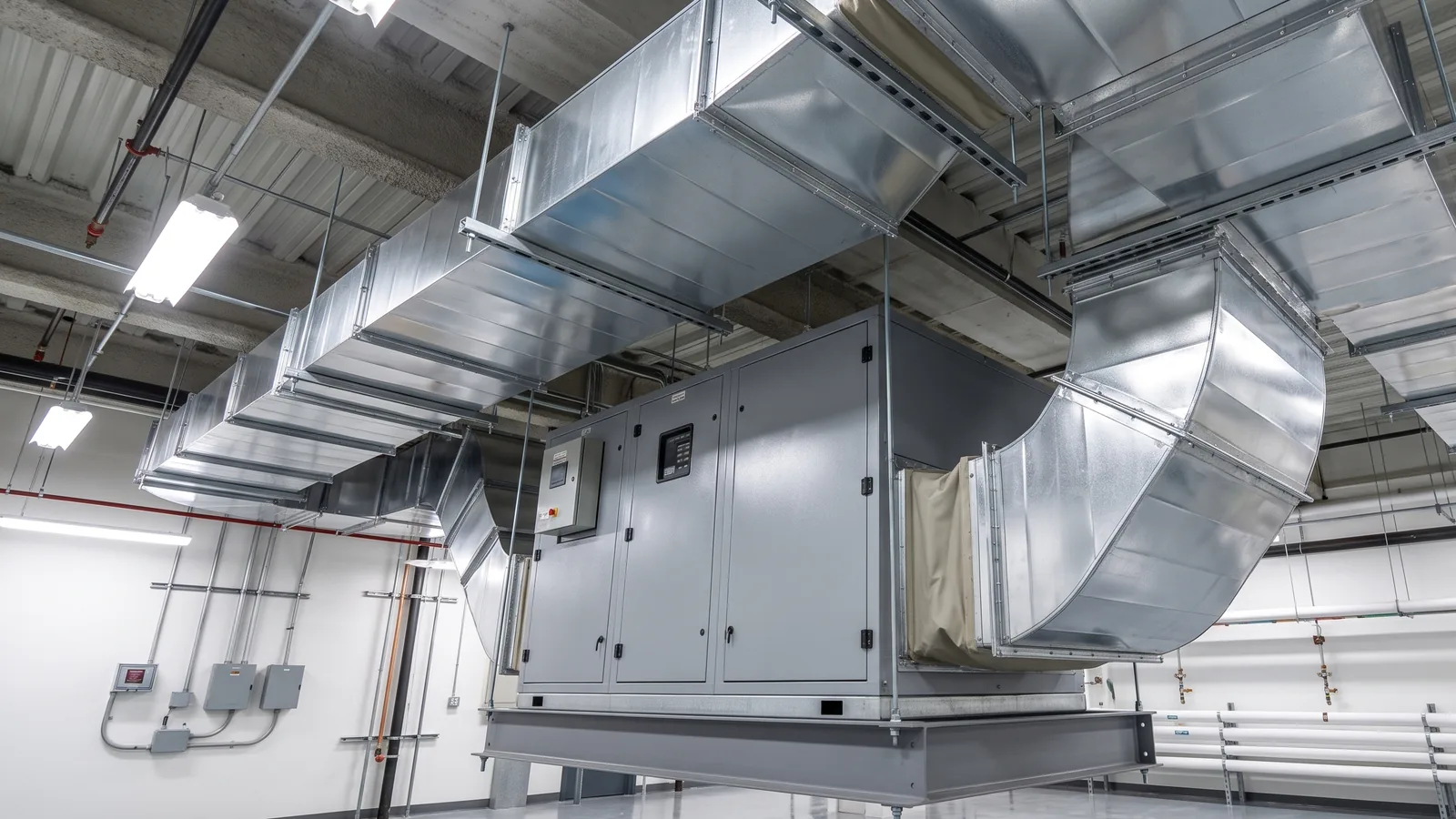
Warehouse humidity control keeps stock intact, equipment functional and structures free from corrosion damage.
Australian warehouses face a specific problem that many facility managers underestimate. Temperature swings between day and night create condensation on metal surfaces, concrete floors and stored goods.
This article covers what causes excess humidity in warehouses, the damage it creates if ignored, and which commercial dehumidifier systems suit Australian conditions.
Need help sizing a warehouse dehumidifier? Desiccant dehumidifiers handle the widest temperature range for Australian warehouse conditions. Contact Moisture Cure Commercial for a free site assessment.
Why Australian Warehouses Have Humidity Problems
Most Australian warehouses are large, uninsulated steel or concrete structures with minimal climate control. During the day, the building absorbs heat from the sun and the internal air temperature rises.
At night, the steel roof and walls cool faster than the air inside. When warm, moist air contacts those cold surfaces, it drops below the dew point and condensation forms.
The main sources of warehouse humidity include:
- Ambient infiltration through roller doors, dock seals and gaps in the building envelope, pulling in humid outside air
- Temperature differentials between the roof, floor slab and air column, driving condensation cycles
- Stored goods that release moisture, including timber, paper products, fresh produce and textiles
- Concrete slabs that wick ground moisture upward, especially in older buildings without a vapour barrier
- Operational moisture from cleaning, washing bays, forklifts and staff activity
In coastal cities like Sydney, Brisbane, Darwin and Perth, ambient relative humidity regularly exceeds 70%. Without active dehumidification, warehouse interiors track those conditions closely.
What Uncontrolled Warehouse Humidity Does to Stock and Equipment
Excess humidity in a warehouse is not a comfort issue. It is a direct threat to stock integrity, equipment lifespan and structural condition.
Corrosion alone costs Australian industry an estimated $17.6 billion per year according to the CSIRO. A significant share of that occurs in inadequately controlled storage environments.
| Stock/Asset Type | Damage from Excess Humidity | Target RH Range |
|---|---|---|
| Metal parts, machinery | Surface rust, bearing corrosion, electrical faults | Below 40% |
| Pharmaceuticals | Reduced potency, packaging degradation, compliance failure | 30-45% |
| Electronics, PCBs | Condensation on contacts, solder corrosion, short circuits | 30-45% |
| Paper, packaging | Warping, mould growth, adhesive failure | 35-50% |
| Timber, furniture | Swelling, mould, joint failure | 40-50% |
| Food (dry goods) | Caking, mould, accelerated spoilage | Below 50% |
| Textiles, fabrics | Mildew, staining, fibre degradation | 40-55% |
The common thread is clear. Most warehouse stock needs relative humidity held between 30% and 50% to avoid damage.
How to Measure Warehouse Humidity Correctly
A single hygrometer mounted on a wall tells you almost nothing useful in a warehouse. Humidity varies dramatically by height, proximity to doors, and time of day.
A warehouse with a 10-metre ceiling height can have 60% RH at floor level and 80% at the roofline. Stock stored on upper racking may be soaking in condensation while lower levels seem dry.
Effective warehouse humidity monitoring requires:
- Data-logging sensors at multiple heights (floor, mid-rack, roofline)
- Sensors near dock doors and loading bays where ambient air enters
- Continuous logging over at least two weeks to capture day/night cycles and weather variation
- Dew point calculations in addition to RH readings, to predict where condensation will actually form
Without this data, any dehumidifier specification is guesswork. The most common sizing mistake in Australian warehouses is relying on a single spot reading taken at midday.
Moisture Cure Commercial includes a full monitoring assessment as part of the consultation process, using the data to specify the correct YAKE RY-800M for mid-volume spaces or larger units for high-capacity requirements.
Desiccant vs Refrigerant Dehumidifiers for Warehouse Use
Refrigerant dehumidifiers work by cooling air below its dew point, collecting the condensate and reheating the air. They perform well in warm, humid conditions above 15°C but lose capacity rapidly as temperatures drop.
YAKE desiccant dehumidifiers work differently. They pass air through a rotating desiccant wheel that adsorbs moisture directly, operating effectively from -20°C to +50°C regardless of ambient conditions.
| Factor | Refrigerant | Desiccant (YAKE) |
|---|---|---|
| Operating temperature | 15°C to 35°C effective | -20°C to +50°C |
| Performance in cold | Drops significantly below 15°C, ices up | Full capacity at any temperature |
| Target RH achievable | 50-60% practical minimum | Below 30% achievable |
| Best suited for | Warm, humid rooms (offices, retail) | Warehouses, cold storage, unheated spaces |
| Ducting compatibility | Limited | Fully ductable for large volumes |
For Australian warehouses, this matters because overnight temperatures in Melbourne, Canberra and Adelaide regularly drop below 10°C in winter. A refrigerant unit sized for daytime conditions will ice up and stop dehumidifying at the exact time condensation risk is highest.
Sizing tip: A warehouse with 5,000 m³ of air volume and 70% ambient RH needs significantly more dehumidification capacity than the same volume at 55% RH. The YAKE RY-1500M removes 240 litres per day, suitable for mid-sized warehouses in moderate humidity zones.
How to Size Warehouse Humidity Control Equipment
Under-sizing is the most expensive mistake in warehouse dehumidification. A unit that cannot keep up with the moisture load runs continuously without reaching the target RH, wasting energy and achieving nothing.
Correct sizing accounts for four variables:
- Air volume. Length x width x ceiling height in cubic metres. A 2,000 m² warehouse with an 8-metre ceiling is 16,000 m³.
- Air exchange rate. How many times per hour the building air turns over through doors, vents and leaks. A busy distribution centre with frequent dock door openings may exchange air 2-3 times per hour.
- Moisture load. What the stored goods release, what staff and equipment generate, and what enters through the building envelope.
- Target RH. Metal storage needs below 40%. General warehousing can sit at 50%. Pharma and electronics need 30-45%.
For large or complex warehouses, ducted systems distribute dry air through the full volume rather than relying on a single unit in one corner. The YAKE RYDZ-240A handles 240 litres per day through a ducted configuration built for spaces above 5,000 m³.
Common Warehouse Humidity Control Mistakes
Most warehouse humidity problems are not caused by a lack of equipment. They are caused by the wrong equipment, installed incorrectly, or specified from a single data point.
These are the mistakes Moisture Cure Commercial sees most often:
- Using residential-grade dehumidifiers. A 20-litre-per-day portable unit in a 10,000 m³ warehouse achieves nothing measurable. It runs 24/7 and barely moves the needle.
- Choosing refrigerant for cold environments. If your warehouse drops below 15°C overnight or seasonally, a refrigerant unit will ice up and cycle off. Desiccant is the only reliable option.
- Sizing from a single spot reading. A midday RH reading of 55% misses the 85% spike at 3am when condensation is forming on stock.
- Ignoring the building envelope. A dehumidifier fighting against an open dock door or a leaking roof will never reach target RH.
- Placing the unit on the ground floor only. Hot, humid air rises. Without ducting or ceiling-level extraction, the roofline stays saturated while the floor level reads acceptable.
Every one of these mistakes leads to the same outcome: equipment that runs continuously, costs money to operate, and does not solve the problem. For large distribution centres, the YAKE RY-2500M removes 360 litres per day and handles the air volumes that smaller units cannot.
Getting Warehouse Humidity Control Right the First Time
The right warehouse dehumidification system depends on your building, your stock, your climate zone and your operational patterns. There is no single product that fits every situation.
Moisture Cure Commercial has over 20 years of experience specifying humidity control systems for Australian facilities. That includes warehouses in tropical Queensland, cold-climate distribution centres in Victoria, and everything between.
Every project starts with a proper site assessment: climate data, building audit, moisture load calculation and stock-specific RH targets. From there, the team recommends the right YAKE unit and configuration for your specific conditions.
Contact Moisture Cure Commercial for a consultation on warehouse humidity control. No obligation, no guesswork.