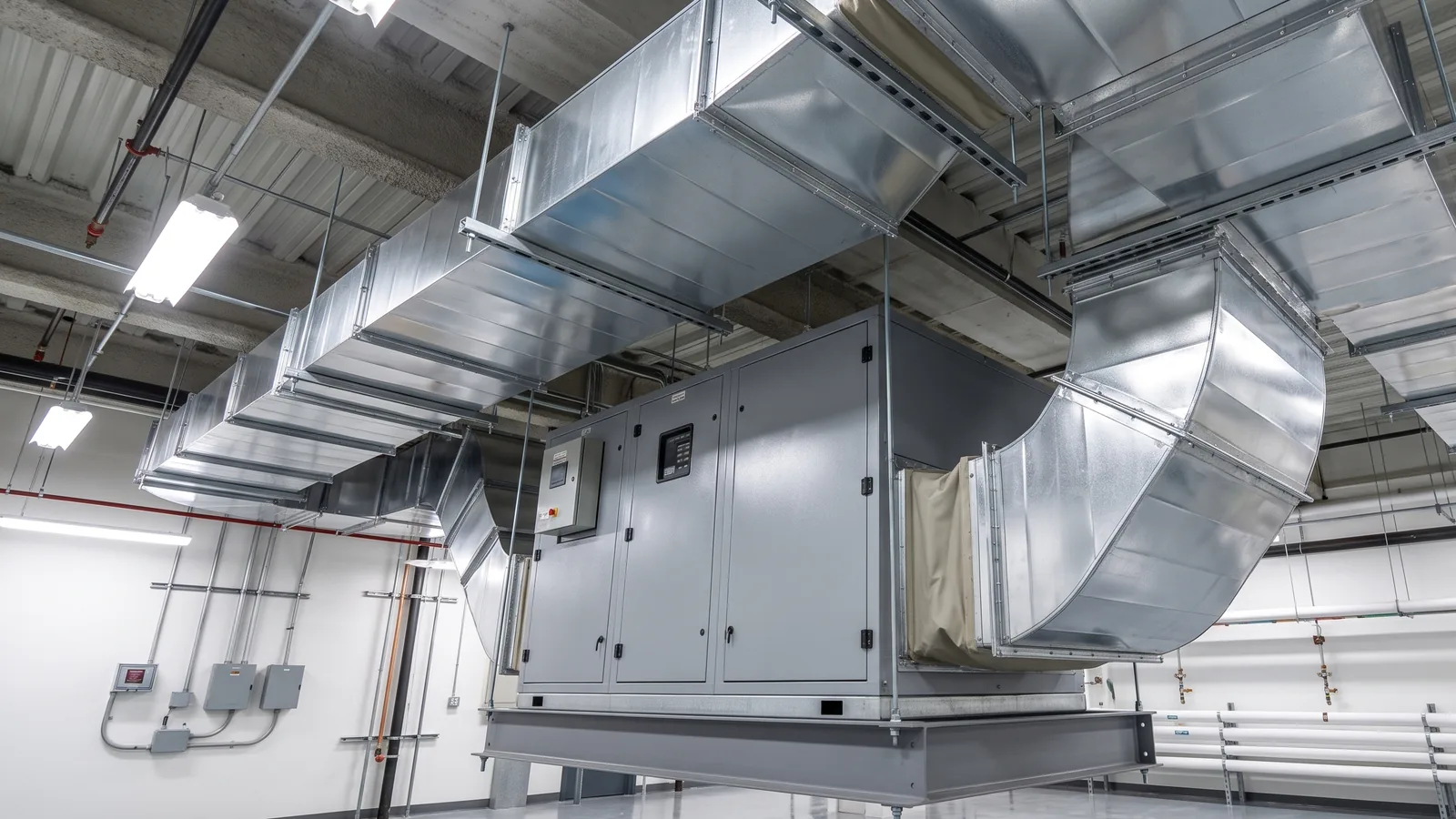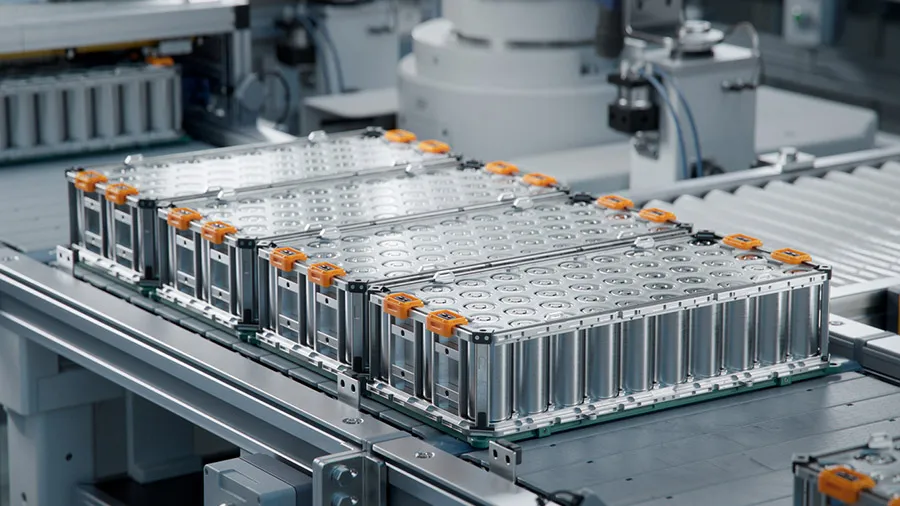
A lithium battery dry room dehumidifier should be selected to meet the process moisture limit, the occupied room load and the required recovery time. Desiccant drying is the usual approach for these very low humidity conditions, but a catalogue capacity alone cannot establish whether a unit will hold the required room dew point.
For facilities managers and engineers, the useful starting point is a written operating specification. Separate the moisture entering the room from the airflow needed to carry that moisture back to the drying system.
Moisture Cure Commercial’s range of desiccant dehumidification systems is the relevant product category to discuss because adsorption removes water vapour without relying on condensation at a cold coil. Ask for confirmation of the proposed system’s performance at your battery process conditions before selecting equipment.
Why Lithium Battery Production Requires Ultra-Low Humidity
Moisture control matters while sensitive battery materials are exposed during production. Required moisture limits depend on the battery material and manufacturing step.
Argonne National Laboratory’s battery manufacturing model describes final drying and dry-room assembly as complementary measures for limiting moisture in the finished cell. Room-air control does not replace component drying or the process owner’s material acceptance tests.
- Identify where dried electrodes and other moisture-sensitive materials are exposed.
- Specify the environment for assembly, electrolyte filling and sealing with the process owner.
- Define transfer and storage arrangements between drying and assembly.
- Keep any water-based processing and its exhaust requirements explicit in the facility design.
Sealed battery storage is a different application from open-cell manufacturing. Do not carry an assembly dry-room specification into a warehouse without a process requirement that justifies it.
Humidity Specifications for Battery Dry Rooms
Battery manufacturing measurement guidance describes typical dry-room dew points around -40°C, with some applications as low as -70°C. Those figures describe applications, not a universal acceptance standard or a guaranteed Moisture Cure equipment rating.
Obtain the actual limit from the cell manufacturer or process engineer. Record the room temperature separately, because relative humidity changes with temperature.
| Specification | What the purchasing brief should state |
|---|---|
| Room moisture limit | The maximum permitted dew point at the exposed product and the normal operating target. |
| Supply condition | The drier supply-air condition needed to absorb the calculated room moisture load. |
| Measurement basis | Whether sub-zero readings use dew point over water or frost point over ice, plus measurement pressure. |
| Temperature and cleanliness | Separate process temperature, filtration and particle-control requirements. |
| Operating scenarios | Maximum occupancy, material movements, extraction and allowable recovery time. |
Dew-point and frost-point measurement guidance explains why the measurement convention matters at low humidity. Use the same convention in equipment schedules, instruments and acceptance records so that apparently matching numbers actually describe the same condition.
Why Desiccant Dehumidifiers Are Used for Battery Dry Rooms
Refrigerant dehumidifiers for warmer, wetter air suit duties where cooling can condense moisture effectively. Conventional refrigerant equipment alone should not be specified for the deep drying required in a battery assembly room; cooling may instead serve as a preliminary treatment stage.
- Process air passes through desiccant material, which adsorbs water vapour.
- A separate regeneration air stream removes collected moisture from the desiccant and carries it to exhaust.
- Cooling and drying stages are combined to deliver the specified supply temperature and moisture content.
- The supplier selects rotor configuration and regeneration conditions against the actual inlet and outlet duties.
The operating principles of desiccant dehumidifiers explain the separate drying and regeneration paths. A low target dew point does not, by itself, prove that a particular number of rotors is required.
Understanding how dehumidifiers remove water vapour helps distinguish adsorption from condensation when comparing equipment. Neither a general ambient operating range nor a nominal daily extraction figure proves battery dry-room suitability.
Sizing a Dehumidifier for a Battery Dry Room
Size the system from a moisture balance and then check airflow, thermal duties and transient recovery. The following worksheet separates the inputs that are often hidden inside a room-volume estimate.
- Record room dimensions, the process moisture limit and the required supply condition.
- Establish outside-air demand for ventilation, extraction replacement and the agreed pressure regime.
- Calculate moisture entry through airlocks, material transfers and leakage, avoiding double-counting air already included as make-up air.
- Estimate personnel moisture from occupancy, activity and clothing assumptions agreed with the designer.
- Include moisture released by incoming materials, surfaces and processes.
- Check start-up drying and expected peak loads separately from normal production.
- Document reserve capacity and any standby requirement against those scenarios rather than applying an unexplained percentage.
A worked moisture-load example
For an air stream, moisture removal in kg/h equals dry-air mass flow in kg/h multiplied by the difference in humidity ratio in kg of water per kg of dry air. Keep all air properties on the same pressure and measurement basis.
Illustrative calculation using assumed inputs, excluding other loads:
- Outside-air flow: 1,000 kg dry air/h.
- Inlet humidity ratio: 0.010 kg/kg.
- Treated-air humidity ratio: 0.0001 kg/kg.
- Calculated removal: 1,000 × (0.010 − 0.0001) = 9.9 kg/h.
The assumed outlet value is not a recommended battery specification. A supplier still needs to verify the proposed machine’s capacity at the actual inlet humidity, airflow, regeneration conditions and outlet requirement.
Room circulation is a separate calculation: required dry-air mass flow equals the internal moisture load divided by the difference between room and supply humidity ratios. A supply condition only slightly drier than the room leaves little moisture-carrying capacity per kilogram of air.
Use room volume to check the resulting air-change rate and distribution, rather than treating a generic air-change figure as the sizing method. Include access, utilities and operating conditions in your industrial dehumidifier selection checklist.
Airlock and Room Design for Battery Dry Rooms
Room construction determines how much moisture the system must handle. Review the enclosure and production movement together before finalising the equipment schedule.
- Specify a continuous vapour-resistant enclosure, including floor interfaces and panel joints.
- Seal cable, pipe and duct penetrations, and make them accessible for inspection.
- Design personnel and material airlocks around actual transfer sizes and frequencies.
- Coordinate pressure control with process extraction and any containment requirements.
- Allow access for filter replacement, rotor servicing and instrument checks.
Positive pressure can reduce inward leakage, but it does not eliminate the moisture introduced during transfers. Ask the designer to assess a busy shift change or material delivery, not just an empty room with its doors shut.
Monitoring and Alarm Systems for Dry Room Humidity
Select instruments with a documented measurement range, uncertainty and response time at the intended operating condition. Guidance on calibrating battery-production dew-point sensors recommends checking readings against a known reference and setting calibration arrangements appropriate to the application.
- Measure supply and return conditions and representative points near exposed product.
- Account for sensor response, sample-line delay and measurement uncertainty when setting alarms.
- Place the warning threshold on the drier side of the process limit so operators have time to act.
- Define production hold, investigation and restart actions with the quality team.
- Retain time-stamped trends and calibration records alongside relevant production records.
An alarm set wetter than the maximum permitted room condition warns too late to prevent a limit excursion. Agree the thresholds with the process owner; there is no safe universal alarm pair for every battery chemistry.
Choosing Lithium Battery Dry Room Dehumidification Suppliers
Compare suppliers on documented performance at your specified operating conditions, including occupied operation and recovery after shift changes and material deliveries. Ask each bidder to return the same completed duty schedule so that equipment offers can be compared fairly.
- Request a moisture-load calculation with assumptions and equipment selection data.
- Separate the guaranteed room condition from the dryer outlet condition.
- Confirm cooling, regeneration heat, electrical supply, exhaust routing and controls interfaces.
- Obtain a commissioning plan covering occupancy, transfers, alarms and recovery.
- Clarify service access, consumables, local support and responsibility for enclosure performance.
Planning a custom dehumidification system helps connect equipment selection with the site’s installation requirements. For this application, ask specifically for evidence that the proposed configuration can meet the battery process duty.
Compare energy at the same duty
Compare heating, cooling and fan demand under the same ambient conditions and production schedule. A primary study of dry-room energy demand evaluates how occupancy, machine exhaust and ambient conditions affect the system, supporting a scenario-based comparison rather than a single headline efficiency claim.
Ask bidders to identify the available regeneration heat source and show both peak and normal operating demand. Any reduced-duty mode should retain the conditions required for materials left exposed between shifts.
Battery Dry Room Dehumidifier FAQs
Use these answers to prepare a project brief; the process owner’s specification remains the basis for final selection.
What dew point should a lithium battery dry room maintain?
Use the limit approved for the cell chemistry and manufacturing step. The typical values discussed above are reference points, not interchangeable specifications for all production rooms.
Can a conventional refrigerant dehumidifier serve the dry room?
Conventional refrigerant drying alone is unsuitable for the deep drying discussed here. Cooling can form part of a treatment train that includes desiccant drying.
Is supply-air dew point the same as room dew point?
No, supply air needs to be drier so it can absorb the room’s moisture load. Confirm both conditions in the equipment offer and commissioning schedule.
Can room volume alone determine dehumidifier size?
No, equal-sized rooms can have very different occupancy, extraction and material-transfer loads. Establish those loads before calculating airflow and selecting capacity.
What information should I send a dry-room supplier?
Send the process limits, layout, occupancy, transfer schedule, exhaust rates, ambient design conditions and available utilities. Include the expected production schedule and recovery requirements.
How much spare capacity should be allowed?
Set reserve capacity against documented peak events and the consequences of equipment downtime. A fixed percentage cannot establish whether the room will recover quickly enough after a particular disturbance.
Do dry rooms also need particle control?
Humidity and particle cleanliness are separate specifications. If the process requires both, include filtration and air distribution in the same design review.
When should a high-moisture warning activate?
Before the process limit is reached, with allowance for measurement uncertainty and response time. The quality team should define the associated operator action and production hold criteria.
What should commissioning demonstrate?
Demonstrate the agreed room condition under representative operation, then test alarms and recovery from the specified disturbances. Record conditions, instrument references and acceptance results for handover.
Discuss Your Dry Room Dehumidification Requirements
Moisture Cure Commercial’s commercial humidity control equipment range provides a starting point for discussing the available options. Battery dry-room selection requires a confirmed performance duty for the proposed system.
- Bring your room layout and process humidity limit.
- Include occupancy, transfer and extraction requirements.
- Identify utilities and any planned production expansion.
Contact Moisture Cure Commercial for a consultation or site assessment of your battery dry-room requirements.