Humidity affects more than comfort in a commercial building. When moisture drifts outside the required range, it can cause condensation, corrosion, unstable materials, process faults and extra pressure on HVAC equipment.
Humidity targets vary by process, materials and operating conditions. Facility managers need to understand the moisture load and surfaces at risk before specifying commercial humidity-control systems designed for process needs.
How humidity behaves inside a commercial building
Relative humidity (RH) describes the amount of water vapour in air relative to the maximum it can hold at the same temperature. The Bureau of Meteorology’s explanation of RH and dew point is useful here because cooling air can raise RH even when no new moisture enters the building.
- Relative humidity: useful for comfort, product and room-control setpoints, but always interpreted with temperature.
- Dew point: indicates the moisture content of the air and helps identify when a cold surface may condense water.
- Surface temperature: matters at glazing, chilled pipes, ducts, cold-room panels and other thermal bridges.
- Moisture load: includes outdoor air, infiltration, people, wet cleaning and moisture released by production.
A room reading may hide risk at cold surfaces or inside cavities. This explanation shows why dew point and relative humidity answer different operational questions.
What high humidity does to buildings and operations
Persistent high RH makes condensation more likely when humid air meets a cold surface. The US EPA recommends treating the building envelope, plumbing and HVAC as parts of the same moisture problem.
| Area affected | What facility teams may observe | Operational consequence |
|---|---|---|
| Building envelope and finishes | Condensation, staining, efflorescence, swollen joinery or damaged coatings | Remediation work, access restrictions and shorter finish life |
| Metal plant and controls | Surface corrosion, damp electrical enclosures or drifting sensors | Faults, calibration work and unplanned maintenance |
| Paper, cartons and textiles | Curling, dimensional change, softened packaging or musty odours | Handling problems, rejects and inventory loss |
| Food and pharmaceutical areas | Condensation or room conditions outside a validated specification | Quality investigation, cleaning and possible product quarantine |
| Warm work areas | Persistent dampness and reduced evaporative cooling | Comfort complaints and greater heat-stress risk |
SafeWork NSW explains that increasing humidity makes sweating less effective at cooling the body, so temperature, air movement, workload and clothing must be assessed together. Its workplace heat guidance is the appropriate starting point where heat is also present.
The Bellingen Shire Council chamber case study documents a mould and moisture remediation project managed at building level.
What low humidity does to commercial spaces
Low RH is common in heated spaces, dry inland climates and moisture-removing processes.
| Application | Likely low-humidity issue | What to verify |
|---|---|---|
| Printing and paper handling | Paper curl, dimensional movement and static-related feed faults | Paper supplier conditions, room RH and moisture addition rate |
| Electronics assembly | More frequent electrostatic discharge events | ESD controls, grounding, process limits and sensor placement |
| Timber and collections | Shrinkage, cracking or movement in hygroscopic materials | Material-specific limits and rate of RH change |
| Occupied offices | Dry-eye or airway discomfort for some occupants | Temperature, ventilation, complaints and calibrated RH data |
Base the target on the product, stored materials or workplace requirements rather than a generic RH range. Consider how balanced humidity affects workplace conditions alongside ventilation and temperature.
Why commercial spaces lose humidity control
A dehumidifier cannot repair a roof leak or correct unbalanced airflow. Identify the source and control failure before sizing equipment.
- Outdoor-air load: humid ventilation or make-up air enters faster than the cooling or dehumidification system can treat it.
- Negative building pressure: excess exhaust draws humid air through doors, service penetrations and envelope leakage.
- Cooling-system behaviour: oversized or poorly controlled cooling plant satisfies temperature demand before removing enough latent load.
- Internal generation: washdown, cooking, people, open tanks, drying materials and production processes add water vapour.
- Water entry: roof, plumbing, drainage or groundwater defects create a moisture source that air treatment alone cannot solve.
- Sensor or control faults: poor location, calibration drift or unsuitable control logic hides the real conditions.
Do not lower the cooling setpoint as the first response to high RH. Overcooling can make surfaces colder and increase condensation risk while leaving the moisture source unresolved.
Diagnose the pattern before sizing equipment
Trend temperature and RH against occupancy, outdoor conditions and equipment status. In large or critical facilities, log dew point across several zones.
| Observed pattern | Likely cause to test | First investigation |
|---|---|---|
| RH rises when exhaust operates | Negative pressure and humid infiltration | Measure supply, exhaust and building pressure |
| RH rises overnight | HVAC schedule or reduced latent removal | Compare control schedules with dew-point trend |
| Condensation appears in one zone | Cold surface, air leak or poor circulation | Check surface temperature, insulation and airflow |
| Temperature is stable but RH remains high | Sensible cooling without enough moisture removal | Review coil condition, airflow and latent capacity |
| Different sensors disagree | Placement or calibration problem | Check against a calibrated reference instrument |
Record room volume, air-change rate, outdoor design conditions, moisture generation, target condition and operating schedule. These inputs matter more than floor area alone.
Choose the control method for the operating condition
The right method depends mainly on temperature, moisture load and the required dew point.
| Control method | Where it fits | Why it fits |
|---|---|---|
| Refrigerant | Warm rooms with moderate to high RH | In warm rooms, refrigerant dehumidification removes moisture efficiently across a cooled coil. |
| Desiccant | Cold stores, dry rooms and demanding process conditions | For cold stores and low dew points, desiccant dehumidifiers keep removing moisture where refrigeration loses capacity. |
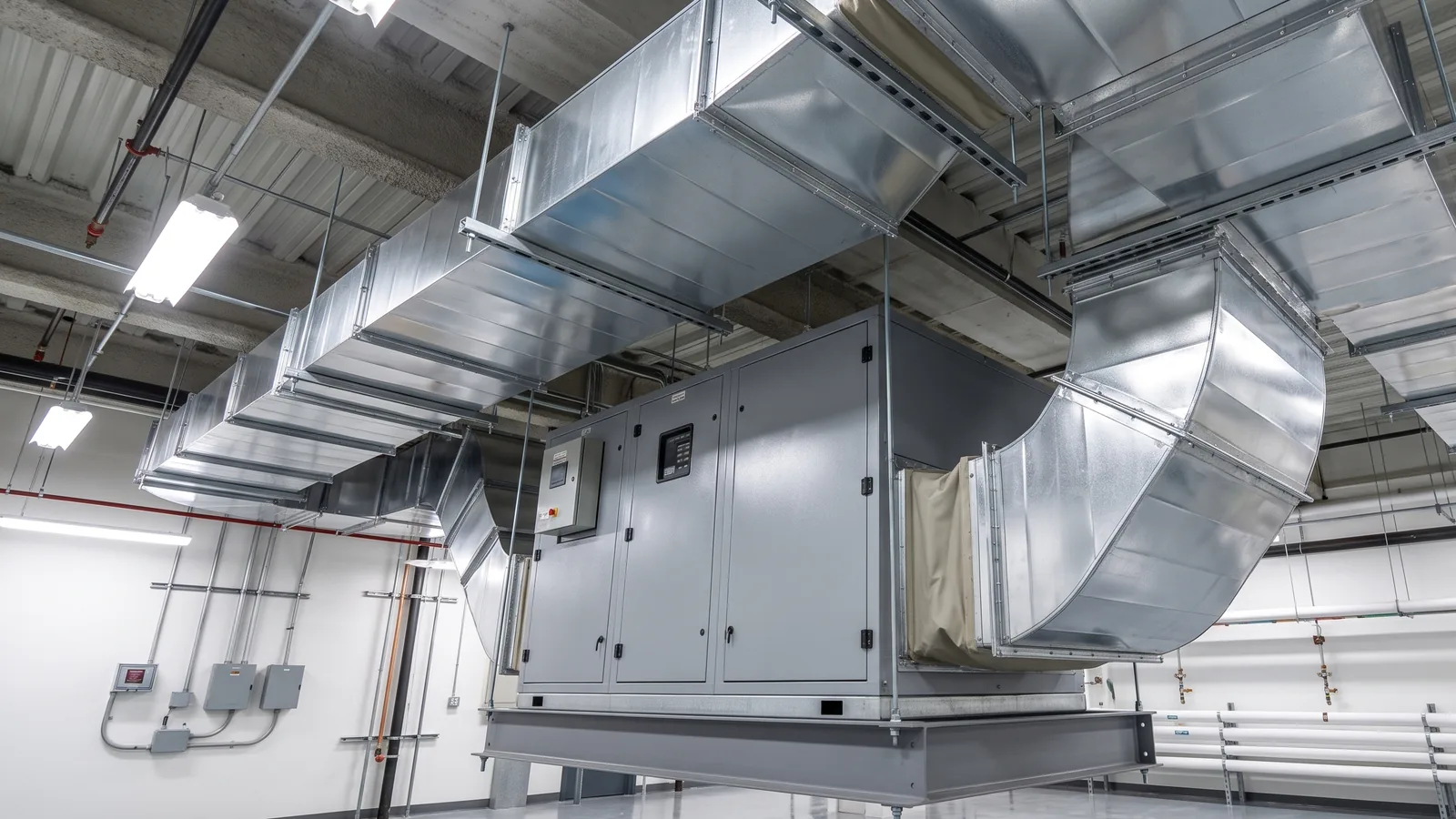
| Ducted | Warehouses, production areas and distributed rooms | Across multiple zones, ducted dehumidification delivers dry air from a serviceable plant location. |
| Ultrasonic | Printing, textiles, produce and selected manufacturing processes | For controlled moisture addition, ultrasonic humidification adds fine droplets without steam heat. The design must account for water quality, hygiene and absorption distance. |
For whole-area coverage, size the ducted dehumidifier to the facility’s latent load, then plan the return-air path, pressure balance and service access.
Setpoints depend on the space and its contents
Commercial humidity targets are site-specific. The US EPA advises keeping indoor RH below 60%, ideally between 30% and 50% where possible, while SafeWork NSW describes 40% to 70% as attainable with air conditioning.
- Offices and public buildings: start with thermal-comfort and moisture-risk guidance, then investigate persistent complaints or condensation.
- Pharmaceutical production and storage: use the registered product, process and quality-system limits. The TGA-adopted GMP guide requires specified humidity conditions to be provided, checked and monitored where they are needed.
- Museums and archives: set limits by material and control rapid fluctuation. The National Park Service museum environment guidance explains why mixed collections need a conservator-informed setpoint.
- Food, cold storage and agriculture: follow product, condensation and hygiene requirements rather than a generic comfort range.
- Electronics and precision manufacturing: coordinate room RH with the site’s electrostatic-discharge and process-control plan.
A setpoint is only useful when the sensor is representative, calibrated and tied to an action limit. Record both the target and the acceptable duration of any excursion.
Monitoring and maintenance priorities
A building management system can expose patterns, but alarms need clear thresholds and ownership. Trend data should lead to inspection and correction.
- Place sensors in representative occupied or process zones, away from direct supply air, doors and local heat sources.
- Trend room temperature, RH and dew point against outdoor air, plant status and production schedules.
- Inspect filters, coils, condensate pans, drains, dampers, duct insulation and envelope leakage.
- Calibrate critical sensors on a documented schedule and investigate readings that disagree with a reference instrument.
- Review supply and exhaust balance after tenancy, process or ventilation changes.
- Define response steps for alarms, leaks and wet materials, including who can adjust controls and who approves process release.
Frequently asked questions
Facility teams often ask these questions when readings or operating conditions move outside target.
When is humidity too high for a commercial room?
In many occupied and storage spaces, sustained RH of 70% warrants investigation because it is above the EPA’s general indoor moisture-control guidance. The limit still depends on temperature, surface dew point, materials and process requirements.
Can a commercial room be too dry?
An RH reading of 37% is not automatically a fault, but it is near the dry end of SafeWork NSW’s indoor guidance. Check comfort, static-sensitive processes and sensor accuracy first.
Is extremely low office humidity acceptable?
An office reading of 10% RH is far below SafeWork NSW’s indoor guidance. Verify it with a calibrated instrument, then investigate heating and ventilation conditions.
How do you reduce humidity in a commercial building?
Find the source: water entry, outdoor air, process moisture, poor pressure balance or inadequate latent capacity. Repair it, then commission ventilation, controls and commercial dehumidification equipment matched to the measured load.
What RH should a commercial building maintain?
Use the limits set by the process, stored material, equipment and workplace risk assessment. Generic comfort ranges are a starting point, not a substitute for engineering or quality requirements.
When is desiccant dehumidification the better choice?
It is usually the stronger option for low-temperature spaces or processes that require a low dew point. Refrigerant equipment is often more suitable for warm, moderately humid rooms, so selection should follow measured entering conditions and the required outlet condition.
Plan a site assessment with Moisture Cure Commercial
Moisture Cure Commercial supplies humidity-control equipment to Australian organisations. The team can assess the source, review trend data and specify the duty.
- Bring available temperature and RH trend data.
- Note where and when condensation, damage or process faults occur.
- Provide room dimensions, ventilation rates, operating schedules and target conditions.
Call (02) 6584 2511 or contact Moisture Cure Commercial to arrange a consultation or site assessment.