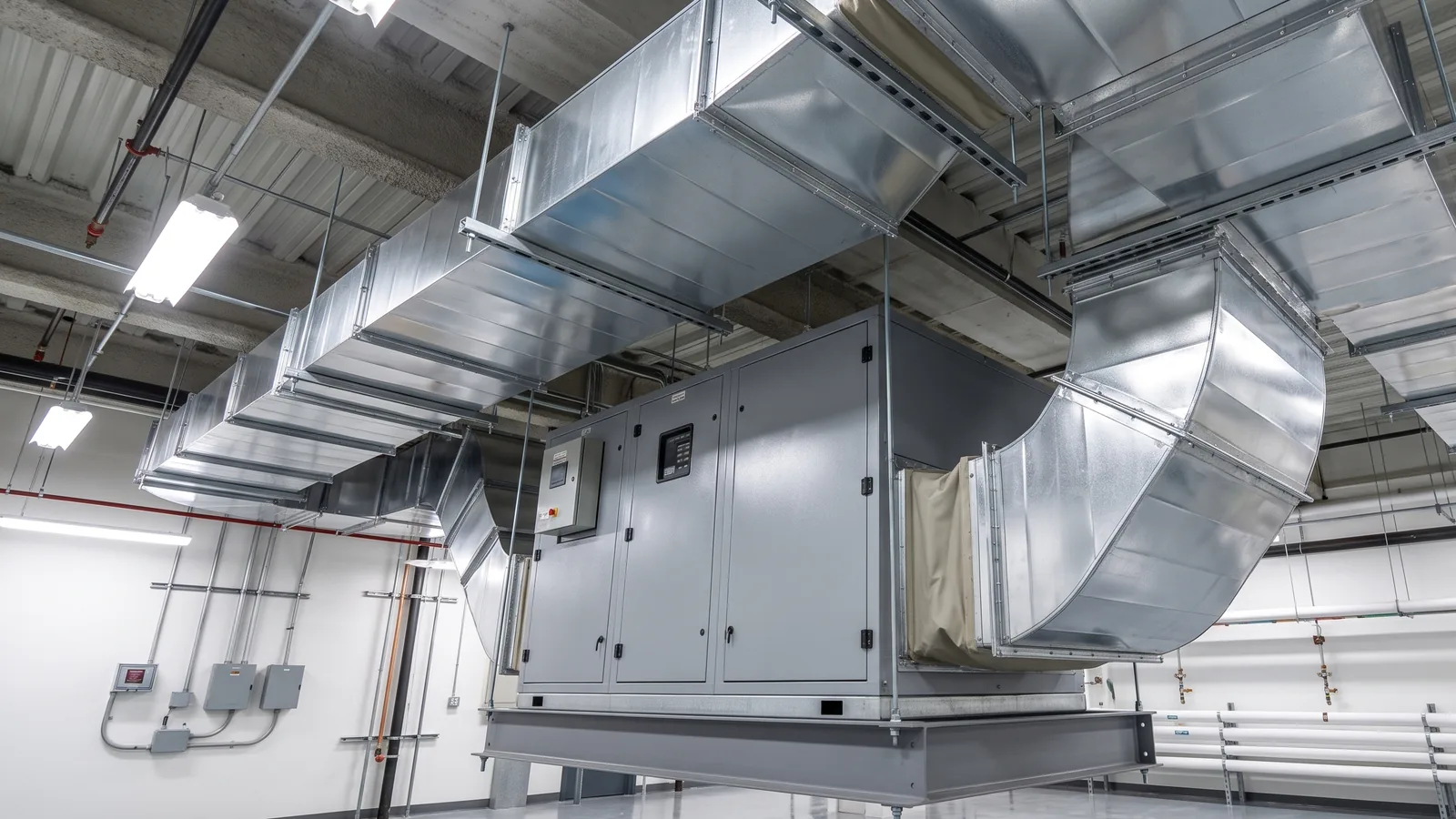
A commercial grade dehumidifier is built for continuous operation, high airflow, and conditions that would destroy a residential unit within months.
Facility managers and engineers regularly make the mistake of specifying residential dehumidifiers for warehouses, plant rooms, and storage areas. The units fail early, run up energy costs, and leave moisture problems unsolved.
This article breaks down the specific engineering differences between residential and commercial grade equipment. You will learn what specifications to look for, why duty cycle matters, and how to match a unit to your facility’s actual conditions.
Need help selecting the right unit? Browse the full range of commercial dehumidifiers or read our guide on how to choose a commercial dehumidifier.
Continuous Duty Cycle vs Intermittent Operation
The single biggest difference between a commercial grade dehumidifier and a residential one is duty cycle. Residential units are designed for intermittent use, typically cycling on and off over 8 to 12 hours before needing a rest period.
Commercial and industrial units run 24/7 without interruption. Their compressors, fan motors, and control boards are rated for continuous duty, meaning they will not overheat or degrade under sustained load.
- Residential duty cycle: 12 to 16 hours per day, with automatic shutoff to prevent motor burnout
- Commercial duty cycle: 24 hours per day, 7 days per week, with no mandatory rest period
- Industrial duty cycle: Continuous operation in extreme conditions, often with redundant components
- Running a residential unit on a commercial cycle typically voids the warranty within weeks
If your application requires the unit to run around the clock, anything less than a continuous-rated machine is a liability.
Airflow Capacity in a Commercial Grade Dehumidifier
Residential dehumidifiers move between 100 and 300 cubic metres of air per hour. That is adequate for a bedroom or lounge room, but nowhere near sufficient for a 500 m² warehouse floor.
Commercial units start at around 800 m³/hr and scale well beyond 3,000 m³/hr for large industrial applications. Higher airflow means faster moisture extraction and more uniform humidity levels across the space.
| Specification | Residential | Commercial Grade |
|---|---|---|
| Airflow | 100 to 300 m³/hr | 800 to 3,000+ m³/hr |
| Moisture removal | 10 to 25 L/day | 50 to 500+ L/day |
| Coverage area | 20 to 60 m² | 100 to 2,000+ m² |
| Duty cycle | Intermittent (12-16 hrs) | Continuous (24/7) |
| Operating temp range | 5°C to 35°C | -20°C to +50°C |
| Construction | Plastic housing | Powder-coated steel |
| Ducting | None | Standard inlet/outlet connections |
| Controls | Basic humidistat | BMS integration, remote monitoring |
When sizing a unit, calculate the volume of your space in cubic metres and multiply by the required air changes per hour. Most commercial applications need 2 to 4 air changes per hour for effective dehumidification.
Operating Temperature Range for Commercial Environments
Residential dehumidifiers stop working effectively below about 15°C. Many freeze up entirely below 10°C as moisture collects on the evaporator coil and turns to ice.
Commercial grade equipment handles a far wider temperature envelope. Desiccant dehumidifiers excel in cold conditions, operating reliably from -20°C to +50°C. Moisture Cure Commercial supplies YAKE desiccant units rated across this full range, purpose-built for Australian conditions from cold storage facilities to tropical processing plants.
- Cold stores and freezer rooms: Desiccant technology avoids the ice-up problem entirely
- Unheated warehouses: Winter temperatures in southern Australia regularly drop below 10°C overnight
- Process areas with heat: Industrial environments above 40°C need components rated for sustained high temperatures
Check the manufacturer’s rated operating range against your site’s actual conditions, including seasonal extremes. A unit that works in summer but fails in winter is not a solution.
Build Quality That Separates Commercial From Residential
Residential dehumidifiers use injection-moulded plastic housings with lightweight internal frames. These are cheap to produce and adequate for a climate-controlled home, but they were never designed to take a hit from a forklift or withstand chemical vapours.
Commercial grade units are built with powder-coated steel or stainless steel frames. The difference is not cosmetic. Steel construction withstands the knocks, vibrations, and corrosive atmospheres common in warehouses, plant rooms, and manufacturing facilities.
- Housing: Powder-coated steel panels resist corrosion and physical damage
- Compressors: Industrial-rated Copeland or Danfoss compressors with longer service intervals
- Fan motors: EC or AC motors rated for continuous duty with sealed bearings
- Coils: Copper tube with aluminium or copper fins, often with epoxy coating for corrosive environments
- IP rating: IP54 or higher for dust and splash protection in industrial settings
Plastic housings crack, warp, and discolour in industrial environments. If the unit is going into any space that is not a comfortable office, steel construction is non-negotiable.
Ducting Capability and HVAC Integration
Residential units are freestanding portable boxes. They pull air from the room and exhaust it straight back into the same space. There is no provision for connecting ductwork or directing airflow to a specific zone.
Ducted commercial dehumidifiers connect directly into existing HVAC ductwork or standalone duct runs. This allows precise placement of air intake and discharge points, which is critical for treating specific zones within a larger facility.
- Identify the zones that need humidity control and calculate the duct run lengths
- Select a unit with sufficient static pressure to push air through the ducting
- Size the ductwork to match the unit’s rated airflow without excessive pressure drop
- Install dampers for zone control if treating multiple areas from one unit
Static pressure is the metric that matters for ducted applications. A unit with high airflow but low static pressure will underperform once connected to ductwork. Ask for the fan curve data before specifying a unit.
Control Systems and BMS Connectivity
A residential dehumidifier has a basic humidistat, an on/off switch, and maybe a timer. A commercial grade dehumidifier offers programmable controllers, remote monitoring, and integration with building management systems.
BMS integration means the dehumidifier communicates with your central plant control system via Modbus, BACnet, or dry contact relays. Facility managers can monitor humidity levels, set schedules, receive fault alerts, and log performance data without visiting the unit.
- Onboard controllers: Setpoint adjustment, timer functions, defrost control
- Remote monitoring: Real-time humidity and temperature readout via network connection
- BMS protocols: Modbus RTU/TCP, BACnet, or 0-10V analog outputs
- Alarm outputs: Fault signals for filter blockage, high humidity, or compressor failure
- Data logging: Historical performance data for compliance reporting and optimisation
For any facility with a BMS, specifying a dehumidifier without integration capability creates a blind spot in your environmental monitoring.
Serviceability and Long-Term Operating Costs
Residential dehumidifiers are designed to be replaced, not repaired. When a compressor fails or a control board dies, the unit goes in the bin.
Commercial units are engineered for serviceability. Access panels, modular components, and standardised parts mean a technician can swap a fan motor or replace a control board on-site without decommissioning the entire unit.
- Hinged or removable access panels for quick inspection
- Replaceable filter media (not disposable filters moulded into the chassis)
- Standard electrical connectors and terminal blocks
- Compressor and motor assemblies that unbolt individually
- Spare parts availability backed by Australian supplier networks and local stock
A commercial dehumidifier costs more upfront, but the total cost of ownership over 10 years is typically lower than replacing residential units every 2 to 3 years. Factor in downtime costs and the maths becomes even more clear.
Warranty Terms and Compliance for Commercial Grade Equipment
Residential dehumidifier warranties are voided the moment the unit is used in a commercial setting. This is not a grey area. Manufacturers explicitly exclude commercial and industrial applications from their residential warranty terms.
Commercial grade dehumidifiers carry warranties that cover continuous operation in the environments they are designed for. Warranty periods of 2 to 5 years on major components are standard, with some manufacturers offering extended coverage on compressors.
- Residential warranty: 1 to 2 years, domestic use only, voided by commercial application
- Commercial warranty: 2 to 5 years, covers continuous duty and industrial environments
- Compliance: Commercial units meet relevant Australian standards for electrical safety and EMC
If you install a residential unit in a commercial facility, you are operating unwarranted equipment. When it fails, and it will, there is no recourse. Read our guide on choosing an industrial dehumidifier for more detail on specification requirements.
Selecting the Right Commercial Grade Dehumidifier
The gap between residential and commercial dehumidification equipment goes well beyond physical size. It comes down to engineering: continuous duty components, metal construction, ducting connections, wide operating temperature ranges, and control systems that integrate with your facility.
Moisture Cure Commercial has over 20 years of experience supplying humidity control solutions for Australian commercial and industrial facilities. Our YAKE desiccant and refrigerant units are selected for the specific conditions of each site, not pulled off a shelf.
Contact Moisture Cure Commercial for a consultation or site assessment. We will review your facility’s conditions, calculate the required capacity, and recommend the right unit for continuous, reliable humidity control.