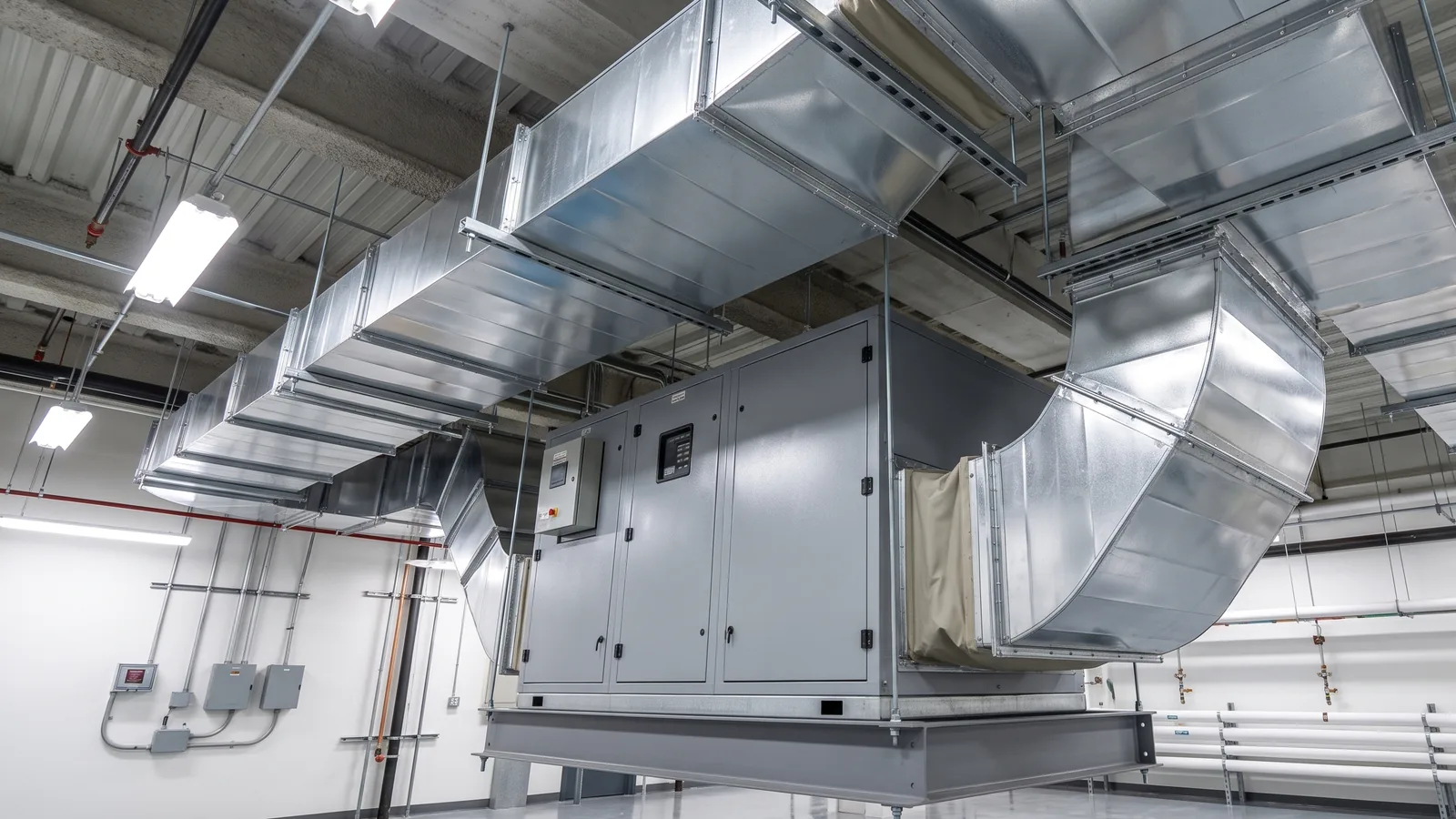
Every desiccant dehumidifier manufacturer makes choices in materials, rotor design, and control systems that determine whether a unit survives five years of industrial service or fails in its first summer.
Commercial desiccant dehumidifiers are engineered for environments that destroy residential equipment. Cold stores operating at -15°C, food processing lines running 24/7, pharmaceutical warehouses holding products worth millions.
This article breaks down what goes into manufacturing these units, the engineering decisions that matter, and how to evaluate whether a desiccant dehumidifier manufacturer has built a machine that will hold up under Australian commercial conditions.
Moisture Cure Commercial works directly with YAKE to supply commercial desiccant dehumidifiers engineered for Australian conditions. Contact the team for a site assessment.
How Desiccant Dehumidifier Manufacturers Engineer the Rotor
The rotor is the core of every desiccant unit. It determines moisture removal capacity, energy efficiency, and service life.
Manufacturing a commercial-grade desiccant rotor starts with a substrate. Corrugated and flat sheets of fibreglass or ceramic fibre are layered into a honeycomb structure, then impregnated with an adsorbent material.
- Silica gel rotors suit general commercial applications where target humidity is 40 to 60% RH
- Molecular sieve rotors achieve lower dew points, down to -40°C, for pharmaceutical and lithium battery manufacturing
- Composite rotors combine both materials to balance extraction rate against energy consumption
- Honeycomb channel density controls airflow resistance and surface area for moisture capture
The impregnation process is where quality separates manufacturers. Uneven desiccant distribution across the rotor face creates dead zones that reduce effective capacity by 10 to 20%.
A detailed comparison of how to choose a commercial dehumidifier covers rotor types in the context of selecting the right unit for your facility.
Reactivation Heater Design
The reactivation system regenerates the desiccant rotor by driving captured moisture out with heated air. Heater design directly affects energy consumption, which is the largest ongoing cost of running a desiccant unit.
Commercial manufacturers use different heating approaches depending on the application:
| Heating Method | Reactivation Temp | Best Application | Energy Efficiency |
|---|---|---|---|
| Electric resistance | 120 to 140°C | Standard commercial installations | Moderate |
| Gas-fired | 120 to 160°C | Large industrial plants with gas supply | High for large volumes |
| Steam coil | 100 to 130°C | Facilities with existing steam infrastructure | High (waste heat reuse) |
| Heat pump assisted | 80 to 100°C | Energy-sensitive applications | Highest |
Electric resistance heaters are the most common in units sold in Australia. They are simple to install and maintain, but account for 60 to 70% of a desiccant unit’s total energy draw.
Manufacturers that offer variable reactivation control, where the heater output adjusts based on actual humidity load, reduce energy waste significantly compared to fixed-output designs.
Airflow Engineering and Motor Selection
A desiccant dehumidifier manufacturer must balance process airflow against reactivation airflow. Getting this ratio wrong reduces extraction capacity or wastes energy.
- Process air (the air being dried) passes through the larger section of the rotor, typically 75% of the face area
- Reactivation air (heated air that strips moisture from the rotor) passes through the remaining 25%
- EC (electronically commutated) motors consume 30 to 50% less power than AC motors at partial loads
- Variable speed drives allow airflow adjustment without ductwork changes
- Fan selection must account for external static pressure from ducting runs
Units rated at 1,000 m³/hr process airflow need motors sized for both the clean filter condition and the dirty filter condition. Undersized motors lose airflow as filters load, and extraction drops with it.
YAKE units supplied through Moisture Cure Commercial use EC motors as standard, reducing operating costs across the full duty cycle.
What Separates Commercial from Residential Desiccant Units
Residential desiccant dehumidifiers and commercial units use the same basic principle. The engineering differences between them are substantial.
| Feature | Residential | Commercial / Industrial |
|---|---|---|
| Duty cycle | Intermittent (6 to 12 hours) | Continuous (24/7) |
| Airflow capacity | 100 to 300 m³/hr | 500 to 15,000+ m³/hr |
| Moisture removal | 8 to 20 L/24hr | 30 to 2,000+ L/24hr |
| Operating temp range | 5°C to 35°C | -20°C to +50°C |
| Ducting | None or basic adaptor | Flanged connections for commercial ductwork |
| Controls | Basic humidistat | PLC or BMS integration, modbus, external sensors |
| Construction | Plastic casing | Powder-coated steel or stainless steel |
| Serviceability | Replace entire unit | Modular components, field-serviceable |
The operating temperature range is the clearest dividing line. Residential units stop performing below 5°C. YAKE commercial units supplied through Moisture Cure Commercial operate from -20°C to +50°C.
For a deeper comparison of technology types, see this guide on how to choose an industrial dehumidifier.
Certifications and Compliance for Commercial Desiccant Units
Certifications tell you whether a desiccant dehumidifier manufacturer has designed a unit for the environment it will operate in. A unit without the right ratings can create compliance issues, insurance exposure, or outright equipment failure.
- CE marking confirms the unit meets European safety, health, and environmental standards, widely accepted in Australian commercial procurement
- IP ratings define dust and water ingress protection. IP55 is common for factory floors. IP65 suits washdown environments. The IP rating reference explains each classification.
- Food-grade materials (stainless steel internals, food-safe seals) are mandatory for units in food and beverage processing
- ATEX certification is required for units operating in explosive atmospheres, such as grain silos or solvent storage
- Compliance with Australian Standards for electrical safety (AS/NZS 3000) applies to all fixed installations
Ask the manufacturer or supplier for certification documentation before purchase. If they cannot provide it, the unit has not been tested for your application.
Sizing and Specification for Commercial Duty
Every desiccant dehumidifier manufacturer publishes extraction rates. Those numbers are only useful if you understand the test conditions behind them.
- Check the rated conditions. A unit rated at 50 L/24hr at 20°C and 60% RH will extract less at 5°C and 40% RH.
- Calculate the moisture load for your space. This includes infiltration air, product moisture release, and any process water.
- Account for the air exchange rate. A warehouse with roller doors opening every 10 minutes has a vastly different load to a sealed cold room.
- Specify the target relative humidity. Tighter targets require larger units or multiple units in series.
- Factor in duct losses. Every metre of ductwork and every bend reduces effective airflow.
Moisture Cure Commercial provides humidity control solutions with free sizing calculations. Getting the specification right before ordering avoids the cost of retrofitting an undersized unit.
Control Systems and Integration
A commercial desiccant unit needs controls that go beyond a simple on/off humidistat. Modern manufacturing integrates the dehumidifier into the facility’s building management system (BMS).
- Modbus RTU or Modbus TCP communication for BMS integration
- External humidity and temperature sensor inputs for multi-zone monitoring
- Variable speed drive control to adjust airflow based on real-time humidity readings
- Alarm outputs for filter blockage, high humidity, motor fault, and heater failure
- Data logging for compliance reporting in pharmaceutical and food production environments
- Remote monitoring capability via 4G or ethernet for unmanned sites
The AIRAH provides Australian guidelines on HVAC integration standards that apply to commercial dehumidification installations.
Units without external sensor inputs or BMS communication protocols are limited to standalone operation. For facilities running multiple dehumidifiers or integrating with existing ducted systems, communication capability is essential.
Get the Right Unit for Your Facility
The difference between a desiccant dehumidifier that performs for a decade and one that underperforms from installation comes down to how it was manufactured. Rotor quality, heater design, motor selection, certifications, and control systems all contribute.
Moisture Cure Commercial has supplied commercial and industrial humidity control across Australia for over 20 years. The team works directly with YAKE to supply desiccant units built for continuous duty in conditions from -20°C to +50°C.
Contact Moisture Cure Commercial for a consultation, site assessment, or quote. Expert sizing advice is included with every enquiry.