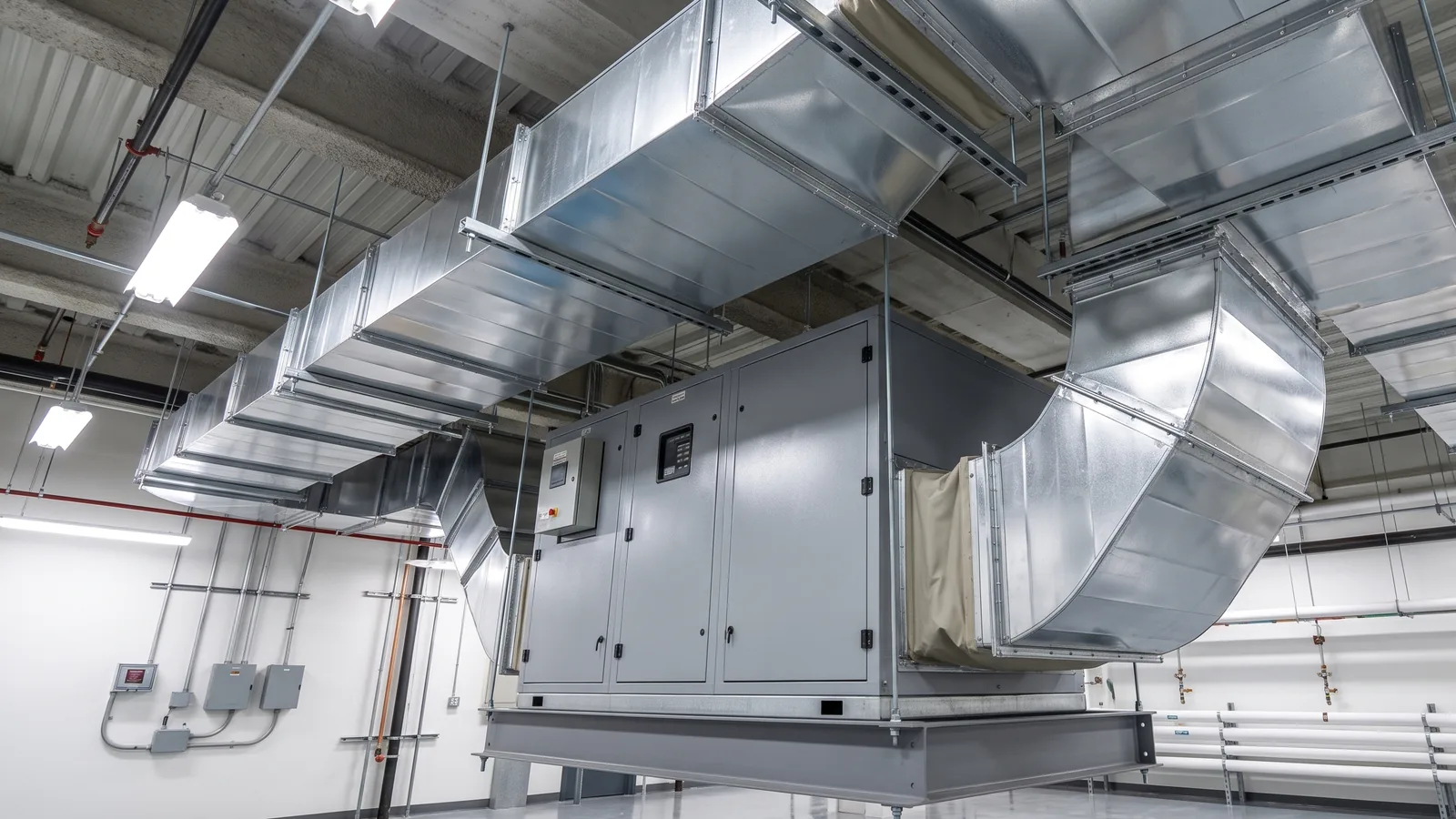
A commercial desiccant dehumidifier uses a silica gel rotor to strip moisture from air, rather than cooling it over a refrigerant coil. This makes it the default choice for cold stores, pharmaceutical cleanrooms, and any facility operating below 15 degrees Celsius.
Moisture Cure Commercial has supplied YAKE desiccant units to Australian industry for over 20 years. These machines operate reliably from -20 degrees to +50 degrees Celsius, well beyond the range of compressor-based alternatives.
Need help choosing the right unit? Contact Moisture Cure Commercial for expert sizing advice and a quote.
How a Commercial Desiccant Dehumidifier Works
Inside every desiccant unit sits a slowly rotating wheel impregnated with silica gel. Wet process air passes through one sector of the wheel, where the silica gel adsorbs water vapour directly from the airstream.
A separate heated reactivation airstream passes through the opposite sector, driving off the captured moisture and exhausting it outside. The wheel rotates continuously, so one sector is always drying while the other regenerates.
- Process air enters the unit and passes through the silica gel rotor
- The desiccant material adsorbs moisture without condensation
- A heated reactivation stream regenerates the saturated section
- Dry air exits at the target humidity, regardless of ambient temperature
Because there is no refrigerant coil, there is no condensate tray and no risk of coil icing. That is the fundamental advantage over refrigerant dehumidifiers, which rely on cooling air below its dew point to wring out moisture.
Desiccant vs Refrigerant: When to Use Each
The choice between desiccant and refrigerant is not about quality. It is about operating conditions. Refrigerant units work well in warm, humid environments above 15 degrees Celsius.
Below that threshold, refrigerant coils ice up and efficiency collapses. Desiccant machines maintain full extraction capacity regardless of temperature.
| Factor | Desiccant | Refrigerant |
|---|---|---|
| Operating temp range | -20°C to +50°C | 15°C to 40°C |
| Low-humidity performance | Effective below 30% RH | Struggles below 45% RH |
| Energy source | Electric heater for reactivation | Compressor (electricity) |
| Condensate produced | None (moisture exhausted as vapour) | Yes (requires drainage) |
| Best for | Cold rooms, pharma, low-RH processes | Warm warehouses, offices, pools |
| Noise level | Generally quieter (no compressor) | Compressor hum |
| Maintenance | Filter + rotor inspection | Filter + coil cleaning + refrigerant checks |
If your facility runs below 15 degrees or requires humidity targets under 40% RH, a desiccant unit is the only practical option. For warmer spaces with moderate humidity goals, browse the refrigerant range instead.
Key Specifications for a Commercial Desiccant Dehumidifier
Spec sheets can be overwhelming. Focus on these five numbers when comparing units.
- Moisture removal rate (L/day or kg/hr) at your actual operating temperature and humidity, rather than the headline figure at 20°C/60% RH
- Airflow volume (m³/hr) matched to the room size and air change requirements
- Operating temperature range confirmed for your coldest and hottest conditions
- Reactivation energy (kW) since the heater is the main running cost on a desiccant unit
- Physical dimensions and weight because commercial units need space for ductwork connections and service access
Moisture Cure Commercial publishes full performance data across temperature bands for every desiccant dehumidifier in the range. That transparency matters when you are sizing a unit for a cold store running at 2 degrees Celsius.
Where Commercial Desiccant Dehumidifiers Are Used
Desiccant technology suits any environment where low temperatures, low target humidity, or both make refrigerant units impractical. Here are the most common applications across Australian industry.
- Pharmaceutical manufacturing and storage where strict humidity control prevents API degradation and meets GMP requirements
- Food processing and cold storage where sub-zero temperatures rule out refrigerant dehumidification entirely
- Data centres where stable humidity between 40% and 60% RH protects sensitive electronics from corrosion and static discharge
- Manufacturing floors handling hygroscopic materials like powders, coatings, or lithium battery components
- Water damage restoration where rapid, temperature-independent drying cuts downtime
- Archive and museum storage where precise RH control prevents mould and material degradation over decades
For installations requiring integration with existing HVAC, ducted dehumidifiers connect directly to supply and return air ducts. This avoids placing a standalone unit on the production floor.
Sizing Mistakes That Cost Money
Undersizing leaves your facility damp. Oversizing wastes energy on reactivation heat you do not need. Both errors are common because people size dehumidifiers the same way they size air conditioners, which is wrong.
- Using headline capacity at 20°C/60% RH when the actual environment is 5°C/80% RH. Real extraction can be 40% lower at colder temps.
- Ignoring moisture load sources like product respiration in food storage, door openings, or wet processes on manufacturing lines
- Forgetting ventilation air since fresh air intake at high ambient humidity adds significant load, especially in tropical regions of Australia
- Skipping a psychrometric calculation and guessing based on room volume alone
Moisture Cure Commercial provides free sizing calculations based on your facility’s actual conditions. Contact the team with your room dimensions, operating temperature, target RH, and moisture sources.
Energy Use in a Commercial Desiccant Dehumidifier
The reactivation heater is the biggest energy draw on any desiccant unit. It accounts for roughly 70% to 85% of total power consumption, depending on the model and operating conditions.
Refrigerant dehumidifiers use less energy per litre of moisture removed in warm conditions above 20 degrees Celsius. But that comparison flips in cold environments where refrigerant units cycle on and off or ice up entirely, wasting energy while achieving nothing.
- Look for units with energy recovery wheels that reclaim heat from the reactivation exhaust
- Variable-speed fans and modulating heaters reduce consumption at partial load
- Insulated casings prevent heat loss from the reactivation sector
- Some YAKE models include automatic standby modes that shut down the heater when target RH is reached
The true cost comparison requires modelling your annual operating hours and conditions. A desiccant unit running 24/7 in a 4 degree cold store will always beat a refrigerant unit that cannot operate at all in those conditions.
Installation Considerations
Where you place a commercial desiccant dehumidifier matters as much as which model you choose. Poor installation creates hot spots, short-circuits airflow, and wastes capacity.
- Reactivation exhaust routing: The wet exhaust air must be ducted outside the conditioned space. Dumping it into an adjacent room just moves the moisture problem.
- Air distribution: Position the dry air outlet to create even coverage across the space. Dead zones against far walls mean localised condensation risk.
- Access clearance: Leave at least 600 mm on the filter and rotor access sides for maintenance. Units jammed against walls become maintenance nightmares.
- Electrical supply: Reactivation heaters on larger commercial units can draw 10 kW or more. Confirm your switchboard has capacity before delivery day.
- Condensation on ductwork: Insulate any ductwork carrying dry air through unconditioned spaces. Temperature differentials cause external sweating on bare metal ducts.
For complex installations involving multiple zones or integration with existing HVAC, ducted dehumidifiers offer the flexibility to serve large areas from a single plant room.
Maintaining a Commercial Desiccant Dehumidifier
Desiccant units have fewer mechanical components than refrigerant machines. No compressor, no refrigerant gas, no condensate pump. That simplicity translates to lower maintenance demands, but not zero.
- Replace intake filters every 3 to 6 months depending on dust levels. Clogged filters reduce airflow and force the unit to work harder.
- Inspect the desiccant rotor annually for contamination or physical damage. Oil mist and chemical vapours degrade silica gel over time.
- Check the reactivation heater elements and thermostat calibration. Heater failure means the rotor cannot regenerate.
- Clean the drive belt and motor bearings at scheduled intervals per the manufacturer’s guide.
- Monitor outlet humidity with an independent sensor. Rising outlet humidity at stable load often signals rotor degradation.
A well-maintained desiccant rotor typically lasts 8 to 15 years. Refer to the ASHRAE guidelines for recommended indoor humidity ranges across different facility types.
Choosing the Right Unit for Your Facility
Start with the environment, not the catalogue. The right unit depends on three things: operating temperature, target relative humidity, and total moisture load.
- If your space runs below 15°C, choose a desiccant unit. Full stop.
- If you need humidity below 40% RH, desiccant is the only technology that reaches those levels efficiently
- If you need to integrate with existing ductwork, specify a ducted desiccant model with matching flange sizes
- If the unit will be moved between sites, look at portable desiccant models with built-in castors
Browse the full commercial dehumidifiers range to compare capacities, or contact Moisture Cure Commercial for a recommendation based on your specific conditions.
For further reading on humidity control in industrial settings, see the CSIRO resources on building science and the AIRAH technical publications.