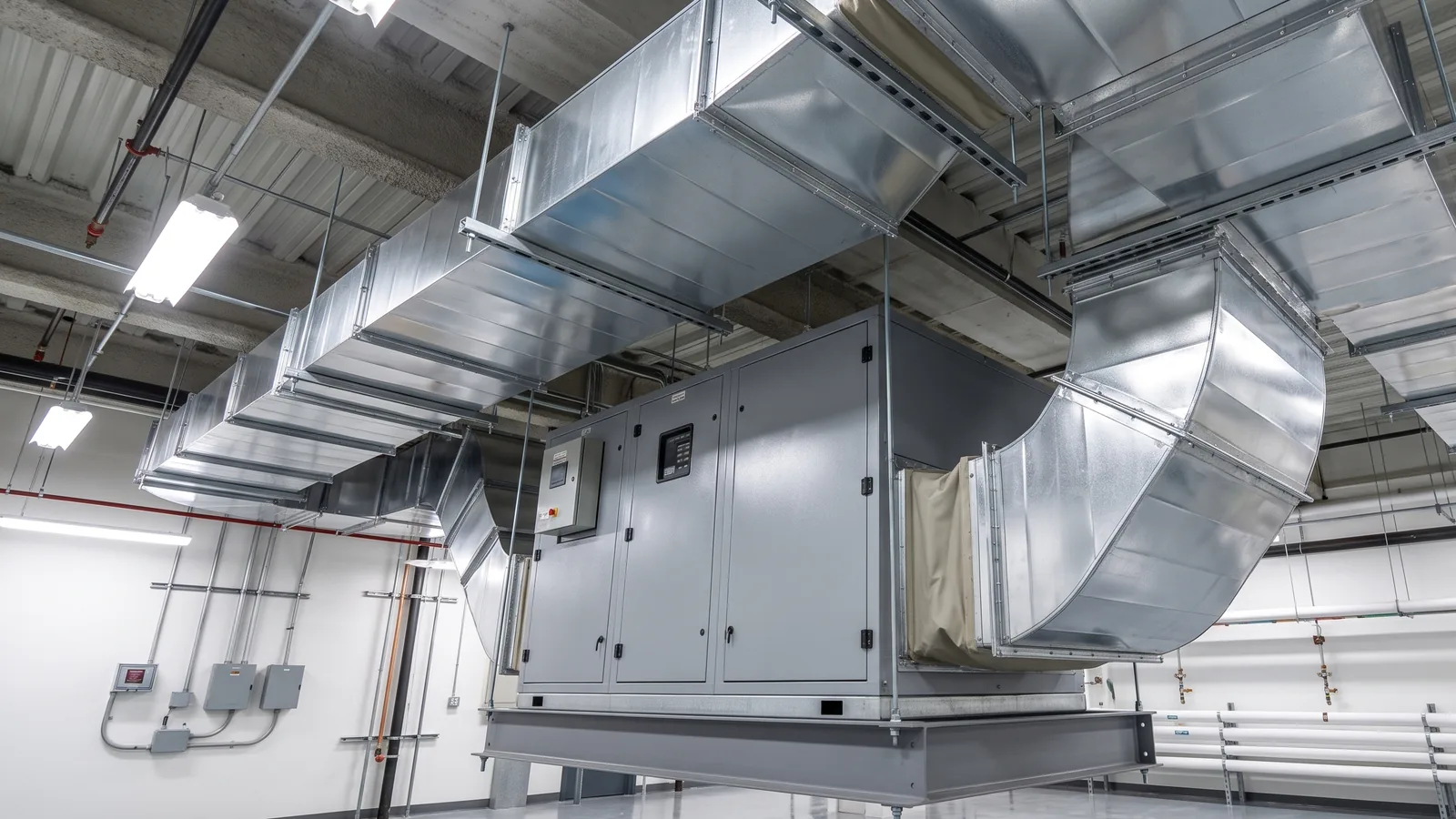
Getting the right commercial dehumidifier wrong is an expensive mistake. Undersized equipment runs flat out without reaching target humidity, while oversized units cycle on and off, wasting power and shortening compressor life.
Australian facilities face particular challenges, from year-round tropical humidity in Queensland warehouses to sub-zero cold stores across Tasmania and Victoria. Safe Work Australia recommends workplace humidity between 40% and 70% RH, while ASHRAE Standard 55 narrows the comfort range to 30-60% RH for occupied commercial spaces.
Selecting the right unit means matching dehumidifier technology and capacity to your facility’s moisture load, operating temperature, and industry requirements. This guide covers the variables that matter and the mistakes that lead to underperforming systems.
Key Selection Criteria for Commercial Systems
Capacity, operating temperature, and moisture load are the three variables that determine which commercial dehumidifier suits a given facility.
Facility Size and Moisture Generation
| Facility Type | Typical Area (m²) | Moisture Load | Recommended Capacity (L/day) |
|---|---|---|---|
| Small warehouse | 500-1,500 | Low | 50-150 |
| Manufacturing floor | 1,500-5,000 | Moderate | 150-500 |
| Food processing | 2,000-10,000 | High | 500-2,000 |
| Indoor pool facility | 1,000-3,000 | Very high | 1,000-5,000 |
Moisture load calculations must account for internal sources (processes, personnel, equipment) and external infiltration through loading docks, doors, and the building envelope.
Operating Temperature Considerations
- Above 20°C: Refrigerant systems operate at peak efficiency
- 15-20°C: Both refrigerant and desiccant technologies perform adequately
- 10-15°C: Desiccant systems maintain consistent performance
- Below 10°C: Only desiccant technology provides reliable moisture removal
Cold storage facilities and unheated warehouses require equipment rated for low-temperature operation. Standard refrigerant units lose capacity below 15°C as evaporator coils ice over.
For a detailed breakdown, see our guide on why refrigerant dehumidifiers fail below 15°C.
Technology Comparison: Refrigerant vs Desiccant
The two core commercial dehumidification technologies suit different operating conditions. Choosing the wrong type for your environment leads to underperformance and higher energy costs. Our desiccant vs compressor comparison guide covers this in detail.
Refrigerant Dehumidifier Performance
Refrigerant-based systems cool air below its dew point, condensing moisture onto evaporator coils. They suit warm, humid environments typical of many Australian commercial spaces.
| Performance Factor | Refrigerant Systems |
|---|---|
| Optimal temperature range | 20-35°C |
| Achievable humidity | 40-60% RH |
| Energy efficiency (20°C+) | Excellent |
| Maintenance frequency | Quarterly filter cleaning |
| Typical lifespan | 10-15 years |
Desiccant Dehumidifier Performance
Desiccant dehumidification systems use silica gel rotors to absorb moisture chemically, maintaining consistent extraction rates independent of ambient temperature. YAKE desiccant units operate from -20°C to +50°C, making them the only viable option for cold storage, unheated warehouses, and facilities with wide seasonal temperature swings.
- Pharmaceutical storage: Maintains 30-40% RH for product stability
- Electronics manufacturing: Achieves below 30% RH to prevent static discharge
- Cold storage: Operates effectively at -20°C to prevent ice formation
- Archive and museum preservation: Delivers stable 45-55% RH for document and artefact protection
- Seed and grain storage: Provides ultra-low humidity below 20% RH
Australian Climate and Equipment Selection
Australia’s climate extremes demand careful equipment matching. A unit that works in air-conditioned Brisbane offices may fail in an unheated Hobart warehouse.
| Climate Zone | Typical Conditions | Recommended Technology |
|---|---|---|
| Tropical north (QLD, NT) | High humidity, 25-35°C year-round | Refrigerant for general use, desiccant for precision control |
| Subtropical (SE QLD, northern NSW) | Humid summers, mild winters | Refrigerant primary, desiccant for winter or cold storage |
| Temperate (VIC, TAS, SA, southern NSW) | Cool winters, moderate humidity | Desiccant for year-round reliability, refrigerant for summer-only use |
| Arid inland (WA, SA, western NSW) | Low ambient humidity, extreme heat | Desiccant for process-specific applications |
Facilities operating across seasons benefit from desiccant technology that maintains rated capacity regardless of ambient temperature. Refrigerant-only installations in temperate regions often underperform during the cooler months when moisture problems peak.
Remote and extreme-climate sites face even steeper challenges. A large-scale dehumidifier deployment on Barrow Island for LNG operations required desiccant units rated for continuous tropical heat and salt-laden air, conditions that would destroy standard refrigerant equipment within months.
Application-Specific Requirements
Target humidity levels vary by industry, driven by product sensitivity, workplace safety requirements, and regulatory compliance.
Manufacturing and Production Facilities
- Metal fabrication: 40-50% RH prevents corrosion during processing
- Timber processing: 45-55% RH maintains dimensional stability
- Textile production: 50-60% RH reduces static and improves handling
- Plastics moulding: 35-45% RH prevents moisture absorption in hygroscopic materials
- Paper converting: 45-50% RH maintains sheet flatness and printability
Production environments often generate process moisture on top of ambient humidity. Equipment must be sized to handle both ambient conditions and the moisture released by cleaning, steam processes, and wet materials moving through the facility.
Storage and Warehousing
Warehouse dehumidification protects inventory value and prevents moisture-related damage. Our guide to preventing mould in commercial spaces covers the consequences of inadequate humidity control.
| Storage Type | Target RH | Critical Concerns |
|---|---|---|
| General merchandise | 50-60% | Mould prevention, packaging integrity |
| Electronics | 30-45% | Corrosion, static discharge |
| Pharmaceuticals | 35-45% | Product stability, TGA compliance |
| Food ingredients | 40-55% | Clumping, microbial growth |
| Paper products | 45-55% | Dimensional stability, mould |
Energy Efficiency and Operating Costs
Operating costs depend on capacity, technology type, and runtime. Selecting the right-sized unit avoids the energy waste of oversized equipment cycling on and off. For a deeper look, see our article on energy efficiency in commercial dehumidification.
Factors Affecting Energy Consumption
- Equipment sizing: Oversized units cycle frequently, reducing efficiency
- Control strategy: Humidistat settings and deadband width impact runtime
- Air distribution: Poor airflow creates moisture pockets requiring extended operation
- Building envelope: Air infiltration through doors, docks, and gaps increases moisture load
- Maintenance: Dirty filters and coils reduce capacity and increase energy draw
Modern commercial and industrial dehumidification units with variable-speed compressors and intelligent controls adapt output to real-time conditions rather than running at full capacity continuously.
Installation and Integration Considerations
Equipment placement, ducting, drainage, and control integration all affect performance. Ducted systems distribute conditioned air through ductwork for uniform humidity control across large areas, while portable units suit smaller zones or temporary applications. Our ducted dehumidifier guide covers when fixed ducted installations make sense.
Space and Infrastructure Requirements
| Installation Factor | Portable Units | Fixed/Ducted Installation |
|---|---|---|
| Floor space | 1-3 m² | 5-20 m² (or ceiling/plant room mounted) |
| Electrical supply | 10-15A single phase | 20-100A three phase |
| Drainage | Gravity or condensate pump | Fixed drainage connection |
| Air distribution | Room air circulation | Ducted distribution for uniform coverage |
| Control integration | Standalone humidistat | BMS compatible with remote monitoring |
Large facilities benefit from centralised dehumidification with ducted air distribution. This approach provides uniform humidity control while keeping equipment out of operational areas.
Condensate and Drainage Management
Every commercial dehumidifier produces water that needs a reliable exit path. Portable units collect condensate in internal tanks or discharge via gravity hose to a floor drain. Fixed installations connect to building drainage through condensate pumps rated for continuous duty.
Facilities without nearby floor drains need a condensate pump capable of the required vertical lift. Specify a pump with a high-level alarm to catch failures before water reaches the floor, particularly in facilities storing moisture-sensitive goods.
Maintenance and Reliability
Preventive maintenance keeps commercial dehumidifiers operating at rated capacity and extends equipment lifespan beyond the typical 10-15 year service life.
Preventive Maintenance Schedule
- Weekly: Check condensate drainage and operating status indicators
- Monthly: Clean or replace air filters, inspect for unusual noise or vibration
- Quarterly: Clean evaporator and condenser coils, verify humidistat calibration
- Annually: Professional service including refrigerant check and electrical testing
- Every 3-5 years: Major service including compressor inspection and control system review
Scheduling preventive maintenance with qualified technicians reduces unplanned downtime and maintains the humidity levels your facility requires.
Common Sizing and Selection Mistakes
Three errors account for most underperforming commercial dehumidification installations.
- Sizing to room volume alone: Capacity calculations that ignore process-generated moisture (steam cleaning, open water, personnel) undersize the equipment by 30-50%. A 5,000 m² warehouse storing dry goods needs a fraction of the capacity that the same space requires during active food processing.
- Choosing refrigerant technology for year-round use in temperate climates: Melbourne and Hobart warehouses drop below 15°C in winter, exactly when condensation problems peak. A refrigerant-only installation that works in February stalls in July.
- Ignoring air distribution: A correctly sized dehumidifier placed against one wall of a 4,000 m² facility leaves the far end untreated. Ducted distribution or multiple smaller units deliver more even results than a single large unit in the corner.
Moisture Cure Commercial provides free site assessments that account for all of these factors before recommending equipment.
Frequently Asked Questions
What size commercial dehumidifier do I need?
Size depends on facility volume, moisture load, and target humidity level. A 500 m² warehouse with low moisture generation typically needs 50-150 L/day capacity, while a 5,000 m² food processing facility may require 500-2,000 L/day. Contact Moisture Cure Commercial for a site-specific calculation.
Should I choose a refrigerant or desiccant dehumidifier?
Refrigerant systems suit warm environments above 20°C where moderate humidity reduction (40-60% RH) is sufficient. Desiccant systems are the better choice for cold environments below 15°C, applications requiring very low humidity (below 40% RH), or facilities with wide temperature variations across seasons.
Can a commercial dehumidifier operate in cold storage?
Only desiccant dehumidifiers operate reliably in cold storage. Refrigerant units lose capacity below 15°C as their evaporator coils freeze. Desiccant units maintain rated performance down to -20°C.
How much does a commercial dehumidifier cost to run?
Running costs depend on unit capacity, technology type, and daily runtime. Proper sizing, clean filters, and humidistat-based controls all reduce energy consumption. Variable-speed models adjust output to real-time demand rather than cycling at full power.
What humidity level should my warehouse maintain?
Most general warehouses should target 50-60% RH to prevent mould and protect packaging. Electronics storage requires 30-45% RH, pharmaceuticals need 35-45% RH for regulatory compliance, and food ingredients are best stored at 40-55% RH.
How often does a commercial dehumidifier need servicing?
Filters should be cleaned or replaced monthly. Coils need quarterly cleaning. A full professional service, including refrigerant and electrical checks, should be scheduled annually.
Can a dehumidifier connect to my building management system?
Fixed and ducted commercial dehumidifiers typically support BMS integration for centralised monitoring and control. Portable units generally operate as standalone devices with onboard humidistats.
Is a ducted or portable dehumidifier better for my facility?
Ducted installations suit large facilities requiring uniform humidity control across the entire space. Portable units work for smaller areas, temporary applications, or supplementing a fixed system in problem zones. See our ducted dehumidifier guide for a detailed comparison.
What Australian regulations apply to commercial humidity control?
There is no single fixed humidity law in Australia. Safe Work Australia recommends 40-70% RH for occupied workplaces, while ASHRAE Standard 55 narrows this to 30-60% RH. Industry-specific requirements, such as TGA regulations for pharmaceutical storage, may set tighter limits than the general workplace guideline.
Do commercial dehumidifiers need three-phase power?
Units above roughly 10 kW typically require a three-phase electrical supply. Smaller portable and mid-range units run on standard single-phase 10-15A circuits. Check the electrical specification before purchasing, because retrofitting three-phase power to a site that lacks it adds cost and lead time.
How loud are commercial dehumidifiers?
Sound levels range from about 50 dB(A) for small portable units up to 75 dB(A) or more for large industrial desiccant machines. For offices, laboratories, and occupied spaces, choose units rated below 60 dB(A) or install the equipment in a plant room with ducted air distribution to the conditioned area.
When should I get a professional site assessment?
Any time the facility exceeds 500 m², involves process-generated moisture, operates below 15°C, or requires precise humidity targets below 40% RH. A site assessment measures actual moisture load rather than estimating from floor area alone, and often identifies ventilation or drainage issues that affect equipment selection. Request a site assessment from Moisture Cure Commercial.
Selecting the right commercial dehumidifier means matching your facility’s moisture load, temperature range, and industry requirements to the right technology and capacity. Contact Moisture Cure Commercial for a professional site assessment and equipment recommendation tailored to your application.