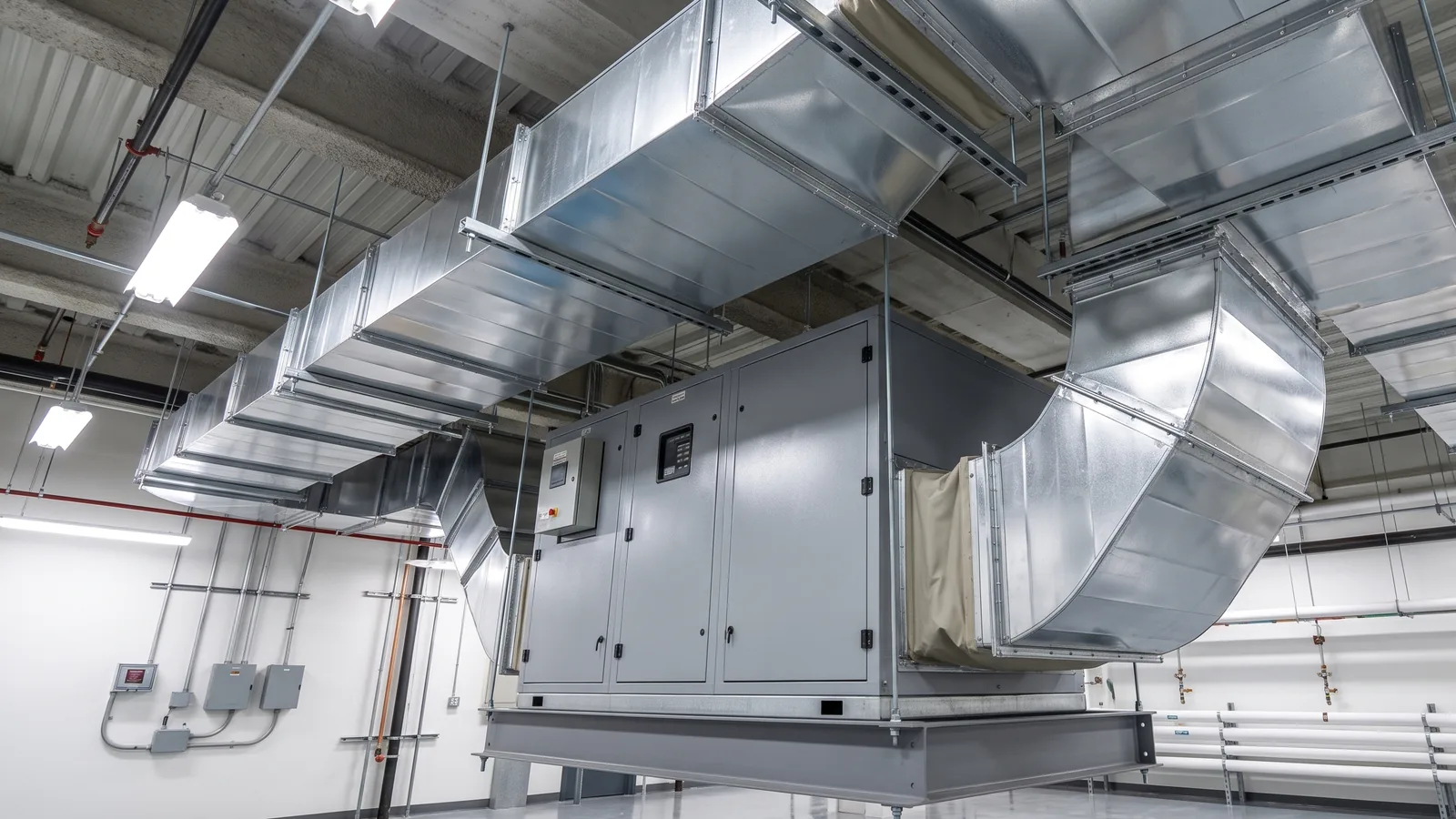
A small desiccant dehumidifier can suit a small commercial room that needs low-humidity control, especially at lower temperatures. Its suitability depends on the moisture entering the space, the required humidity and the installation, not just the size of the cabinet.
For procurement, start with the conditions the equipment must maintain during normal operations. Leave room in the installation plan for ductwork and servicing as well as the equipment itself.
Moisture Cure Commercial’s range of commercial desiccant dehumidifiers suits applications where cold conditions or low moisture targets favour adsorption technology. Ask for a selection based on your operating conditions and available installation space.
How desiccant dehumidifiers work
A commercial unit using desiccant technology draws air through a moisture-attracting material, commonly silica gel, which adsorbs water vapour onto its surface. In a rotary unit, a heated regeneration air stream removes that moisture so the rotor can continue drying the process air.
The US Department of Energy’s technical description of desiccant systems explains this drying and regeneration cycle. It also describes the heat associated with the process, which matters when specifying equipment for a temperature-controlled room.
- Process air passes through the drying portion of the rotor.
- A separate heated air stream regenerates the desiccant.
- Dry process air returns to the space or a connected duct.
- Moisture leaves through the equipment’s specified discharge arrangement.
The operation of a desiccant wheel explains why airflow and regeneration must both be maintained. The technology behind desiccant dehumidification differs from condensation-based drying; check the model manual for its specific moisture discharge arrangement.
When to choose desiccant over refrigerant
Refrigerant equipment removes moisture by cooling air until water condenses, while desiccant equipment uses adsorption. Understanding how commercial dehumidifiers remove moisture helps when comparing the two technologies.
When deciding when to use desiccant technology, request performance data at the actual inlet temperature and humidity. There is no single temperature cut-off that makes every refrigerant unit unsuitable.
| Commercial application | Selection question | What to compare |
|---|---|---|
| Warm, damp storeroom | Can refrigerant equipment meet the target? | Removal capacity and electrical input at room conditions |
| Cold room or antechamber | Will drying continue at the lowest operating temperature? | Low-temperature performance, door-opening load and added heat |
| Electronics storage enclosure | What moisture limit does the stored component require? | Achievable humidity, sensor accuracy and air distribution |
| Museum archive | What conditions suit this collection? | Control stability and material-specific requirements |
| Local construction drying | How much moisture is still leaving the materials? | Changing load, containment and drying progress |
Moisture Cure Commercial’s refrigerant dehumidifiers for warmer applications are worth comparing where the room conditions allow effective condensation. Choose between technologies on delivered performance, rather than assuming desiccant equipment is always the better option.
Where small desiccant units make sense
A compact unit is useful when a defined room, enclosure or process zone needs separate moisture control. Small floor area alone does not establish a small moisture load.
- Pharmaceutical packaging areas with a documented humidity requirement for the product.
- Electronics storage enclosures holding moisture-sensitive components.
- Cool room antechambers where incoming humid air needs treatment.
- Museum storage cabinets or archive rooms with collection-specific limits.
- Wine storage rooms where persistent damp is damaging labels or packaging.
- Equipment rooms where condensation has been identified and the equipment’s environmental limits are known.
For collections, the Canadian Conservation Institute’s guidance on incorrect relative humidity explains that materials have different sensitivities. A lower humidity target is not automatically better for every object in a mixed collection.
Likewise, a dehumidifier does not replace an electronics facility’s electrostatic discharge controls. Obtain the relevant product or process requirements before choosing the setpoint.
A small production enclosure also needs a different assessment from a general storeroom. In medical device manufacturing environments, the humidity specification should follow the production process and quality requirements.
What to specify when choosing a unit
Record target humidity, room volume, operating temperature and sources of incoming moisture before comparing models. Process airflow in m³/h describes air movement; moisture removal in kg/h or litres per day describes drying capacity at stated conditions.
Match the rating to the job
- Ask for removal capacity at both the normal operating condition and the most demanding expected condition.
- State the humidity setpoint and acceptable variation, or the required dew point if the process specification uses it.
- Include outdoor air, door openings, extraction systems, wet materials and process moisture.
- Check available power, maximum electrical input and any additional cooling requirement.
- Provide proposed duct lengths and bends, and ask the supplier to confirm airflow at the resulting duct resistance.
- Allow space to remove filters and service the rotor, heater and fans.
A nominal daily extraction figure is only meaningful with its test temperature and humidity. When assessing a unit with a 10-litre daily rating, ask what it can remove at your facility’s conditions rather than treating that label as a guaranteed daily output.
Size for moisture entering the space
Consider two equally sized store rooms: one stays closed, while the other receives deliveries through an open door throughout the shift. The second can need substantially more drying capacity despite having the same floor area.
For a practical assessment, log temperature and humidity through a representative operating period and record when doors open, washdown occurs or wet stock arrives. The supplier can then separate the initial drying requirement from the ongoing load and allow for recovery after disturbances.
Moisture Cure Commercial can assess these inputs against its range of commercial humidity control equipment. The assessment establishes the drying capacity and installation space needed, including whether a compact desiccant unit is sufficient.
Installation and maintenance considerations
Plan the moisture discharge route before purchasing a wet-air exhaust model. Discharging into the treated room returns the removed moisture, while an unassessed ceiling void or adjacent room can simply move the problem elsewhere.
Confirm the exhaust termination, duct material, insulation and any condensate management with the supplier. Follow the manufacturer’s limits for duct resistance and keep the discharge away from air intakes.
Ask how the proposed arrangement affects room pressure and replacement air. A system that exhausts air from the controlled space may draw humid air back through gaps unless the design accounts for it.
- Keep process-air inlets and outlets clear of stored goods.
- Place the humidity sensor where it represents the controlled space, away from the immediate dry-air outlet.
- Check operating noise at the proposed location; compact equipment is not necessarily quiet.
- Confirm automatic restart behaviour, alarms and unattended operation requirements.
- Arrange safe access for servicing and filter changes.
Where the equipment must sit outside the occupied area, ducted dehumidifiers for connected spaces may suit the layout because supply and return air can be routed to the controlled zone. Ducted describes the installation arrangement, so confirm the drying technology as part of the specification.
Maintenance and handover
Use the selected model’s service schedule, adjusted for dust and operating hours, rather than a universal calendar. There is no reliable rotor replacement interval that applies to every unit and application.
- Inspect and clean or replace filters as instructed.
- Have the rotor, seals, drive and regeneration heater checked by an appropriate technician.
- Check ducts for obstruction, leakage and unwanted condensation.
- Verify sensors and alarm operation against the required control tolerance.
- Record operating conditions and drying performance so deterioration can be investigated.
At commissioning, verify humidity at the stored goods or process, not only on the equipment display. Test recovery after a normal door-opening event and record the temperature change with the unit running.
Small desiccant dehumidifier FAQs
Keep the selected model’s performance data and installation manual with the procurement specification.
What counts as a small desiccant dehumidifier?
There is no universal commercial size category. Compare cabinet dimensions, weight, process airflow, rated moisture removal and the space needed for ducts and maintenance.
Is desiccant better than refrigerant for a small room?
It may suit cold conditions or a low moisture target, but room size alone does not decide the technology. Compare both options at the required temperature and humidity, including electrical input and installation requirements.
What are the disadvantages of a compact desiccant unit?
Regeneration needs energy, the process can add heat, and a wet-air model needs a suitable discharge route. Restricted ducting, insufficient service access or poor sensor placement can make an otherwise suitable unit difficult to operate.
Does every desiccant dehumidifier need an exhaust duct?
No, moisture discharge arrangements vary by design. Commercial wet-air rotor models need the specified exhaust connection, so check the manual instead of assuming the unit has a collection tank or drain.
Can a mini moisture absorber control a commercial room?
A passive desiccant pack has a finite moisture capacity and may suit a small sealed enclosure with a defined maintenance plan. It is not interchangeable with a powered unit selected for continuous moisture entering an occupied room.
Can a small unit run continuously?
Specify equipment approved for the intended duty and follow its operating instructions. Continuous running without reaching the target calls for checks of moisture load, airflow, regeneration, sensors and equipment capacity.
Talk to Moisture Cure Commercial
Send Moisture Cure Commercial your room dimensions, operating conditions and humidity target. Include the following information so the assessment can address both drying duty and installation.
- Room dimensions, use and operating hours.
- Temperature and humidity records, plus the required target.
- Door use, ventilation and moisture-producing activities.
- Available power, equipment location and possible exhaust routes.
Contact Moisture Cure Commercial for a site assessment to discuss a small desiccant dehumidifier suited to your facility.