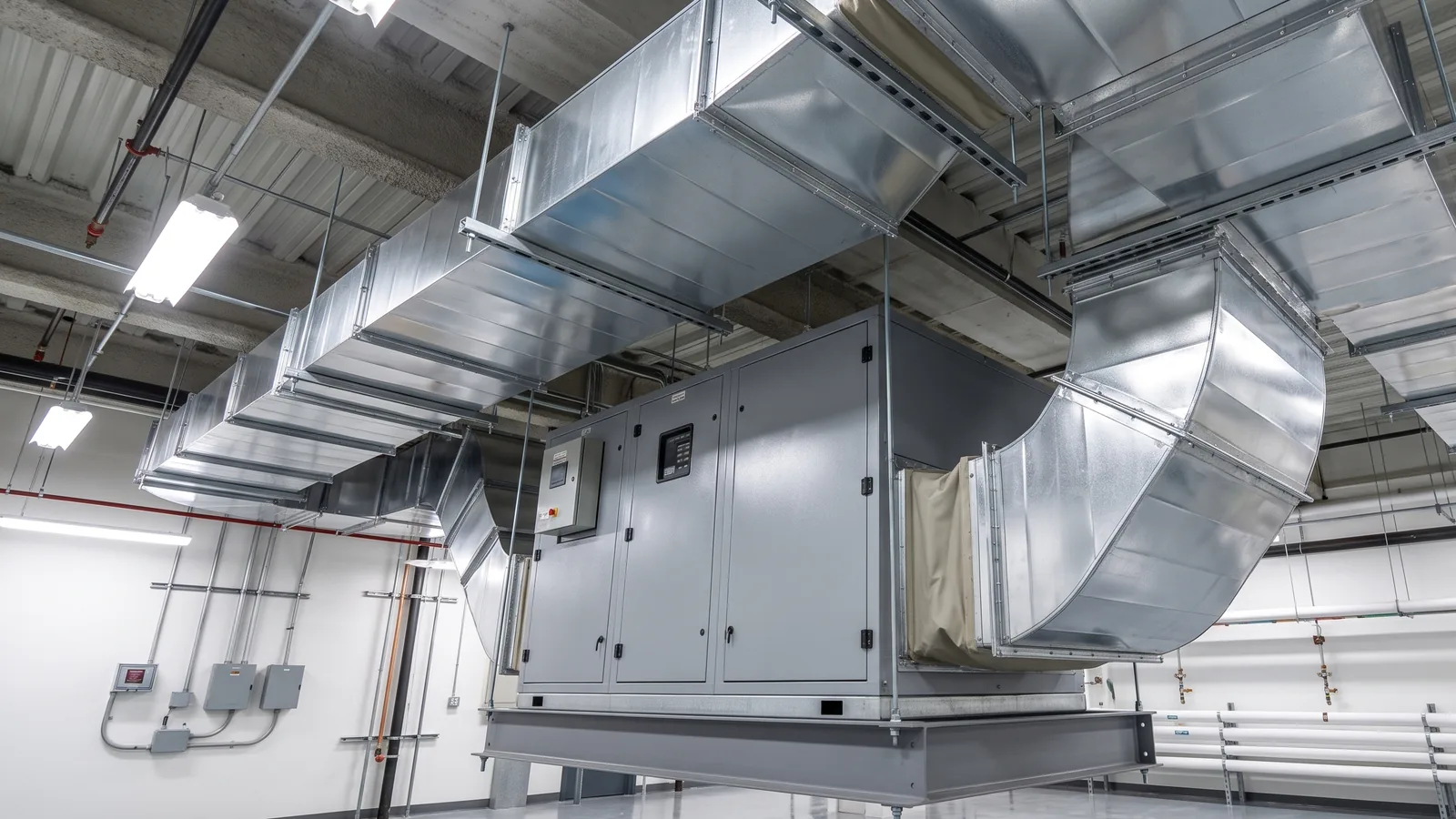
Desiccant dehumidifiers are the only viable technology for cold storage environments operating below 15°C.
Choosing between a desiccant dehumidifier and a refrigerant unit for cold storage is not a preference decision. It is an engineering constraint dictated by operating temperature.
This article compares how each technology performs in cold storage conditions, where refrigerant units fail, and how to size a desiccant system for your facility. It is written for facility managers and engineers specifying humidity control equipment.
For a general comparison of desiccant and compressor technologies, see Desiccant vs Compressor Dehumidifier for Your Space. This article focuses specifically on cold storage applications.
How Each Technology Handles Low Temperatures
Refrigerant dehumidifiers work by cooling air below its dew point on an evaporator coil, condensing moisture out. This process requires a temperature differential between the coil and the incoming air.
In cold storage at 2°C to 10°C, the incoming air is already near the coil temperature. The evaporator coil cannot get cold enough to produce condensation, so moisture extraction drops to near zero.
Desiccant dehumidifiers use a different mechanism entirely. A silica gel rotor adsorbs moisture directly from the air stream regardless of temperature.
- Refrigerant units rely on a temperature differential to condense water. Below 15°C, extraction rates collapse. Below 5°C, the evaporator coil ices over and the unit cycles into defrost mode repeatedly.
- Desiccant units adsorb moisture through chemical affinity, not condensation. The silica gel rotor works at any temperature from -20°C to +50°C with consistent extraction rates.
This is why every cold storage dehumidification specification defaults to desiccant technology. The physics of refrigerant dehumidification simply do not support sub-15°C operation.
Why Refrigerant Dehumidifiers Fail in Cold Storage
Refrigerant (compressor) dehumidifiers are effective between 15°C and 35°C. Outside that range, three failure modes occur simultaneously.
- Reduced extraction. As ambient temperature drops, the temperature differential between the evaporator coil and the air shrinks. At 10°C ambient, a unit rated at 50L/day may extract less than 15L/day.
- Coil icing. Below 5°C, the evaporator coil drops below 0°C. Ice forms on the coil surface, blocking airflow. The unit enters defrost mode, which consumes energy and produces zero dehumidification.
- Compressor stress. Compressors are designed for a specific operating range. Continuous operation in cold environments increases refrigerant viscosity, raises compressor load, and shortens component life.
Some refrigerant units include hot-gas defrost cycles to manage icing. These cycles consume 20% to 40% of the unit’s operating time in cold storage, reducing effective capacity by the same margin.
A refrigerant dehumidifier rated at 50L/day in a cold storage environment at 5°C may extract as little as 5 to 8L/day once defrost cycles are factored in. That is an 85% reduction from the rated capacity.
Where Desiccant Dehumidifiers Outperform in Cold Storage
Desiccant dehumidifiers maintain consistent extraction rates across the full operating range. A unit rated at 30L/day delivers close to 30L/day whether the ambient temperature is 5°C or 40°C.
YAKE desiccant units supplied by Moisture Cure Commercial operate from -20°C to +50°C. That range covers every cold storage scenario in Australian commercial and industrial operations.
Key advantages for cold storage applications:
- No defrost cycles. Desiccant rotors do not ice. The unit runs continuously without interruption, maintaining target relative humidity around the clock.
- Precise RH control. Desiccant systems can achieve and hold relative humidity below 40% RH, which is difficult or impossible for refrigerant units in any environment.
- No condensate drainage required. Moisture is exhausted as warm, humid air from the regeneration side. In cold storage facilities where floor drainage is limited, this simplifies installation.
- Lower maintenance in cold conditions. No compressor, no refrigerant gas, no evaporator coil to clean. Fewer moving parts means fewer failure points in demanding environments.
For facilities in major Australian cities, Moisture Cure Commercial provides on-site specification advice. See the full range of commercial desiccant units for capacity options.
Performance Comparison for Cold Storage
The table below compares desiccant and refrigerant performance across the temperature ranges found in Australian cold storage facilities.
| Factor | Desiccant | Refrigerant |
|---|---|---|
| Operating range | -20°C to +50°C | 15°C to 35°C |
| Extraction at 5°C | 90–95% of rated capacity | 10–20% of rated capacity |
| Extraction at -10°C | 85–90% of rated capacity | Unit inoperable |
| Defrost downtime | None | 20–40% of run time below 10°C |
| Minimum achievable RH | Below 30% RH | 45–55% RH (temperature dependent) |
| Condensate drainage | Not required (exhaust air) | Required (liquid condensate) |
| Compressor risk | No compressor | High stress, shortened life below 10°C |
| Energy source | Electricity + regeneration heat | Electricity only |
The extraction figures at low temperatures are the deciding factor. A refrigerant dehumidifier is the right choice above 15°C where energy efficiency matters most, but it cannot deliver in cold storage.
Which Industries Need Cold Storage Dehumidification
Any facility that stores temperature-sensitive goods below 15°C needs humidity control. Without it, condensation forms on products and surfaces, creating mould, corrosion, and compliance failures.
- Food and beverage. Cold rooms storing meat, dairy, and produce operate between 0°C and 4°C. Excess humidity accelerates spoilage, ice buildup on packaging, and bacterial growth. Australian food safety standards under the Food Standards Australia New Zealand (FSANZ) framework require controlled storage conditions.
- Pharmaceutical. Cold chain warehouses for vaccines and biologics maintain 2°C to 8°C. Humidity excursions can compromise product stability. TGA guidelines require documented temperature and humidity records.
- Logistics and 3PL. Third-party logistics providers managing multi-temperature zones need reliable humidity control in each zone. A single desiccant unit can service a zone that a bank of refrigerant units cannot.
- Wine storage. Long-term wine storage at 12°C to 14°C with 60–70% RH prevents cork drying without promoting mould. Desiccant units with humidistat control maintain this narrow band accurately.
- Manufacturing. Cold storage for raw materials in food manufacturing, chemical storage, and electronics component warehousing all require stable humidity regardless of ambient temperature.
Each of these applications falls below or near the 15°C threshold where refrigerant dehumidification becomes unreliable.
How to Size a Desiccant Dehumidifier for Cold Storage
Sizing a desiccant unit for cold storage requires four variables. Getting any one of them wrong leads to an undersized system that cannot maintain target RH.
- Room volume (m³). Length x width x height of the cold storage area. Include any connected spaces that share the air volume.
- Air changes per hour. How often the door opens, how much outside air infiltrates. A busy distribution cold room with frequent door openings may see 5 to 10 air changes per hour. A sealed long-term storage room may see 0.5.
- Ambient conditions. The temperature and humidity of the air entering the space each time the door opens. Summer conditions in Sydney or Brisbane can push 30°C at 70% RH, which introduces a significant moisture load.
- Target RH. The relative humidity you need to maintain inside the cold room. Food storage typically targets 85–90% RH. Pharmaceutical may target 40–60% RH. Lower targets require higher capacity units.
Moisture Cure Commercial provides free specification advice for cold storage projects. Their team has 20+ years of experience sizing commercial desiccant systems for Australian conditions.
The most common sizing mistake is ignoring air infiltration. A cold room that opens 50 times per day in a Brisbane summer imports far more moisture than a sealed room in Melbourne winter. Always calculate based on worst-case seasonal conditions.
Get a Cold Storage Dehumidification Quote
Moisture Cure Commercial supplies and supports YAKE desiccant dehumidifiers across Australia. Every project includes site assessment and specification advice at no charge.
- Browse the full commercial dehumidifier range
- View ducted dehumidifier options for integrated cold room installations
- Contact the team for specification advice and project pricing
Cold storage humidity problems get worse the longer they go unaddressed. Condensation, mould, and product loss compound over time. Get the right unit specified from the start.