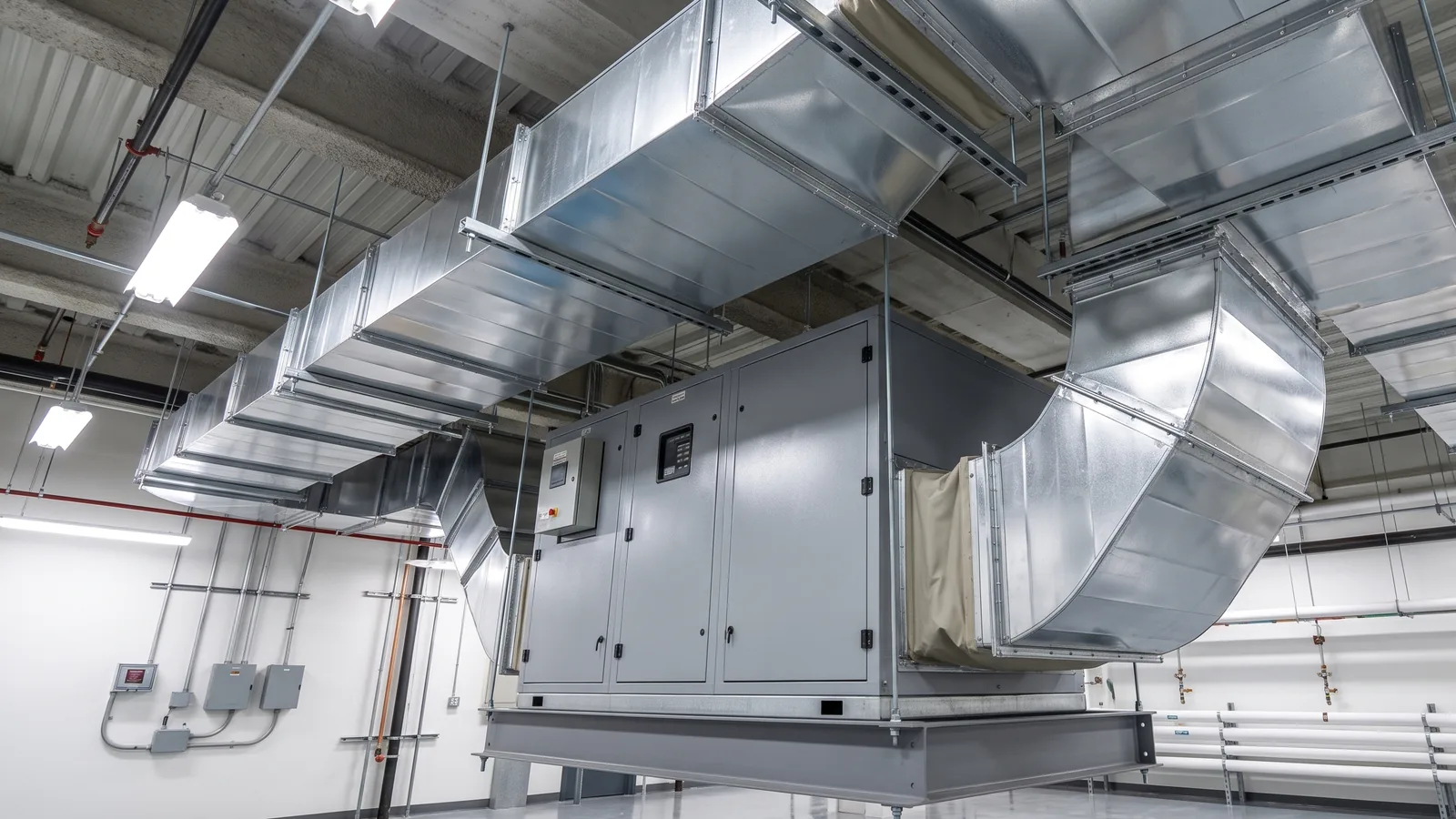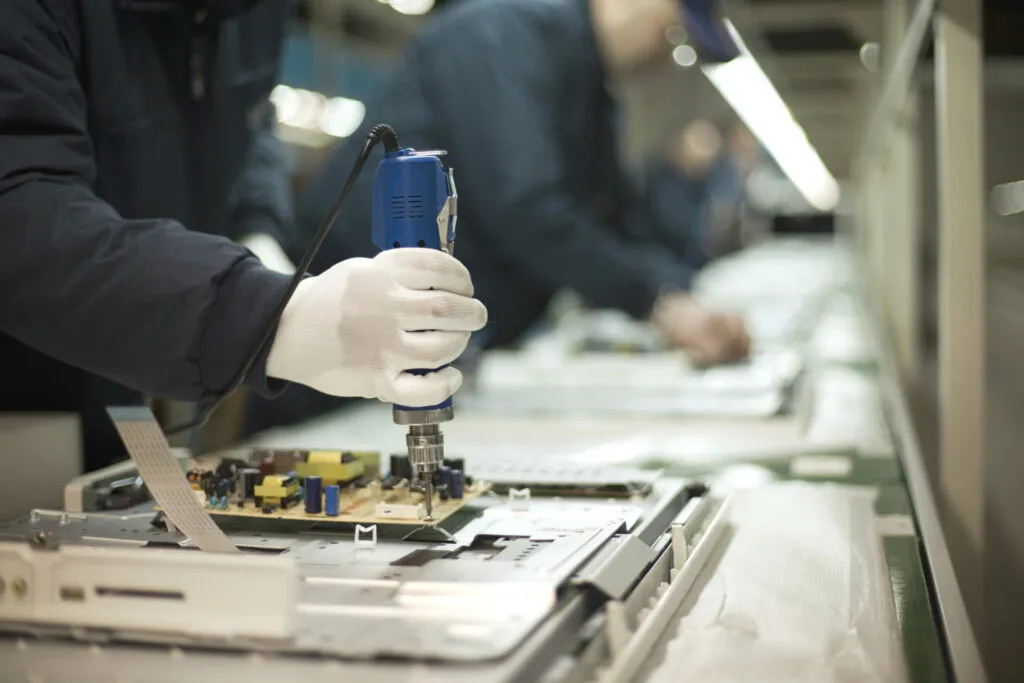
Commercial and industrial dehumidifiers are built for different duty cycles, and picking the wrong class is an expensive mistake.
The spec sheets look similar. Both quote litres per day, both run on single or three-phase power.
This guide walks through what separates a commercial vs industrial dehumidifier, where each class is the right choice, and the specification traps that cause facility managers to pick the wrong one.
Specifying a dehumidifier? Browse the commercial dehumidifier range, the industrial dehumidifier range, or contact Moisture Cure Commercial for sizing help.
What Commercial and Industrial Actually Mean Here
The words get used loosely in marketing copy, but they describe different equipment classes once you look at the build. Commercial dehumidifiers suit typical non-residential interiors like offices, retail, small warehouses, gyms and indoor pools.
Industrial dehumidifiers are for heavier environments like cold storage, manufacturing, pharmaceutical rooms, large warehouses and water damage restoration. The distinction is not only size.
A 100 L/day unit can be either class depending on how it is built and how hard it is expected to run. A commercial unit might manage 2,000 hours of runtime a year, while an industrial unit of the same capacity is specified for 8,000 hours or more.
- Commercial: non-residential spaces at normal temperature, duty cycle measured in hours per day
- Industrial: harsh or continuous-duty environments, duty cycle measured in months without a break
- Duty cycle is the single biggest build difference, bigger than nameplate capacity
- Enclosure rating (ingress protection) determines where each class can legally be installed
- Serviceability differs, with industrial units designed for in-place component replacement
Shortcut test. If the unit has to run 24/7 for months, or sit in an environment with dust, corrosion, temperature extremes or water nearby, it needs an industrial-class dehumidifier regardless of litres per day.
Capacity and How It Is Actually Rated
Both classes quote capacity in litres of water per day, but the rating conditions tell you whether the number is useful. Commercial units are typically rated at 30 degrees Celsius and 80 per cent RH under the AHAM standard or similar.
Industrial units are rated at multiple operating points because they need to perform across a wider band. A refrigerant commercial unit quoting 70 L/day at 30C/80 per cent RH might deliver only 20 L/day at 15C/60 per cent RH.
| Spec point | Commercial rating | Industrial rating |
|---|---|---|
| Capacity quoted at | 30C / 80 per cent RH | Multiple points, often 20C / 60 per cent |
| Capacity at 15C | Typically 30-40 per cent of nameplate | Typically 70-100 per cent of nameplate |
| Minimum operating temperature | Around 5 to 10 degrees Celsius | As low as minus 20 degrees Celsius (desiccant) |
| Continuous-duty capable | Intermittent runs expected | Designed for 24/7 operation |
| Target RH band | 40-60 per cent | 10-60 per cent depending on process |
The practical rule is to compare units at the conditions where they will actually run, not at the nameplate test point. A cold store dehumidifier needs a capacity curve, not a single headline figure.
Build and Enclosure Differences Between Commercial and Industrial Units
Once you get past the nameplate, the mechanical differences are where the price gap comes from. Industrial units cost more because they are built to survive environments that would destroy a commercial unit in a year.
Enclosure and corrosion resistance
Commercial dehumidifiers use powder-coated mild steel or plastic casings suitable for clean indoor air. Industrial units use galvanised or stainless steel, epoxy-coated coils for corrosive atmospheres, and often carry an IP54 or IP55 rating per IEC 60529.
Compressor and fan specifications
Commercial refrigerant units typically use hermetic rotary or scroll compressors rated for intermittent duty. Industrial refrigerant units use semi-hermetic or scroll compressors rated for continuous duty with field-replaceable components.
Controls and integration
A commercial dehumidifier usually ships with a fixed onboard controller and a humidistat input. An industrial unit will have Modbus or BACnet communications for BMS integration, remote alarms and operating-hour logging.
How the Commercial vs Industrial Dehumidifier Split Relates to Technology
Most commercial dehumidifiers are refrigerant units because refrigerant is cost-effective in the 15 to 30 degrees Celsius range where commercial interiors sit. Industrial dehumidifiers split between refrigerant for warmer factories and desiccant for cold storage and low-RH requirements.
- Commercial refrigerant: the default for offices, retail, gyms and most warehousing above 15 degrees Celsius
- Industrial refrigerant: larger factories and warehouses, heavy-duty builds above 15 degrees Celsius
- Industrial desiccant: cold storage, pharmaceutical drying, lithium battery rooms, any process below 15 degrees Celsius or below 40 per cent RH
- Ducted industrial: centralised humidity control across multiple zones or large open spaces
YAKE desiccant dehumidifiers are industrial-class equipment built for low-temperature, low-RH operation. They hold capacity from minus 20 degrees Celsius up to 50 degrees Celsius, a band no refrigerant unit can cover.
For the typical commercial setting, a well-sized refrigerant dehumidifier is still the cost-effective answer. Cold work and very low RH is where desiccant equipment becomes the only realistic option.
When to Specify a Commercial vs Industrial Dehumidifier
Work through the environment and duty cycle before looking at any product spec. If any of the industrial triggers below is present, the answer is industrial, even if the required litres per day figure is modest.
- Ambient temperature below 15 degrees Celsius: cold storage and refrigerated warehouses require industrial desiccant
- Target RH below 40 per cent: lithium battery rooms, pharma drying and electronics manufacture require industrial desiccant
- Continuous 24/7 operation for more than 3 months at a time: continuous duty rules out most commercial builds
- Corrosive or wet environment: food processing, pool plant rooms and wastewater facilities require IP-rated industrial units
- BMS integration required: regulated facilities need Modbus or BACnet, which is industrial standard
- Dust or particulate in the air stream: industrial filter racks and washable pre-filters are required
If none of those triggers apply, a commercial dehumidifier is the right call. It costs less, integrates more easily in smaller buildings and handles the typical commercial workload without strain.
Common Sizing and Specification Mistakes
Most dehumidifier problems on commercial and industrial sites come down to a handful of specification errors. Seeing these in advance saves a lot of remediation cost.
Specifying on nameplate capacity only
Comparing a commercial unit at 30C/80 per cent RH against an industrial unit at 20C/60 per cent RH is not a like-for-like comparison. The commercial unit looks bigger on paper but may deliver a fraction of the capacity at actual conditions.
Using a commercial unit in a cold environment
Refrigerant commercial dehumidifiers stall below 15 degrees Celsius because the coil runs below freezing, and the defrost cycle eats most of the runtime. A cold-capable industrial desiccant is the only sensible answer.
Under-sizing for duty cycle
A commercial unit specified at 100 per cent of the calculated moisture load will run flat out 24/7 and burn through its service life in 12 to 18 months. Either step up to an industrial-class unit or size the commercial unit at 130 to 150 per cent of the load.
Skipping BMS integration on regulated sites
Pharmaceutical, food processing and healthcare facilities need humidity logging as part of the quality management system. A commercial dehumidifier without Modbus or BACnet output means manual hand-logging, which fails audits.
For large or regulated sites, specify the dehumidifier as part of the HVAC package, not after the building is finished. Fitting BMS integration and wash-down enclosures retroactively costs two to three times the original install.
Which Class of Dehumidifier Fits Which Facility Type
Industry conventions give a useful starting point, though the final call comes down to the specific design conditions. The table shows where commercial-class and industrial-class units typically land across Australian facility types.
| Facility type | Typical class | Notes |
|---|---|---|
| Office building, retail, clinic | Commercial refrigerant | Intermittent duty, 40-60 per cent RH target |
| Gym, indoor pool | Commercial refrigerant (large) | Heavier duty but still above 15C most of the time |
| Warehouse (ambient) | Commercial or industrial refrigerant | Depends on volume, duty cycle and whether BMS is needed |
| Cold storage, chilled warehouse | Industrial desiccant | Refrigerant fails below 15C |
| Food processing | Industrial, IP rated | Wash-down, BMS logging, often desiccant |
| Pharmaceutical production | Industrial desiccant + BMS | Low RH, GMP documentation, redundancy |
| Water damage restoration | Industrial (portable) | Continuous 24/7 operation for weeks at a time |
| Lithium battery / electronics | Industrial desiccant | Sub-1 per cent RH achievable with desiccant only |
| Greenhouse, indoor growing | Commercial or industrial refrigerant | Depends on crop, light cycle and climate |
Location matters too. In humid coastal cities like Sydney and Brisbane, duty cycles run higher even in mild buildings, which can push a specification from commercial to industrial-class.
In drier cities like Melbourne and Adelaide, commercial-class units often carry the load easily.
Cost Over the Life of the Unit
Capital cost is the first number facility managers see, but it is not where the real money is decided. The lifecycle cost picture usually favours the right-class unit even when the capital number is higher.
- Capital cost: industrial units cost roughly 1.5 to 3 times the capital of a similar-capacity commercial unit
- Service life: industrial units run 15 to 20 years, commercial units run 5 to 10 years in typical duty
- Energy draw: industrial units are often more efficient per litre removed, especially desiccant in cold conditions
- Spares and service: industrial units have field-replaceable components, commercial units are often replaced whole
- Downtime cost: regulated facilities lose production when a commercial unit fails an audit
Replacement frequency is the biggest hidden cost. A commercial unit in an industrial setting typically needs replacement every 18 to 36 months, while an industrial-class unit in the same setting runs for a decade or more.
Choosing Between a Commercial and Industrial Dehumidifier
The commercial vs industrial dehumidifier decision is really about environment and duty cycle, not capacity. Commercial-class equipment suits typical non-residential interiors running intermittent duty above 15 degrees Celsius.
Industrial-class equipment is the right choice once any of the hard triggers kick in, such as cold temperatures, low RH targets, continuous operation, corrosive environments or BMS integration. Getting this decision right at specification time saves years of remediation cost.
Need help sizing or specifying the right class for your facility? Contact Moisture Cure Commercial for a consultation, or browse the full range of humidity control solutions.