Humidity is the single most controllable cause of coating failures in industrial painting.
Moisture in a spray booth or coating facility affects every stage of the process, from surface preparation through to final cure. When relative humidity (RH) exceeds acceptable limits, coatings lose adhesion, flash rust forms on freshly blasted steel, and films blister before they harden.
A dehumidifier for industrial painting environments removes this variable. Controlled humidity means consistent results, fewer rework cycles, and coatings that perform as specified.
Explore the range: Moisture Cure Commercial supplies commercial dehumidifiers suited to spray booths, blast rooms, and large coating facilities. Options include desiccant dehumidifiers and refrigerant dehumidifiers depending on your operating conditions.
How Humidity Damages Industrial Coatings
Water vapour interacts with paint films in several ways, all of them destructive. The effects range from visible surface defects to hidden adhesion failures that only appear months after application.
The following defects are directly linked to excessive ambient humidity during application or curing.
- Poor adhesion: moisture on the substrate surface acts as a barrier between the coating and the metal, preventing proper bonding
- Sagging and running: high humidity slows solvent evaporation, leaving wet films that flow before they set
- Blistering: moisture trapped beneath the coating film vaporises during heat exposure, lifting the film from the substrate
- Delamination: intercoat moisture breaks the bond between primer and topcoat, causing layers to separate under service conditions
- Tackiness: two-pack and thermosetting coatings fail to cure properly at elevated humidity, leaving sticky or under-cured films
- Discolouration and hazing: moisture vapour reacts with certain coating chemistries, producing a white or milky surface haze
Each of these failures has the same root cause: water vapour that was not removed before or during application. A properly sized dehumidifier eliminates the conditions that allow them to occur.
Flash Rust: The Dehumidifier for Industrial Painting Case Study
Abrasive blasting creates a chemically active steel surface. In humid conditions, that surface begins to oxidise within minutes of blasting, forming flash rust before any coating is applied.
Flash rust is a structural defect, not a cosmetic one. It prevents the coating from bonding to the clean steel profile and provides initiation sites for corrosion that spreads beneath the film over time.
- At 60% RH: flash rust can appear on blasted steel within 30 minutes
- At 70% RH: visible rust forms in under 10 minutes on freshly blasted surfaces
- At 80% RH: re-blasting is often required before any coating can proceed
- Below 50% RH: the working window extends significantly, allowing proper coating application
ISO 8502-4 defines the requirements for assessing condensation risk before applying coatings to steel surfaces. The standard requires that the steel surface temperature be at least 3°C above the dew point before coating proceeds.
Dehumidifying the blast room and coating area simultaneously controls both ambient RH and surface dew point margin. This is the minimum requirement for compliant surface preparation on structural steel and heavy equipment.
Optimal Humidity Range for Industrial Painting Operations
Different coating types tolerate different humidity ranges. The table below shows the general working parameters for the most common industrial coating systems.
| Coating Type | Min RH | Max RH | Notes |
|---|---|---|---|
| Epoxy (two-pack) | 30% | 55% | Sensitive to moisture cure inhibition above 55% |
| Polyurethane topcoat | 30% | 60% | Hazing risk above 60% in humid conditions |
| Zinc-rich primer | 30% | 55% | High sensitivity to surface moisture |
| Alkyd enamel | 40% | 70% | More tolerant, but adhesion reduced at extremes |
| Powder coating | 30% | 50% | Pre-treatment and curing both humidity-sensitive |
| General industrial | 40% | 55% | Conservative target for mixed coating operations |
For most industrial painting operations, a target range of 40 to 55% RH covers the majority of coating systems without over-drying the environment. Operations using zinc-rich or epoxy systems should maintain the lower end of that range.
Note on surface temperature: ambient RH alone is not sufficient. Coating inspectors must verify surface temperature exceeds dew point by at least 3°C per ISO 8502-4; dehumidifying the space raises the dew point margin by reducing vapour pressure.
Desiccant Dehumidifiers and the Spray Booth Environment
Spray booths present a specific challenge for humidity control: temperature varies significantly depending on whether the booth is in spray cycle, flash-off, or bake cycle. Refrigerant dehumidifiers lose efficiency sharply at temperatures below 15°C because the evaporator coil approaches the dew point of the incoming air.
Desiccant dehumidifiers use a hygroscopic rotor to adsorb moisture directly from the airstream, independent of temperature. They operate effectively at temperatures as low as -20°C and maintain consistent performance across the full temperature range of an industrial spray booth.
- Consistent performance across temperature cycles: no efficiency drop during cool-down between coats
- Lower dew point output: desiccant units can achieve RH levels below 30% where required
- No condensate drainage required in the spray zone: adsorbed moisture is regenerated and exhausted separately
- Compatible with heated bake cycles: performance improves at higher temperatures, unlike refrigerant units
- Suitable for cold-climate operations: effective in unheated or partially heated facilities during winter
For booths that operate exclusively at controlled temperatures above 18°C year-round, refrigerant dehumidifiers remain an efficient and cost-effective option. The choice depends on operating temperature range, target RH level, and facility layout.
Integrating Dehumidification into a Spray Booth System
A standalone dehumidifier positioned inside a spray booth is rarely the correct approach. Coating overspray will contaminate the unit and reduce its service life.
The standard method is to condition the makeup air entering the booth before it reaches the spray zone. This keeps the dehumidifier outside the contaminated zone and extends equipment service intervals significantly.
- Pre-condition makeup air: the dehumidifier treats incoming air before it passes through the booth filters
- Maintain positive pressure differential: conditioned dry air should be supplied at slightly higher volume than exhaust to prevent humid ambient air infiltrating the booth
- Monitor with a calibrated hygrometer: install a fixed RH sensor in the spray zone, not in the supply duct
- Interlock with the spray process: coating should not proceed until the booth hygrometer confirms RH is within specification
- Log conditions: maintain records of RH and surface temperature for quality control documentation
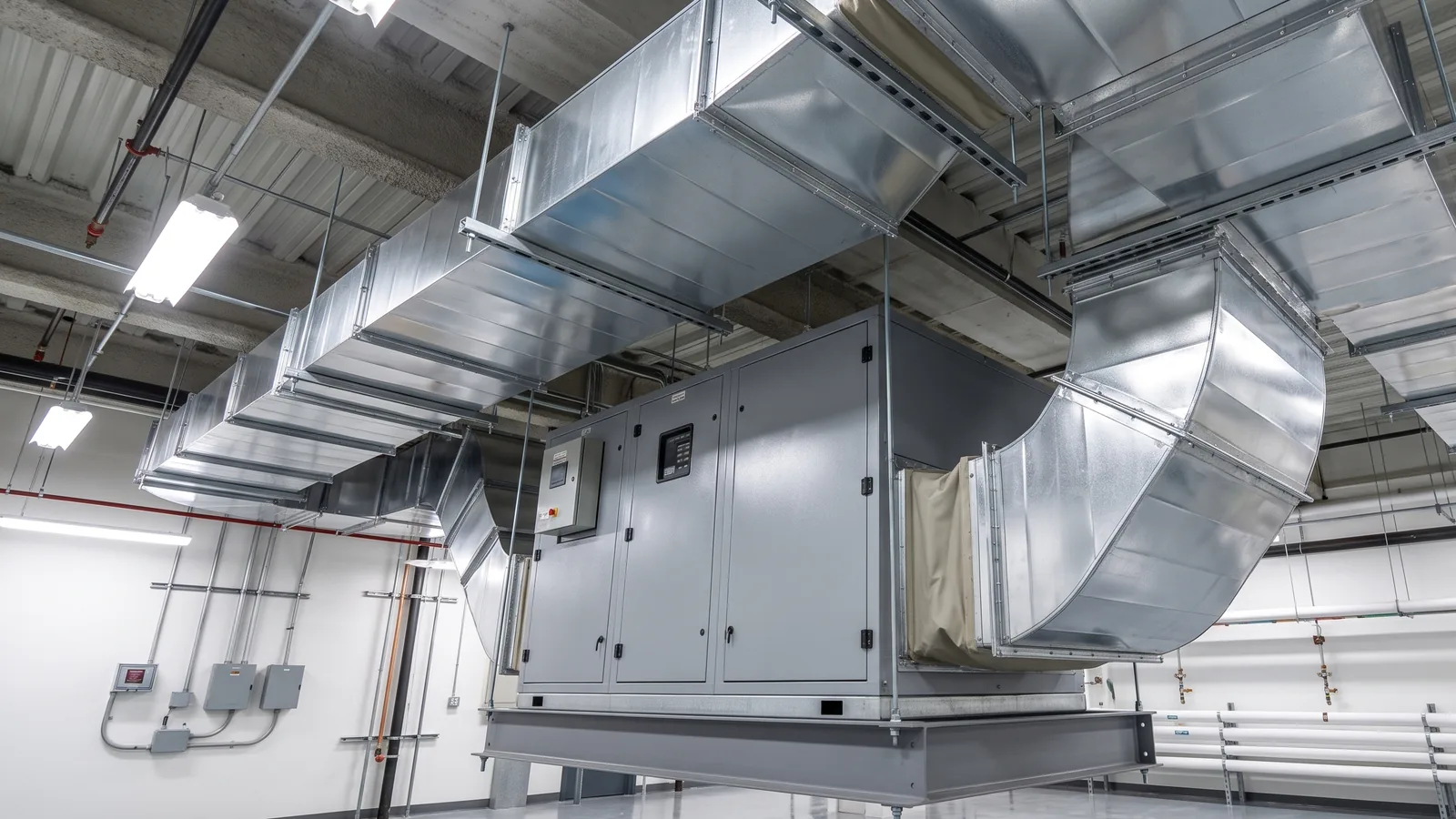
For facilities with multiple booths or large open coating areas, ducted dehumidifiers distribute conditioned air across the full floor area through a duct network. This approach suits automotive manufacturing lines, rail carriage coating facilities, and large fabrication shops.
Safe Work Australia provides guidance on spray booth ventilation requirements under the model WHS regulations. The Code of Practice: Spray Painting includes requirements for ventilation rates and atmospheric controls that dehumidification systems must complement.
Quality Control and Compliance Benefits of Humidity Control
Consistent humidity control produces measurable improvements in coating quality. The following outcomes are reported across industrial painting operations that have implemented active dehumidification.
- Reduced rework rate: adhesion failures and surface defects drop significantly when RH is held within specification
- Lower coating consumption: sagging and runs waste material, controlled conditions reduce overapplication
- Extended coating pot life: two-pack systems remain workable longer in controlled humidity
- Faster throughput: consistent conditions allow curing schedules to be met without weather-related delays
- Documented compliance: logged environmental conditions support quality assurance records required by AS/NZS coating standards
- Reduced warranty claims: premature coating failures traced to application conditions are eliminated
For coating contractors working to AS 3715 or ISO 12944 specifications, environmental condition records are a requirement, not optional. Automated data logging from integrated dehumidification systems simplifies this compliance requirement.
Sizing a Dehumidifier for an Industrial Painting Facility
Dehumidifier sizing for a spray booth or coating facility depends on several factors beyond floor area. Infiltration rate, ventilation volume, process moisture loads, and target RH all affect the required capacity.
- Volume of the conditioned space: the total air volume (m³) determines the baseline moisture load
- Ventilation air changes per hour: spray booths typically require high air change rates, each bringing in humid outside air
- Ambient outdoor conditions: coastal and tropical locations have higher design moisture loads than dry inland sites
- Process moisture sources: wet preparation, water-borne coatings, and wash-down areas add significant load
- Target RH level: achieving 40% RH requires more capacity than maintaining 55% RH in the same space
A correctly sized unit maintains the target RH band without cycling excessively or running at full capacity continuously. Undersized units cannot reach setpoint during peak conditions; oversized units short-cycle and wear prematurely.
The Moisture Cure Commercial team can assist with capacity calculations for specific spray booth configurations. The full commercial dehumidifier range covers capacities suited to single-vehicle booths through to large industrial coating halls.
Get the Conditions Right Before the First Coat Goes On
Humidity control in industrial painting is not an optional upgrade. It is a prerequisite for coatings that perform to specification, pass inspection, and hold up in service.
The cost of rework, re-blasting, and warranty claims consistently exceeds the investment in proper dehumidification equipment. A controlled environment is the most direct way to reduce coating failures and meet the quality records required by industrial coating standards.
Moisture Cure Commercial supplies dehumidification equipment to coating contractors, manufacturing facilities, and surface preparation operations across Australia. Contact the team to discuss the right unit for your spray booth or coating facility.